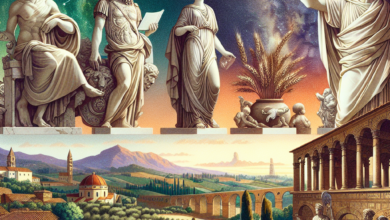

The Romans, a civilization famed for its engineering prowess, political innovations, and military might, also possessed a richly woven tapestry of mythology that painted the night sky with stories of gods, heroes, and celestial beings. Their myths were not merely tales of wonder; they were a way to interpret the cosmos, impart moral lessons, and create a sense of order in an unpredictable world. As we delve into the Roman myths of the stars, we can uncover how these ancient narratives shaped their understanding of the universe and continue to influence contemporary thought.
The Constellations as Mythological Figures
The stars, each a shimmering point in the night sky, served as the backdrop for archaic tales of gods and mortals in Roman mythology. While many of the most recognizable constellations in the night sky are derived from earlier Greek myths, the Romans adapted these stories, blending them into their unique cultural fabric. For the Romans, constellations were embodiments of their deities, heroes, and the virtues they revered.
For example, Orion, the great hunter, found his place in the Roman sky much as he did in Greek mythology. To the Romans, Orion represented strength and skill, a metaphor for humanity’s struggle against nature. His myth intersected with themes of conquest and valor and served as a reminder of the importance placed on such qualities in Roman society. The annual rising of Orion heralded the arrival of winter, a time reflected upon by the Romans as they prepared for the hardships ahead. This celestial figure served both as a mythical representation and a practical marker for the changing seasons.
The Myths of Major Deities
Roman mythology is rich with tales of deities who guided the cosmos and influenced human destinies. Jupiter, the king of the gods, played a pivotal role in shaping both the myths and the cosmos as envisioned by the Romans. Worshiped as the god of the sky, his presence was woven into the very fabric of constellations. His counterpart, Juno, the goddess of marriage and childbirth, was equally significant. The relationship between Jupiter and Juno is mirrored in the stars by their depiction as celestial figures, reflecting both divine harmony and the complexities of marital life.
Another prominent figure was Venus, the goddess of love and beauty, who illuminated the night sky as the morning and evening star. In Roman mythology, Venus was born from the sea foam and personified both the beauty and the unpredictable nature of love. To the Romans, her presence in the sky was not a mere coincidence but a reflection of the interplay between romantic aspirations and the challenges of life.
The Roman Adaptation of Greek Myths
Although Roman mythology borrowed extensively from Greek stories, the Romans added their cultural nuances to these tales. One notable adaptation is that of Hercules, a hero known for his prodigious strength and his twelve labors. While his Greek counterpart, Heracles, is recognized as a symbol of physical prowess, the Romans emphasized Hercules’ moral attributes. This was evident in how the Romans honored him not merely as a legendary figure, but also as a protector of virtue. The constellation Hercules portrays a strong figure wrestling a lion, embodying the triumph of virtue over chaos.
Additionally, the myth of Pleiades, the seven sisters, emphasizes themes of loss, longing, and transformation, resonating with Roman sensibilities. This stellar cluster, associated with the myth of navigation and agriculture, illustrated the importance of connectivity in both nature and society. The agricultural calendar, marked by the rise of the Pleiades, dictated the rhythm of Roman life, thereby intertwining celestial observation with practical earthly endeavors.
Celestial Symbols and the Roman Calendar
The Romans adeptly utilized their understanding of the cosmos to create a calendar system that reflected their civilization’s values. The movements of celestial bodies dictated agricultural practices, religious festivals, and even military campaigns. The careful observation of the stars allowed Romans to align their societal activities with the rhythms of nature, thus reinforcing their connection to the cosmos.
The lunar calendar, for instance, was aligned with the cycles of the moon, influencing the timing of festivals and religious observances. In this way, myths surrounding the moon, including those of Luna, the goddess of the moon, informed the spiritual life of the Romans. Celebrations dedicated to lunar cycles represented not only reverence for the divine but also a recognition of the moon’s influence on human behavior and the tides.
Astronomy as a Reflection of Culture
Roman myths of the stars were not solely tales woven from imagination; they intersected with the advancement of astronomy, showcasing a society deeply invested in understanding the universe. Figures like Ptolemy, a Hellenistic astronomer whose works were foundational for later thinkers, illustrated the melding of observation with mythology. Ptolemy’s Almagest organized the known stars and planets, integrating them into a system that mirrored Roman understanding of the cosmos.
As they explored the skies, the Romans sought to rationalize their beliefs through astronomy, crafting a worldview wherein celestial phenomena were manifestations of their myths. Every star and constellation had a story, and like the characters in their myths, they played a role in the grand narrative of the universe.
Conclusion: The Legacy of Roman Celestial Myths
The myths that the Romans constructed around the stars are enduring testimonies to their worldview—an intricate tapestry of culture, morality, and the desire to comprehend an expansive universe. As they turned their eyes toward the sky, they infused the cosmos with meaning, enabling them to navigate both the challenges of earthly existence and the mysteries of the divine.
Even today, as we gaze up at the night sky, we are not merely observing celestial bodies; we are connecting with the narratives that shaped ancient thought. The stars remain a canvas upon which dreams, fears, and aspirations are painted, echoing the timeless relationship between humanity and the cosmos. As we explore the past, we find that the stories of the ancients continue to resonate, reminding us of our shared quest for understanding in an ever-expanding universe.