Exploring the Myths of Roman Technology and Innovation
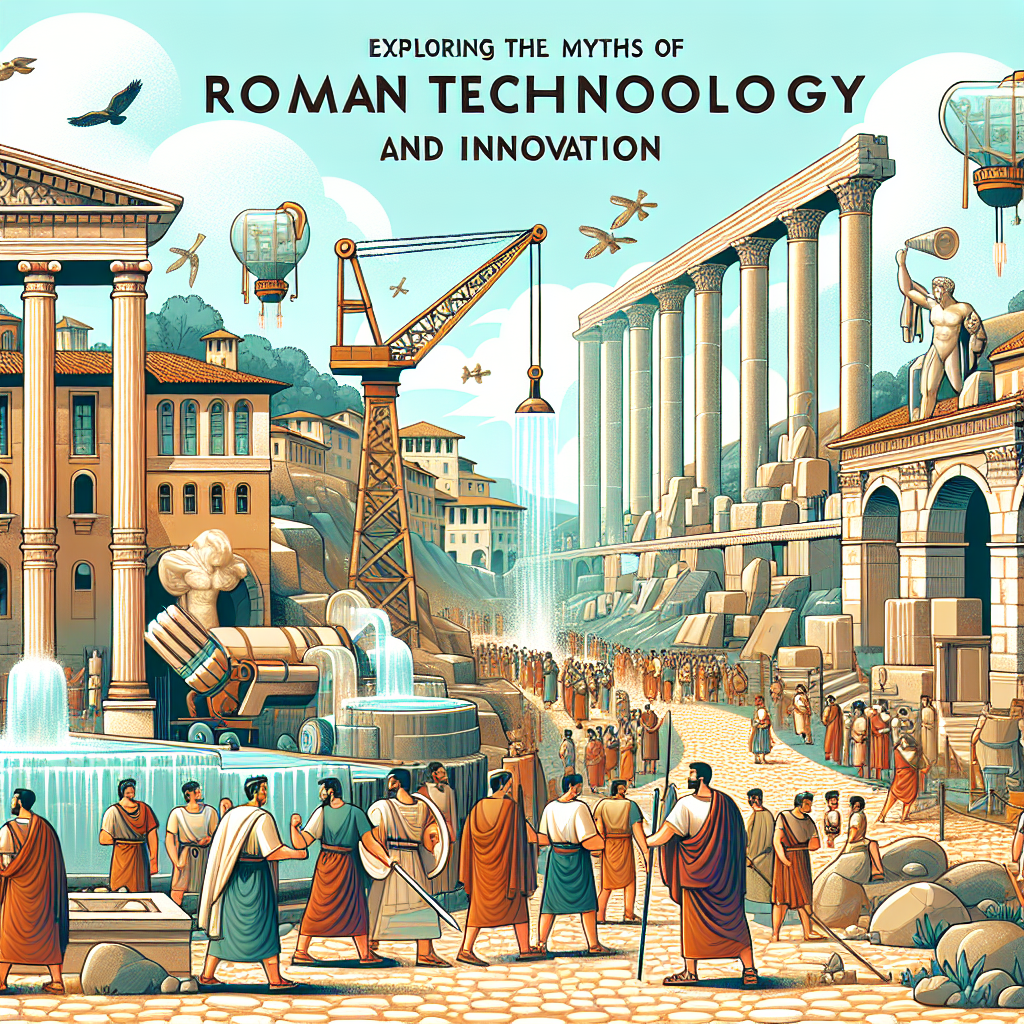
Exploring the Myths of Roman Technology and Innovation
When we think of ancient civilizations, the Roman Empire often stands out as a hallmark of innovation and engineering prowess. From aqueducts to monumental buildings, the achievements of this milieu seem monumental, yet they are often shrouded in misconceptions and exaggerations. This article delves into the myths surrounding Roman technology and innovation and aims to provide a clearer picture of their actual contributions and limitations.
The Aqueducts: Feats of Engineering or Simple Impressions?
One of the most celebrated hallmarks of Roman engineering is the aqueduct. Historically, it has been touted as an unparalleled achievement of engineering, transporting water over long distances with remarkable precision. While the Romans did indeed excel in constructing aqueducts, they were not the first to do so. Civilizations such as the Assyrians and Greeks had already built aqueduct systems prior to Roman advancements, often utilizing similar engineering principles.
The Roman aqueducts, however, were notable for their scale and efficiency. They utilized the principle of gravity to ensure a consistent flow of water, and many of them spanned great distances, crossing valleys and rivers through the use of archways. That said, these structures also required substantial resources and labor. The myth of sheer invincibility veils the reality that Romans faced significant challenges, including the deterioration of materials, the political climate affecting construction, and localized water quality issues.
Ingenious Inventions or Rehashes of Others?
Another myth is that Rome was the cradle of numerous groundbreaking inventions. While ancient Romans were certainly adept at adapting and improving upon existing technologies, they were not always the originators. The Roman use of concrete is frequently touted as revolutionary; however, this material had been used in various forms by other civilizations, notably the Babylonians.
Roman concrete, known as opus caementicium, was indeed groundbreaking for its durability and versatility, allowing for structures like the Pantheon and the Colosseum. This innovation was less about inventiveness and more about refinement. Romans understood locally available materials, such as volcanic ash, which contributed to the strength of their concrete. Thus, while one cannot deny Roman contributions to construction techniques, the narrative that they single-handedly ushered in these advancements can be misleading.
Roads and Infrastructure: Moving Beyond the Myths
Roman roads, often referred to as the backbone of the Empire, facilitate trade and military movement. The saying “All roads lead to Rome” underscores the belief in their unrivaled road-building capabilities. Yet again, this narrows their accomplishments to a singular narrative. Prior to Rome’s extensive road networks, various cultures had laid out extensive paths for trade and exploration.
What sets Roman roads apart is their systematic planning, a gradual consolidation of various techniques from previous civilizations. They understood the importance of a solid foundation, drainage systems, and gradation, leading to their durability. Still, constructing a road was an expensive endeavor, often requiring massive investments in terms of labor and resources. The concept of a “common road network” was also fraught with challenges, including maintenance, regional conflicts, and proficiency in land navigation.
Military Innovations: Advanced Warfare or Adoptive Strategies?
Fabled for their military prowess, the Romans are frequently credited with a host of innovative military strategies and technologies. However, many of their innovations were adaptations of existing methods used by other cultures, notably the phalanx formation of the Greeks or siege techniques from the Carthaginians and the Persians. The Roman legion, considered a sophisticated fighting unit, indeed incorporated various tactics and equipment from conquered territories.
The famous pilum (a type of javelin) is often heralded as a symbol of Roman ingenuity. Yet, it followed earlier designs, demonstrating the ability of Romans to refine and improve upon what was already in place. While Roman military organization was exceptional, combining discipline with strategy, the myth of entirely original contributions is less accurate. The efficient use of resources and adaptation of existing strategies had more to do with their success than merely innovative thinking.
The Fallacy of Uninterrupted Progress
One of the most persistent myths about Roman technology and innovation is the idea of uninterrupted progress. The narrative often implies that Roman engineering was synonymous with constant advancement, evolving without setbacks. However, this overlooks various socio-political challenges that impacted Roman technological development.
For example, the decline of the Western Roman Empire around the 5th century AD can be partly attributed to economic fragmentation and political instability, contributing to stagnation in technological innovation. As centralized power waned, many technologies were either lost or neglected, leading to a regression in certain practices. This cycle contradicts the myth of a steady trajectory of advancement, painting a more complex picture of innovation in the Roman context.
Conclusion: Reconciling Myths with Reality
The appeal of Roman technology and innovation lies in the empire’s remarkable achievements and the way these reflect human ingenuity. However, it is crucial to sift through the myths and assess their contributions in a more nuanced manner. Romans were not always the originators of technologies or concepts; they were often better draughtsmen and refineries, adept at borrowing and improving upon existing designs.
Through understanding these myths, one gains not only a perspective on Roman capabilities but also an appreciation for the interconnectedness of human innovation. The Romans synthesized ideas from various cultures, built upon them, and contributed their own twists—an evolution marked by collaboration, adaptation, and often, necessity.
In summary, while the legacy of Roman technology and innovation is deserving of admiration, the myths surrounding it can detract from a deeper understanding of their contributions to the tapestry of human history. By demystifying these narratives, we foster a more comprehensive view of ancient ingenuity and its lasting impact.