The Symbolism of the Phoenix in Roman Mythology
The Symbolism of the Phoenix in Roman Mythology
The phoenix, a legendary bird renowned for its cyclical nature of death and rebirth, occupies a unique and significant place in Roman mythology. Though its origins are rooted in ancient Egyptian and Greek traditions, the Romans embraced and adapted the symbolism of the phoenix to convey deeper philosophical, cultural, and political meanings within their own context.
The Origins and Cultural Context of the Phoenix
The concept of the phoenix can be traced back to ancient Egypt, where it was associated with the sun god Ra and represented resurrection and renewal. The bird was said to live for several hundred years before bursting into flames and being reduced to ashes, only to rise anew from those very ashes. In Greek mythology, the phoenix underwent a similar transformation but evolved to embody the themes of immortality and eternal life.
When the Romans encountered the phoenix, particularly through their interactions with Greek literature and culture, they incorporated this powerful symbol into their own mythological narrative. The Latin term for the phoenix is “phoenix,” derived from the Greek “phoinix.” Roman poets and writers, including Ovid and Pliny the Elder, began to reference the phoenix in their works, weaving it into the fabric of Roman mythology and culture.
Symbolism of Death and Rebirth
At its core, the phoenix embodies a profound cycle of death and rebirth. This symbolism resonates deeply within Roman society, mirroring the cultural beliefs about death and the afterlife. In a civilization characterized by its expansions and conflicts, the notion of renewal was particularly appealing. The phoenix became synonymous with hope and the idea that from destruction could arise new life and greatness.
This theme is vividly expressed in Roman literature. Ovid, in his “Metamorphoses,” uses the phoenix as a metaphor for transformation. The bird’s ability to rise again reflects the belief in the potential for personal and societal regeneration. As Rome faced challenges, be it through war, political strife, or social upheaval, the phoenix symbolized resilience and the promise of better days ahead.
Political Symbolism
The phoenix’s association with rebirth also lent itself to political symbolism in Rome. Emperors and leaders often adopted the phoenix as a symbol of their rule, suggesting that their reign would usher in a new era, akin to the rising of the phoenix. It was a symbol of stability and continuity amid uncertainties, representing the aspiration for renewal in governance.
The association between emperors and the phoenix is evident in the depictions on coins and public monuments. For example, Emperor Nero, who faced significant opposition during his reign, used the phoenix to signify his aspirations for renewal not only of his rule but also of Roman society. The bird represented the idea that under his leadership, Rome would experience a revitalization, akin to the phoenix rising from its ashes.
The Phoenix and the Sun
In Roman mythology, the phoenix is often intertwined with solar imagery. The bird is thought to rise at dawn and set at dusk, akin to the sun’s journey across the sky. This connection emphasizes the duality of life and death, light and darkness, growth and decay. The imagery of the phoenix emerging from flames encapsulates the idea of the sun’s fiery brilliance, which brings light and life to the world.
The solar symbolism of the phoenix also reinforces its connection to deities like Apollo, the god of the sun and music. As Apollo was often associated with enlightenment and divine inspiration, the phoenix, as a creature of renewal and immortality, mirrored these themes. In this sense, the phoenix not only represents physical rebirth but also the spiritual enlightenment that can follow periods of significant change or turmoil.
The Phoenix in Art and Literature
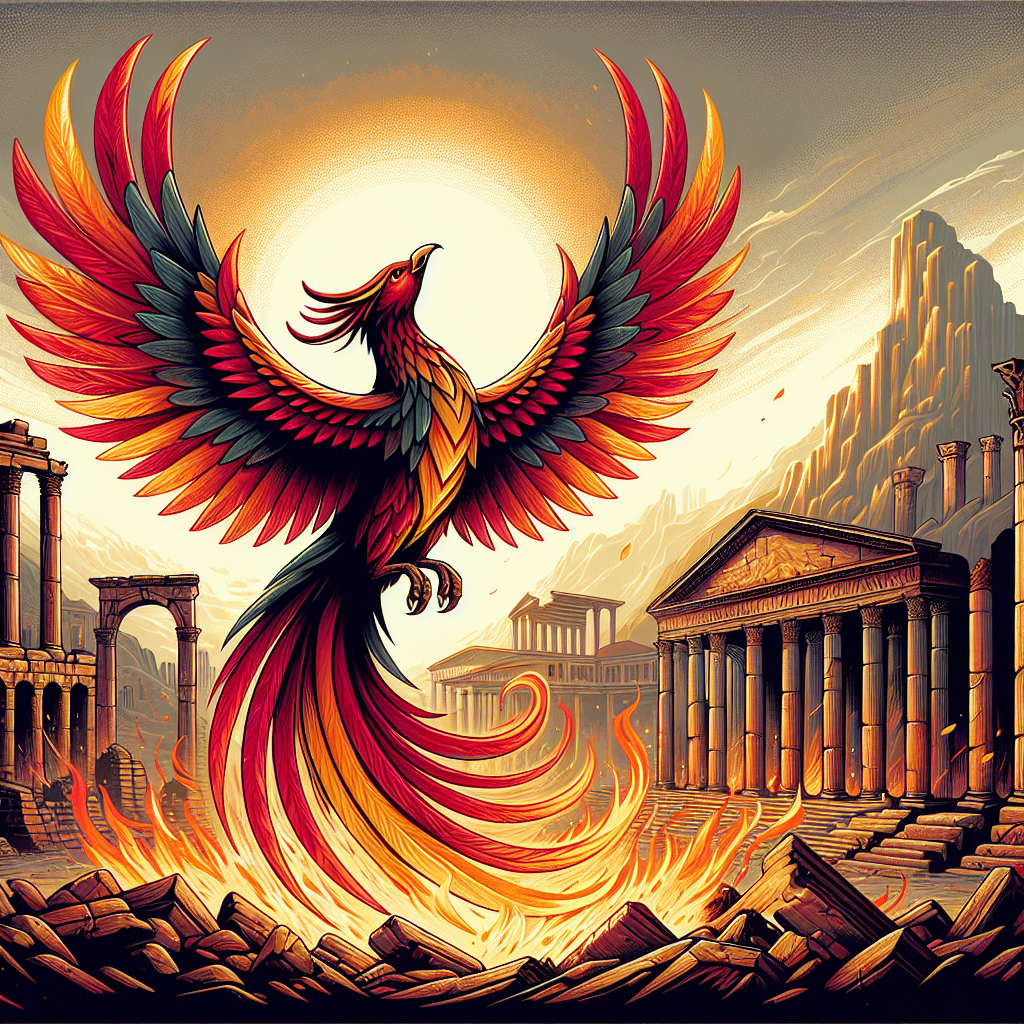
Roman art and literature often reflected the complex symbolism of the phoenix. Poets, sculptors, and painters employed the image of the phoenix to evoke themes of continuity, transformation, and the eternal cycle of life. In coins and sculptures, the phoenix was artistically rendered, often surrounded by flames or depicted rising from ashes, capturing the essence of its symbolic nature.
Literary references to the phoenix can be found in works beyond Ovid, including the writings of Cicero and Seneca. These authors employed the phoenix to discuss philosophical ideas related to the soul, mortality, and the nature of existence. In this way, the phoenix served as a means to explore deeper moral and existential questions, allowing individuals to reflect on their place in the cosmos.
The Phoenix as a Christian Symbol
Interestingly, the symbolism of the phoenix transcended Roman mythology and played a role in early Christian thought. Early Christians adopted the image of the phoenix as a distinct symbol of resurrection and eternal life, paralleling the resurrection of Christ. This adoption further solidified the notion of rebirth in the cultural consciousness of the time, as the phoenix was seen as a harbinger of hope, pointing to the possibility of life after death.
Just as the phoenix rises anew, Christians viewed Christ’s resurrection as a victory over death. This duality of life, death, and rebirth echoed through early Christian writings and iconography, demonstrating the adaptability and enduring nature of the phoenix’s symbolism through varying cultural contexts.
Conclusion
The phoenix stands as a powerful emblem of resilience, renewal, and transformation in Roman mythology. Its journey from destruction to rebirth reflects the broader themes of the human experience—struggles, victories, and the hope for a brighter future. Through its rich symbolism, the phoenix not only influenced literature and art but also served as a political metaphor and spiritual symbol, bridging the gap between pagan beliefs and early Christian thought.
Ultimately, the enduring legacy of the phoenix in Roman mythology underscores the timeless human fascination with the concepts of death and rebirth, reminding us of our intrinsic desire for renewal in the face of adversity. As a symbol that transcends time and culture, the phoenix continues to inspire and evoke the promise of new beginnings, making it a fixture in the collective consciousness of humanity.