Norse Creation Myths: From Nothingness to Order
Norse Creation Myths: From Nothingness to Order
The Norse creation myths reflect the rich tapestry of beliefs that characterized ancient Scandinavian culture. Contrary to the orderly narratives of some other mythological systems, the Norse tales often begin with chaos and the absence of form. This initial void establishes the grandeur of the cosmos’s eventual emergence, demonstrating the interplay between chaos and order, a theme prominent in Norse mythology.
The Void: Ginnungagap
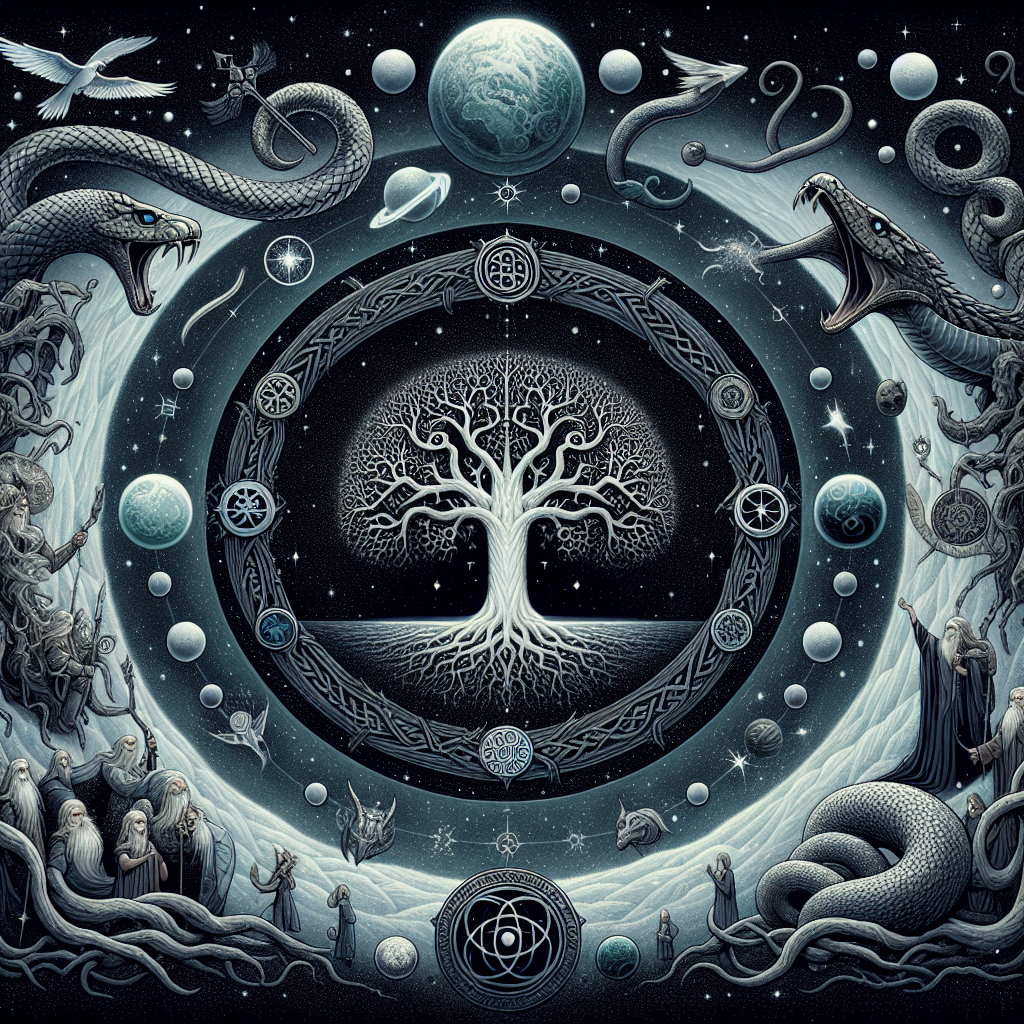
At the foundation of the Norse cosmogony lies Ginnungagap, a primordial void filled with nothingness. It existed before the world was formed, a yawning emptiness that stood between two realms: Niflheim, a land of ice and cold, and Muspelheim, a realm of fire and heat. Here, in the silence of Ginnungagap, the ingredients for creation were meticulously aligned.
As Niflheim’s icy breath met the fiery exhalations of Muspelheim, the interaction produced the first life: Ymir, the primordial giant. He emerged from the melting ice and was not merely a being but a force of nature, embodying both chaos and potential. Ymir symbolizes the raw power of creation, but he is also a harbinger of destruction—the duality inherent in the universe.
The Birth of the Gods
Ymir’s existence did not go unnoticed, as he was soon discovered by the three sons of Buri, the first god: Odin, Vili, and Ve. Alarmed by Ymir’s strength and potential for chaos, the gods decided to put an end to the giant’s reign. In a tragic twist emblematic of many creation myths, the slaying of Ymir led to the world’s formation. The gods crafted the earth from Ymir’s flesh, the oceans from his blood, and the mountains from his bones. This act of creation is not merely an act of destruction; rather, it illustrates a vital theme of transformation in Norse mythology, where life emerges from death.
From the chaos of Ymir’s existence, order and structure took place. The cosmos was divided into various realms, including Midgard, the world of humans, and Asgard, the dwelling of the gods. Each realm is interconnected, reflecting a complex web of existence.
The Creation of Humanity
With the earth established and the realms defined, the next stage of creation saw the emergence of humanity. Odin and his brothers found two logs washed ashore. From these, they fashioned the first two humans: Ask (the ash tree) and Embla (the elm tree). Each deity endowed them with distinct gifts—Odin gave them life and spirit, Vili endowed them with reason and intelligence, and Ve provided senses and speech. Thus, human beings were born, symbolizing a closer connection to the gods and a new level of order within the cosmos.
The creation of humanity signifies the transition from chaos to a structured existence, where choices and responsibilities now shaped the human condition. Humans became integral to the balance of the cosmos, possessing the ability to reason, create, and even disrupt the order established by the gods.
The Significance of Yggdrasil
Central to Norse cosmology is Yggdrasil, the World Tree, a massive ash tree that connects all realms. Yggdrasil symbolizes the interconnectedness of existence, illustrating that every aspect of life is interdependent. Its branches reach into the heavens, its roots dig deep into the underworld, binding together the different realms. The tree has three primary roots: one extends to Asgard, another to Helheim (the realm of the dead), and the third to the well of Mimir, a source of wisdom.
Yggdrasil serves as more than a mere physical representation; it embodies the cycle of life, death, and rebirth, demonstrating the ongoing struggle between chaos and order. The tree’s survival hinges on the actions of the beings that inhabit the worlds it connects, portraying the idea that creation is an ongoing, dynamic process.
The Role of the Aesir and Vanir
The gods themselves played a crucial role in establishing order from the prevailing chaos. The Aesir and the Vanir, two groups of deities, symbolize different aspects of existence. The Aesir, including Odin and Thor, are often associated with war and governance, while the Vanir, including Njord and Freyr, embody fertility and prosperity.
Their historical conflict and eventual truce further illustrate the dual nature of existence. After years of war, the two groups of gods united, demonstrating that cooperation among opposing forces is necessary to maintain cosmic balance. This harmony, sheathed in the complexity of their relationships, echoes the fundamental belief that order can emerge from discord.
The Cycle of Creation and Destruction
Norse mythology conveys that order is never static; rather, it is in a constant state of flux. The cyclical nature of existence is epitomized in the myth of Ragnarok, the apocalypse. This catastrophic event represents the ultimate confrontation between chaos and order, resulting in death and destruction but also the possibility of renewal. In the aftermath, a new world rises from the remnants of the old, suggesting that destruction is often a precursor to rebirth.
This cyclical pattern—creation, destruction, and rebirth—illustrates the Norse belief in the impermanence of life and the world. Instead of viewing chaos and order as oppositional forces, they are seen as integral to the unfolding experience of existence.
Conclusion
The Norse creation myths encapsulate profound themes of existence that resonate through time—the balance of chaos and order, the interconnectedness of life, and the cyclical nature of reality. From the void of Ginnungagap to the complex interdependencies of the cosmos, these tales offer insights into the human condition, the divine, and the universe’s workings.
By understanding these myths, one can appreciate not only the rich cultural heritage of the Norse people but also the universal themes that connect us all in the quest for meaning amidst chaos. India asserts that from nothingness, life and order can emerge, echoing the eternal struggles that define existence—a reminder that even in the depths of chaos, the seeds of order and rebirth are sown.