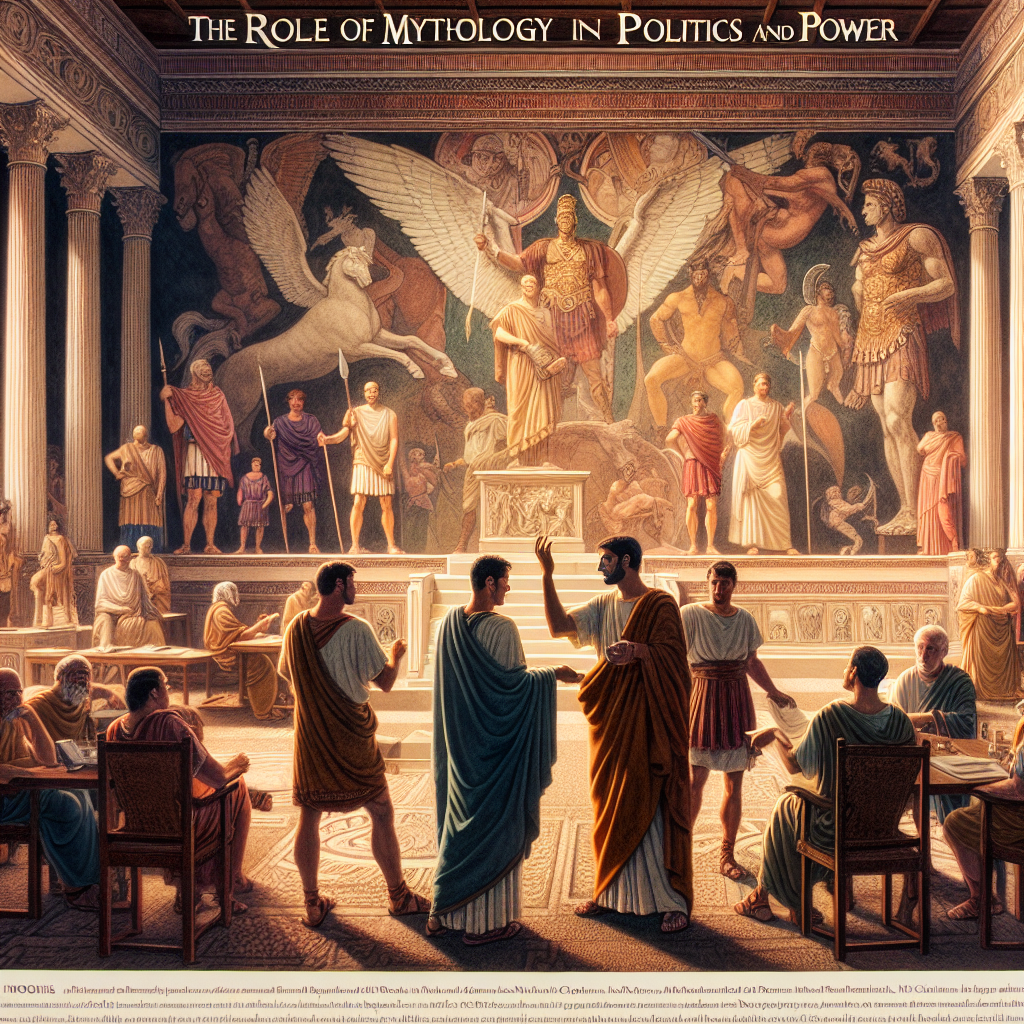
The ancient Roman Empire was not only a powerful political entity but also a cultural crucible where mythology played a significant role. Mythology, interwoven with the fabric of Roman society, acted as a tool for political legitimacy, social cohesion, and the assertion of power. This article examines how Roman mythology shaped and influenced its political landscape, contributing to the legacy of one of history’s most formidable civilizations.
Mythology as Political Legitimacy
At the heart of Roman politics was the belief in divine favor and ancestry. The Romans traced their lineage back to the legendary figures of Aeneas and the Trojans. By claiming descent from these heroic figures, particularly through Aeneas, Romans not only established their city’s origins but also infused their political authority with divine approval. This connection to the gods was vital for leaders seeking to legitimize their reign.
Julius Caesar exemplified this need for divine association. He claimed to be a descendant of Venus, the goddess of love, which elevated his status beyond mere mortal. Caesar’s public imagery often included references to mythological themes—his role as a general was depicted in a way that likened him to Hercules, a hero known for his strength and valor. Such mythologizing provided Caesar with the authority to execute decisions as if they were sanctioned by the divine.
Furthermore, the emperors who followed Caesar continued to use mythology as a means of consolidating power. Augustus, Caesar’s adopted heir, adeptly crafted the narrative of his rule by connecting himself with the divine. He commissioned works like the Res Gestae, highlighting his accomplishments with references to gods and myths. In this sense, mythology was not mere storytelling; it was an essential tool that fostered a cult of personality around the ruler, reinforcing the idea that the emperor was chosen by the gods.
The Integration of Myth and Governance
Roman mythology was deeply embedded in the governance of the state. The Roman calendar was filled with festivals and rituals dedicated to various deities, such as Jupiter, Mars, and Vesta. These celebrations did not merely serve religious purposes; they were pivotal in reinforcing political structures and societal norms.
The religious aspects of governance granted political leaders the dual authority of secular and sacred. For instance, the office of the Pontifex Maximus, the highest priest in Rome, was a position that allowed emperors like Augustus to not only govern but also have divine oversight in matters of state. The intertwining of mythological beliefs and state functions established a framework that encouraged both loyalty and respect towards the ruling class.
Moreover, Roman temples and monuments, often constructed in honor of mythological figures, stood as reminders of the divine presence in public life. The Pantheon, originally dedicated to the gods of Rome, symbolized the unity of the state under divine auspices. Such architectural marvels invoked reverence and awe, reinforcing the belief that Rome was favored by the gods, further solidifying the power of its leaders.
Social Cohesion Through Mythology
Beyond the political and governmental aspects, mythology served as a unifying tool among the Roman populace. The shared understanding of myths and their morals fostered a common identity and facilitated mutual respect among diverse groups within the empire.
The myths of Rome often encapsulated ideals such as bravery, sacrifice, and fidelity to one’s home. Stories of figures like Romulus and Remus not only narrated the founding of Rome but also provided citizens with a narrative of resilience and fortitude. During times of strife, these myths offered a shared narrative that galvanized the population, promoting unity in times of turmoil.
Additionally, mythological narratives were often instrumental in influencing military endeavors. The belief in divine favor—properly cultivated through rituals and sacrifices—added a psychological edge to Roman soldiers. The myths surrounding gods like Mars, the god of war, imbued soldiers with courage, inspiring them to undertake military campaigns with a sense of purpose and divine backing.
Mythology and Propaganda
As the Roman Empire expanded, so did the use of mythology as a tool of propaganda. The Romans adapted and adopted myths from conquered peoples, using these stories to integrate and assimilate diverse cultures into the Roman sphere of influence. By valorizing local myths, Rome could portray itself as a benevolent conqueror who fostered the preservation of local customs while simultaneously emphasizing the superiority of Roman culture.
Imperial propaganda often employed mythological imagery to assert dominance. Trajan’s Column, for instance, depicted scenes from military conquests in a manner reminiscent of heroic myths. This structure symbolized not only the accomplishments of the emperor but also the will of the gods in supporting Roman endeavors. Recognizing the importance of image and storytelling, emperors often commissioned artworks that conveyed their power and divine favor in ways that resonated with the populace.
The Decline of Mythology’s Political Role
As Rome transitioned from the imperial phase to a more Christianized society, the role of mythology evolved. By the time of Constantine and the establishment of Christianity as the state religion, the traditional mythological narratives began to lose their grip on the political arena. Nevertheless, elements of these myths continued to survive in various forms, influencing medieval and Renaissance thought.
The relationship between mythology, politics, and power in ancient Rome serves as a profound example of how narratives can shape a civilization. The intertwining of divine myth and political authority not only allowed the Roman Empire to propagate its ideology but also provided a framework for governance and social cohesion that remains relevant in discussions of power dynamics today.
Conclusion
In conclusion, the role of mythology in Roman politics was multi-faceted and deeply influential. It acted as a legitimizing force for rulers, a means of governance, a tool for social cohesion, and an instrument of propaganda. By navigating the intersection of myth and power, the ancient Romans crafted a narrative that not only sustained their empire but also left an indelible mark on the course of history. The echoes of their mythological beliefs still resonate in contemporary discussions about politics, identity, and authority, reminding us of the enduring power of narrative in shaping human experience.