
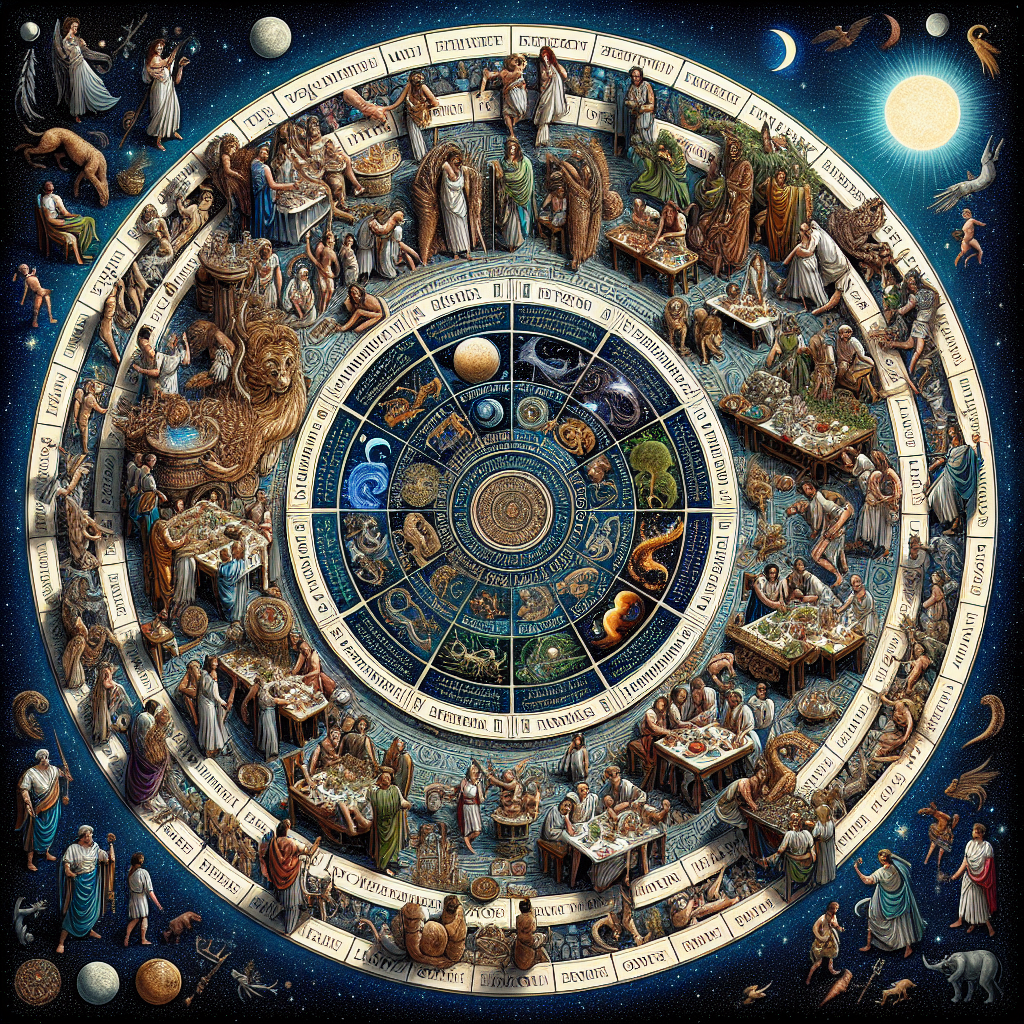
The Roman calendar, a complex tapestry woven with the threads of mythology, agriculture, and cultural tradition, serves as a fascinating reflection of the values and beliefs of ancient Rome. This system, which evolved over centuries, incorporated a variety of festivals and rituals that were deeply rooted in Roman mythology, reflecting the interplay between the divine and the mundane. To fully understand this calendar, we must explore its structure, key festivals, and the rituals that defined the lives of the Romans.
Structure of the Roman Calendar
Originally, the Roman calendar was lunar-based, consisting of ten months beginning in March. The months, often associated with various deities and agricultural cycles, included Martius (March), Aprilis (April), Maius (May), and Iunius (June). Later, under Julius Caesar, the calendar was reformed into the Julian calendar, adding two months—January and February—making it a solar calendar.
Central to understanding the Roman calendar is the division of the year into distinct periods marked by festivals. The Romans observed various types of festivals, each with its unique significance. These fell broadly into three categories: religious festivals, agricultural observances, and civic celebrations.
Major Festivals and Their Mythological Roots
Several key festivals punctuated the Roman year, each steeped in myth and cultural significance.
1. Lupercalia
One of the most well-known Roman festivals, Lupercalia, celebrated in mid-February, was dedicated to Lupercus, the Roman god of fertility, often equated with the Greek god Pan. The festival’s origins trace back to the myth of Romulus and Remus, the twin brothers said to be raised by a she-wolf. During Lupercalia, male priests, known as Luperci, would sacrifice goats and a dog, using the hides to strike women, believed to promote fertility.
The Lupercalia rites also included a matchmaking lottery, where young men drew names of young women, pairing them for the duration of the festival. This practice emphasized both fertility and the importance of community ties, echoing the mythological founding of Rome.
2. Saturnalia
Saturnalia, held in mid-December, was dedicated to Saturn, the god of sowing and seeds. Traditionally, this festival marked the winter solstice and the end of the agricultural year. The festivities included feasting, gift-giving, and a societal role reversal, where slaves were temporarily freed, and social classes were blurred.
This festival resonates with many myths surrounding Saturn, particularly his once-tyrannical rule and subsequent overthrow by his son, Jupiter. The revelry of Saturnalia provided an opportunity for the Romans to challenge societal norms and acknowledge the cyclical nature of life, death, and rebirth—core themes in Roman mythology.
3. Vinalia
Vinalia, celebrated in both April and August, was dedicated to Jupiter and Venus, the god of wine and the goddess of love, respectively. The April Vinalia, in particular, was a celebration of the wine harvest, crucial for both sustenance and social cohesion. Myths surrounding Bacchus, the god of wine, often permeated the festival’s celebrations, highlighting the duality of wine as both a source of joy and a potential source of chaos.
The rituals associated with Vinalia included offerings of new wine to the gods, representing gratitude and the hope for future abundance. The interconnectedness of agriculture and deity reflected the Romans’ reliance on divine favor for a bountiful harvest.
4. Consualia
Consualia, dedicated to Consus, the god of harvests and stored grain, underscored the agricultural calendar. Celebrated in August, this festival commemorated the first harvests. The mythological narrative often cited Consus as the protector of the stored grain, a fundamental aspect of Roman society.
During Consualia, Romans engaged in horse and chariot races, evoking myths of victory and strength. This celebration highlighted the importance of agriculture in Roman identity and the community’s dependence on the land’s bounty.
Rituals: Connecting the Divine and Human
Rituals accompanying these festivals were not merely ceremonial; they carried profound significance, merging the everyday with the sacred. For the Romans, participating in these rites was an obligation that ensured societal harmony and divine favor.
Sacrificial Offerings
Sacrifices played a crucial role in Roman religious practice. Animals, crops, and sometimes even wine were offered to the gods during festivals to seek favor or offer thanks. The act of sacrifice created a tangible connection between mortals and deities, reinforcing the belief that the gods influenced everyday life.
Public Games and Competitions
Many festivals included public games and competitions, a way for the community to celebrate together. These events served the dual purpose of honoring the gods and fostering unity among the populace. The games often mirrored themes of mythology, such as conquest or fertility, reminding participants of the divine narratives guiding their lives.
Role of the Priesthood
Among the rituals, the role of priests was paramount. They performed sacred rites and maintained the temple’s sanctity, acting as intermediaries between the people and the gods. The Vestal Virgins, for example, played a vital role in ensuring the sacred fire of Vesta remained lit, symbolizing the eternal bond between the gods and the city of Rome.
Legacy and Influence
The Roman calendar’s festivals and rituals not only shaped the rhythm of Roman life but also influenced future civilizations. Many customs, such as those seen in Christmas celebrations, have roots in Roman practices like Saturnalia. The blending of myth, agriculture, and civic pride ensured that these festivals remained central to Roman identity.
In summarizing the mythology of the Roman calendar, we uncover a profound and multifaceted interaction with the divine, illustrating how the ancients perceived their world. Each festival served to reinforce social bonds, honoring the gods who governed the cycles of life, death, and rebirth. The enduring influence of these celebrations continues to ripple through time, reminding us of the power of mythology to shape cultures and societies.


