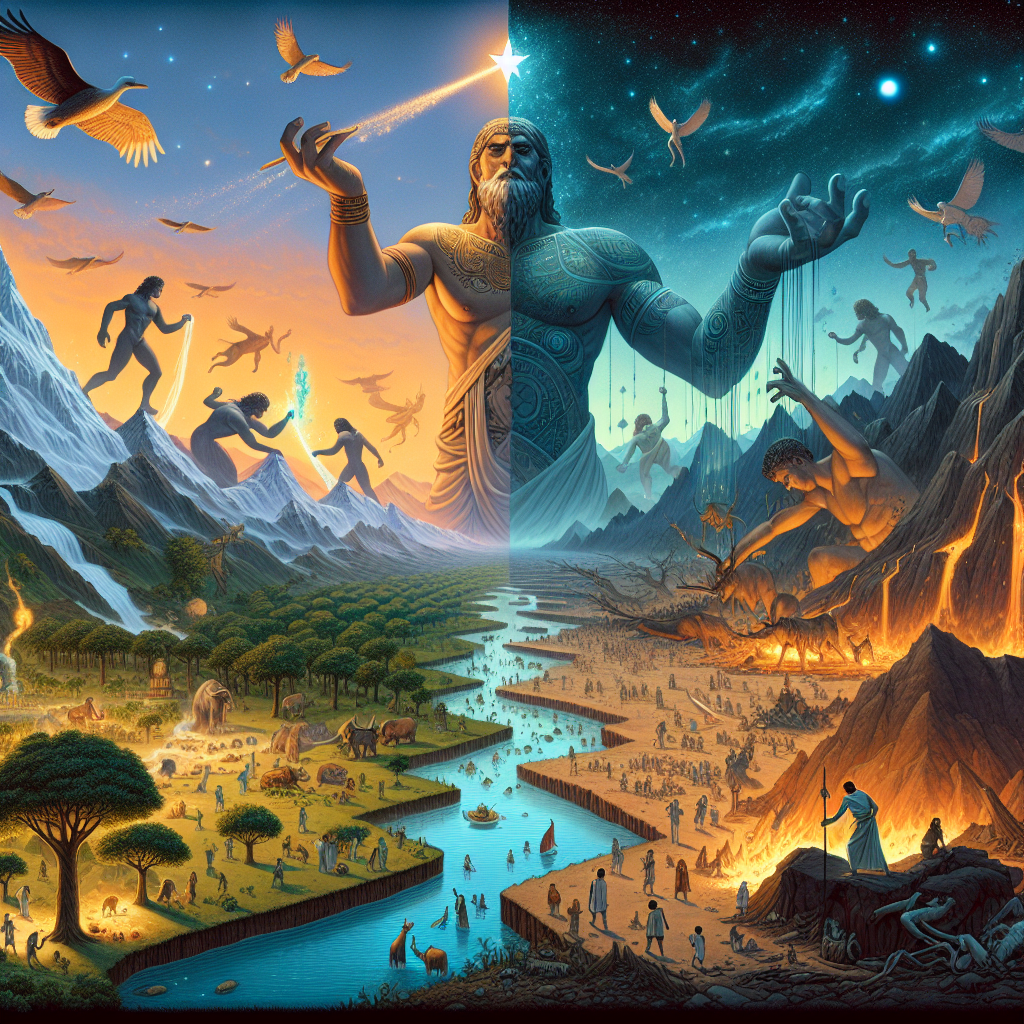
The concept of giants appears across various mythologies and folklore, often embodying both creative and destructive forces. These colossal beings have roots in ancient narratives, from Norse mythology’s Jotunn to the biblical Nephilim. This duality highlights the giants’ integral role in shaping, preserving, and ultimately destroying the cosmos. This article explores the multifaceted roles giants play in the creation and destruction of the world through mythological contexts, examining their symbolism and influence on the human experience.
Giants in Creation Myths
In many cultures, giants are often seen as primordial beings—entities that existed before the world’s current order was established. In the creation myths of various traditions, giants frequently act as catalysts for the formation of the world.
Norse Mythology
In Norse mythology, the first giant, Ymir, is a primeval being whose death leads to the creation of the world. According to the “Poetic Edda,” Ymir’s body is dismembered by Odin and his brothers, who use various parts to form the Earth. His flesh becomes the land, his blood the seas, the bones the mountains, and the skull the sky. This act of creation showcases the giants as both the raw material and the agents of creation. The death of Ymir serves as a reminder of the symbiotic relationship between chaos and order, suggesting that the universe rises from the remnants of tremendous, untamed power.
Greek Mythology
Similarly, in Greek mythology, the Titans—who can be viewed as a form of giants—play a crucial role in creation. They are the progeny of Gaia (Earth) and Uranus (Sky), and their existence precedes the Olympian gods. The generation of life, in this context, arises from the chaotic and often violent relationships among these titanic figures. The conflict known as the Titanomachy leads to the downfall of the Titans, paving the way for the Olympian gods to establish order. This narrative underscores the idea that giants can be central to the formation of the cosmos while simultaneously embodying the chaotic forces that threaten to undo it.
Giants as Guardians
While giants often represent chaos, many traditions also depict them as guardians of the natural world and humanity. They serve as protectors of sacred spaces and the natural order, maintaining the balance between nature and civilization.
Celtic Mythology
In Celtic mythology, giants are often depicted as guardians of land and resources. The giant Fomorians, who represent forces of chaos and darkness, stand in stark contrast to the Tuatha Dé Danann, a race of deities and heroes. The struggles between these factions highlight the giants’ role in maintaining balance. While the Fomorians embody destructive forces, the heroism of the Tuatha Dé Danann often leads to a reprieve of order and prosperity.
Native American Mythology
In Native American traditions, various giant figures serve as custodians of nature. For example, the giant in the “Coyote and the Giants” tale represents both a hurdle and a guide for Coyote, who must navigate challenges to bring harmony to his community. This duality reflects the giants’ role in teaching humanity essential lessons—often through trials that test bravery, intelligence, and resilience.
The Destructive Aspects of Giants
While giants can create and protect, they are equally associated with destruction. Their immense size and power frequently lead to havoc, symbolizing humanity’s fears of uncontrollable forces.
The Great Flood: Biblical Context
In the Bible, the Nephilim—often interpreted as giants—are depicted as beings who existed before the Great Flood. The Book of Genesis describes them as “mighty men” who indulged in wickedness, eventually leading to God’s decision to cleanse the earth. This narrative emphasizes that giants can represent humanity’s hubris, warning of consequences when the natural order is disrupted. The cataclysmic flood serves as a purging event, reflecting the idea that giants, in their unchecked might, can bring about their own downfall and that of humanity.
Ragnarok: The Norse Apocalypse
In Norse mythology, the giants return during Ragnarok, the end of the world. These beings, initially subdued, rise to reclaim their power in a cosmic battle against the gods. This cataclysmic event represents the ultimate destruction of the world, wherein giants reclaim their role as forces of chaos. The inevitability of Ragnarok reinforces the notion that creation is an ongoing cycle, where renewal and destruction coexist.
The Cultural Legacy of Giants
The mythological narrative of giants extends beyond ancient texts into modern cultural expressions—literature, art, and film. These figures often serve as metaphors for undercurrents within human society and nature itself.
Modern Interpretations
In contemporary storytelling, giants often symbolize the challenges that humanity faces—environmental degradation, war, and societal upheaval. Works like J.R.R. Tolkien’s “The Lord of the Rings” feature colossal beings, emphasizing the struggle between good and evil, creation and destruction. This continuing fascination with giants reflects humanity’s complex relationship with power and the natural world.
Conclusion
Giants serve as multifaceted symbols within mythology, embodying the dichotomy of creation and destruction. Whether as creators of the world, guardians of balance, or forces of chaos, their presence underscores the primal truths within human existence. They remind us of our own size in the universe, the consequences of unchecked power, and the cyclical nature of life itself: that creation often arises from destruction. Ultimately, the giants’ legacy invites us to reflect on our role within this world and the delicate balance that sustains it. Thus, in understanding the giants’ role in the creation and destruction of the world, we gain insights into our place within the cosmos—a reminder that even in our most mundane actions, we can influence the tapestry of existence.