
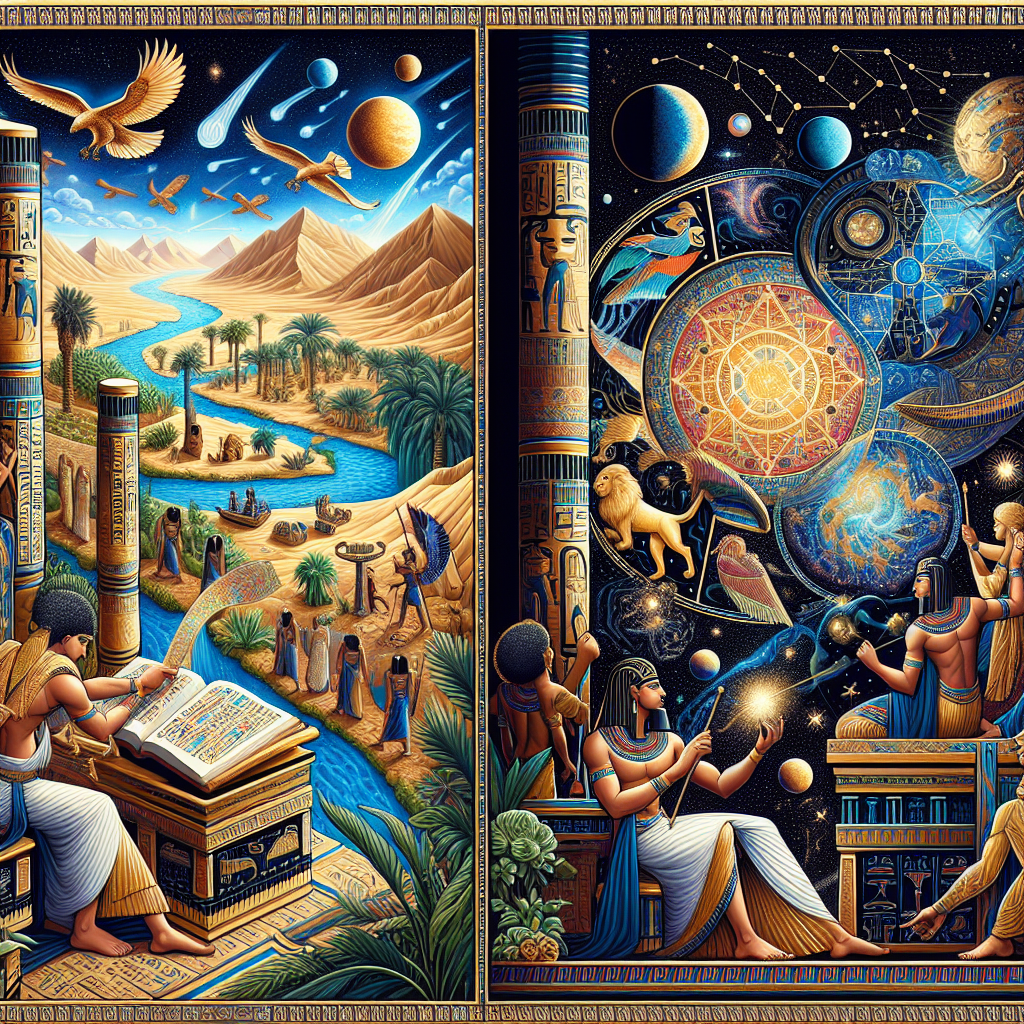
Ancient Egypt, one of the most influential civilizations in human history, is renowned for its rich tapestry of mythological narratives that explain creation, existence, and the divine order of the universe. The myths of creation in ancient Egypt are not singular or monolithic but rather a collection of narratives that reflect the diversity of thought, culture, and spirituality across different eras and regions within the kingdom. This article explores several of the major creation myths from ancient Egypt, examining their unique characteristics, significance, and the cosmological perspectives they convey.
The Primordial Chaos: Nun
At the heart of Egyptian creation myths lies the concept of Nun, the primordial chaos or the watery abyss that existed before creation. In many narratives, Nun represents the infinite, unformed, and formless substance from which the cosmos would emerge. This chaotic state is often depicted as dark waters that held the potential for life, emphasizing a common theme in ancient creation myths: that creation begins from a state of non-being.
The Ogdoad: Hermopolitan Myth
One prominent version of the creation myth emerges from Hermopolis, revolving around the Ogdoad—an assembly of eight deities symbolizing the elements of creation. Each god and goddess of the Ogdoad embodies fundamental aspects of existence:
- Nun and Naunet: Representing the primordial waters,
- Amun and Amunet: Symbolizing air and invisibility,
- Heh and Hauhet: Representing infinity,
- Kuk and Kauket: Representing darkness.
In this narrative, it is from Nun that a primordial mound rises, emerging from the chaotic waters. The god Amun (or sometimes Atum, depending on the narrative) emerges on this mound, often depicted as a self-created being who brings forth other gods and initiates order in the universe.
The Heliopolitan Myth: Atum and the Ennead
Another significant creation narrative originates from Heliopolis and centers around Atum, often considered the creator god. According to this myth, Atum emerges from the primordial waters of Nun and first creates himself. The act of self-creation is a powerful motif, symbolizing comprehensive power over existence.
Following this, Atum creates the first pair of deities, Shu (air) and Tefnut (moisture). From their union, Geb (earth) and Nut (sky) are born, forming the basis of the cosmic order. The lineage continues with Osiris, Isis, Seth, and Nephthys, creating a pantheon that encapsulates various aspects of life, death, and regeneration. This myth emphasizes not just the creation of the world but also the intricate relationships among gods and the establishment of ma’at—balance and order in the cosmos.
The Memphite Theology: Ptah
In Memphite theology, the god Ptah assumes a central role in the creation narrative. Unlike Atum and the Ogdoad, Ptah creates through thought and word. The account suggests that the act of creation involves Ptah contemplating the world in his heart and then speaking it into being.
This version highlights the potency of language and intellect in creation, suggesting that the universe’s formation is an extension of divine will articulated through speech. This distinction between physical creation and the creative power of thought resonated throughout ancient Egyptian society, influencing art, architecture, and governance.
The Theban Creation Myth: Amun-Ra
In Thebes, a syncretic blend of the creation myths emerged, centering around the god Amun, particularly as he was merged with Ra, the sun god. This narrative posits that Amun-Ra is a self-created being who represents both the hidden force and the radiant sun, embodying both mystery and enlightenment. Here, creation is a cyclical process, with the sun setting and rising, symbolizing rebirth and continuity.
The incorporation of Amun with Ra also illustrates a significant shift in worship as political power gravitated towards Thebes. Through this syncretism, Amun-Ra established a divine authority closely tied to the pharaohs, legitimizing their rule through divine connection and emphasizing the importance of the sun in daily life and spiritual belief.
Common Themes and Symbolism in Egyptian Creation Myths
While diverse, these creation myths share a set of common themes:
-
Primordial Chaos: The imagery of a watery abyss or chaotic state signifies a universal starting point for creation narratives across cultures. The struggle between chaos and order serves as a central motif.
-
Self-Creation: The concept of gods bringing themselves or others into existence reflects the idea of divine authority and the power of intention. This highlights the deeply embedded belief in the power of thought and the spoken word.
-
Divine Hierarchies: The interrelationships among the deities not only structure the heavenly realm but also serve as mirrors for socio-political hierarchies on earth, illustrating the interconnectedness of religion and governance.
-
Order vs. Chaos: The emphasis on ma’at reflects the Egyptians’ deeply rooted understanding of balance, justice, and harmony essential for both the cosmos and societal structure.
-
Cycles of Life: Many myths convey themes of death and rebirth, symbolizing the agricultural cycles pivotal to Egyptian society and underscoring the connection between their belief systems and daily survival.
Conclusion
The creation myths of ancient Egypt are both intricate and varied, offering rich insights into the spiritual and cultural landscapes of one of history’s most enduring civilizations. From the primordial waters of Nun to the triumphant emergence of divine order, these narratives convey profound truths about existence, purpose, and the forces that shape the universe. They illustrate how ancient Egyptians grappled with the fundamental questions of life, weaving together a tapestry of mythology that continues to inspire and intrigue contemporary audiences. As we explore these myths, we not only gain insight into ancient Egyptian thought but also the timeless human quest for understanding in an often chaotic world.


