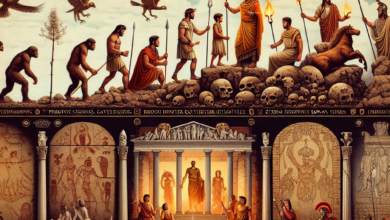

The concept of fate, or “fatum,” played a significant role in Roman mythology and culture. Unlike the more capricious nature of the Greek gods, Roman beliefs about fate conveyed a more deterministic framework, emphasizing that individuals’ lives were subject to a predetermined order. This article explores the various dimensions of fate in Roman myths, its embodiment in deities and narrative structures, and its implications for human agency and morality.
The Nature of Fate
In Roman thought, fate was often understood as a divine order that governed the universe. Unlike mere chance or randomness, fate was symbolized by the unwavering laws of nature and divine will. This distinction is crucial; while mortals could attempt to influence or understand their destinies, they were ultimately bound by a larger cosmic plan. The Latin word “fatum” derives from “forari,” meaning “to speak” or “to declare,” suggesting that fate is a spoken decree, an unchangeable order from the divine.
The Romans personified fate through various deities, the most prominent being the Parcae, known in Greek mythology as the Moirai or the Fates. These three sisters—Nona, Decima, and Morta—were responsible for spinning, measuring, and cutting the thread of life. Each sister had a specific role: Nona spun the thread of life, Decima measured it, and Morta cut it, determining how long an individual would live. This triadic structure emphasized the inescapable nature of fate, as not even the gods could alter the decisions of the Parcae.
Fate and the Divine
In Roman mythology, the relationship between the gods and fate is complex. The gods, while powerful, were often portrayed as being subservient to fate, unable to intervene in the predetermined paths set by the Parcae. This concept suggests that fate acts as a higher authority, a force that even the mightiest gods respect. For example, in Virgil’s “Aeneid,” the hero Aeneas is depicted as bound by fate to found Rome, no matter the innumerable obstacles he faces. His journey underscores a central theme in Roman myths: that human efforts and divine interventions are ultimately guided by the inexorable hand of fate.
The interplay of fate and the will of the gods can be seen in the story of Tantalus, whose punishment was a reflection of his hubris and the inevitability of his fate. He was punished for his transgressions by being made to stand eternally in a pool of water beneath a fruit tree—both tantalizingly close yet eternally out of reach. His myth underscores the idea that while individuals may seek favor from the gods, they remain unaware of the full scope of their fates.
Human Agency and Responsibility
The concept of fate in Roman mythology raises important questions about human agency and moral responsibility. If individuals are fated to follow a predetermined path, what role do their choices play in their lives? In myths and stories, characters often grapple with their destinies, revealing a tension between free will and predestination. Romans frequently portrayed their heroes as wrestling with the burden of fate.
For instance, in the tale of Oedipus, although originally a Greek story, its intersections with Roman thought reflect the cultural exchanges of the time. Oedipus attempts to escape his fate of killing his father and marrying his mother, only to inadvertently fulfill it. This narrative illustrates the futility of resisting fate; the more one struggles against it, the more firmly one seems to be bound by it.
Such themes resonated with Roman values, mirroring societal beliefs about duty, honor, and the inevitability of one’s assigned role in the larger civic context. Romans believed that one should accept their fate with dignity, embodying the Stoic philosophy that later became influential in Roman culture. Stoicism emphasized that while individuals could not control external events, they could control their responses to those events, promoting a sense of resilience amidst the inexorability of fate.
Fate in the Roman Epic
Fate plays a pivotal role in Roman epics, particularly in works like the Aeneid and Metamorphoses by Ovid. In the Aeneid, Aeneas’s journey is meticulously crafted around the idea of fate. His struggles and sacrifices serve to emphasize the importance of destiny—not just for himself but for the future of Rome. The poem illustrates how personal desires and conflicts often clash with fate, but ultimately, it is the latter that prevails.
Ovid’s Metamorphoses, while more playful and fantastical, also touches upon fate’s influence. The transformations of characters often occur as a result of the inexorable pull of fate, teaching moral lessons about hubris and the human condition. The story of Pygmalion, for instance, emphasizes the relationship between desire and the preordained, as Pygmalion’s wish for a perfect partner is ultimately fulfilled, showcasing the complexities of fate in achieving personal desires.
Conclusion
The Roman conception of fate encompasses a rich tapestry of narratives, symbolism, and moral lessons. Far from being a mere backdrop, fate was interwoven with the very fabric of Roman identity and belief systems. It presented a worldview where individuals were intricately linked to a cosmos governed by divine order, even as they sought to carve out their own identities.
In grappling with the dualities of fate and free will, Romans created a mythology that reflects their understanding of human existence—its struggles, its triumphs, and its inevitable submission to a greater cosmic order. This theme of fate continues to resonate in modern narratives, reminding us that while we may navigate our paths, the threads of destiny remain ever-present, woven into the fabric of human experience.