The Story of Anubis and the Weighing of the Heart
In the rich tapestry of ancient Egyptian mythology, few stories capture the imagination as vividly as that of Anubis and the Weighing of the Heart. Anubis, the jackal-headed god, played a pivotal role in the afterlife journey, guiding souls and assisting in their judgment. This narrative weaves themes of morality, the concept of the afterlife, and the eternal struggle between good and evil, offering insights into ancient Egyptian beliefs that resonate even today.
Anubis: The Guardian of the Underworld
Anubis, known as the god of embalming and the protector of the dead, had a dual role that encompassed both guidance and judgment. Depicted with a black canine head, Anubis represented the colors of life and death; black symbolized the fertile soil of the Nile and, by extension, rebirth, while the jackal was often associated with graveyards, highlighting his connection to death.
In ancient Egypt, death was not seen as the end of existence but rather a continuation of life in another realm. The Egyptians believed in an afterlife where individuals would face judgment based on their earthly deeds. Anubis was revered as the one who prepared the dead for this journey, overseeing the mummification process and ensuring that the deceased were properly buried with the necessary rituals and offerings.
The Journey to the Afterlife
Upon death, a soul embarked on a perilous journey to the afterlife, navigating a series of obstacles and tests. In the Egyptian conception of the afterlife, the soul had to pass through Duat, the underworld, where it faced various trials. Anubis served as a guide and protector, leading souls through this daunting realm.
As the deceased neared the final judgment, they arrived at the Hall of Ma’at, the heart of the final assessment. Here, the soul would face Anubis, who would initiate the process known as the Weighing of the Heart — a ritual that symbolized the moral evaluation of a person’s life.
The Weighing of the Heart
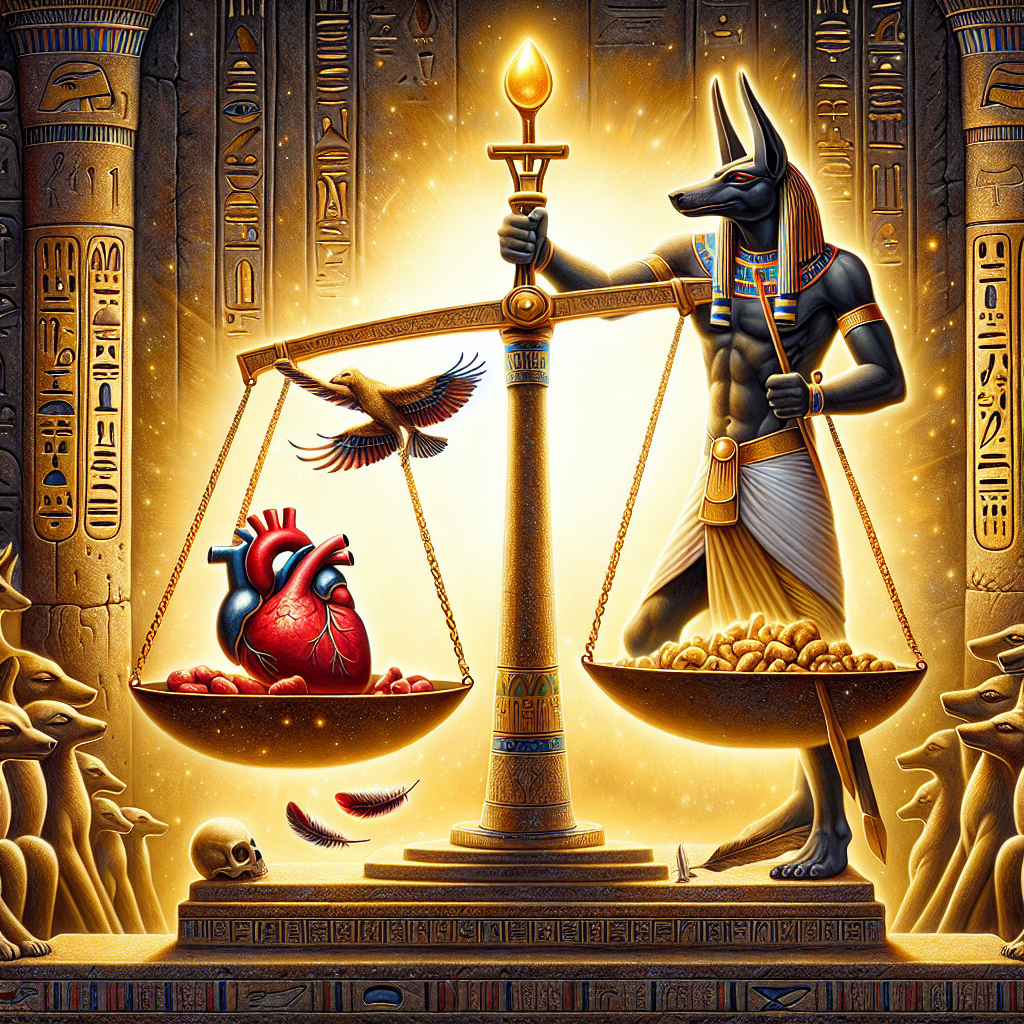
The Weighing of the Heart ceremony underscored the ancient Egyptians’ belief in accountability. At its core, this ritual was a profound exploration of morality, weighing the heart of the deceased against a feather, symbolizing Ma’at, the goddess of truth and justice.
As the ceremony commenced, the soul of the deceased would be presented before the divine jury, which included Osiris, the god of the afterlife and resurrection, and other deities. Anubis would oversee the weighing process. The heart, regarded as the seat of the soul and the center of emotion and intellect, was placed on one side of a scale. On the other side, the feather represented truth and the moral purity of the deceased’s actions during their lifetime.
If the heart balanced with the feather, it indicated a life lived in accordance with the principles of Ma’at — honesty, integrity, and goodness. The deceased would then be deemed worthy and granted passage into the afterlife, where they could enjoy eternal peace and bliss alongside the gods.
However, if the heart was heavier than the feather, this imbalanced outcome served as a damning verdict. The weight of the heart symbolized the burdens of negative actions and moral failures. In such a case, the soul would face annihilation, its spirit consumed by Ammit, a fearsome creature known as the Devourer of the Dead, a hybrid of a lion, hippopotamus, and crocodile. Thus, the Weighing of the Heart served as both a judgment of the individual’s life and a cautionary tale about the repercussions of one’s actions.
Symbolism and Significance
The Weighing of the Heart is layered in symbolism, reflecting the values and beliefs of ancient Egyptian society. The heart was not merely a physical organ; it represented one’s thoughts, intentions, and actions throughout life. This belief in the moral weight of the heart illustrates the understanding of ethics in ancient Egypt, emphasizing that one’s choices directly influenced their fate in the afterlife.
Moreover, this mythological narrative encapsulates the duality of existence — life and death, truth and deceit, justice and punishment. The endeavor to achieve balance in the scales signifies the pursuit of harmony in life. In a society deeply rooted in religious beliefs, this story also served to instill a sense of responsibility among individuals – the idea that every action has consequences, not just in this life, but in the life to come.
Cultural Legacy
Though the worship of Anubis has long faded, the themes encapsulated in his story continue to resonate. The Weighing of the Heart remains a poignant representation of moral evaluation and the quest for truth, relevant in contemporary dialogues around ethics, justice, and accountability.
In art and literature, depictions of Anubis and the weighing ceremony have inspired a myriad of interpretations. Movies, novels, and video games often draw on the rich imagery and emotional weight of this myth, helping introduce new generations to the complex beliefs of ancient cultures.
Even in modern times, the questions raised by the Weighing of the Heart — Are we living a life true to our values? What will be our legacy? — linger in discussions about personal development and ethical living.
Conclusion
The story of Anubis and the Weighing of the Heart encapsulates the profound beliefs of ancient Egyptians regarding life, death, and morality. Through Anubis, they articulated the importance of living a life of virtue, facing the consequences of one’s decisions with grace, and seeking balance in all things.
In a world where moral ambiguity often complicates choices, Anubis’s enduring legacy reminds us of the significance of integrity and the weight of our actions. As we navigate our own journeys through life, we may ponder: What will our hearts weigh when placed on the scales of judgment? In the end, the story of Anubis continues to challenge and inspire us toward a path of honor, truth, and self-reflection.