The Children of Lir in Irish Tradition: Transformation, Exile and Sea-Magic
The Children of Lir are among the best-known figures in Irish tradition: four royal children turned into swans, condemned to wander Ireland’s lakes and seas for nine hundred years. The story is not an ancient pagan scripture, but a medieval Irish tale, preserved in Christian-era manuscript culture and later reshaped in modern retellings. That makes it especially interesting: it is both a haunting narrative of exile and a vivid example of how Irish literature imagines the meeting point between kinship, loss, the supernatural and the sea.
A tale from medieval Irish tradition
The principal version usually told today is Oidheadh Chloinne Lir, often rendered in English as The Fate of the Children of Lir. It belongs to Irish literary tradition, not to a single pan-Celtic mythology shared unchanged by every Celtic-speaking people. The tale survives in Early Modern Irish manuscripts, and the standard printed and translated forms descend from those later copies rather than from an untouched “original”. In other words, we are reading a medieval and post-medieval literary narrative that drew on older themes, not a direct transcript of pre-Christian belief.
The story also sits within a wider Irish tradition of tragic family tales sometimes grouped as the Three Sorrows of Storytelling, alongside the stories of Deirdre and the sons of Uisliu, and the children of Tuireann. Those associations are literary rather than evidence for a single ancient cult or ritual pattern. What survives is a powerful narrative world, not a frozen religious handbook.
Lir, Aoibh, Aoife and the question of succession
The tale begins among the Tuatha Dé Danann, the supernatural people of Irish mythic narrative. Lir is presented as a noble figure, though the broader mythological background of that name is complex. In other early Irish sources, mac Lir means “son of the sea”, and the name is associated with sea-divinity and otherworldly authority; the ninth-century glossary Sanas Cormaic even explains Manannán mac Lir through sea and navigation. But in Children of Lir, Lir functions mainly as a father and kingly figure within the story.
After the death of Lir’s first wife, his children are cared for by her sister Aoife, who becomes his second wife. The children are usually named Fionnuala, Aodh, Fiachra and Conn. Their age and order matter because the tale is built around sibling bonds and inheritance: the children are not simply victims of random magic but figures caught in a struggle over affection, status and succession within a noble household.
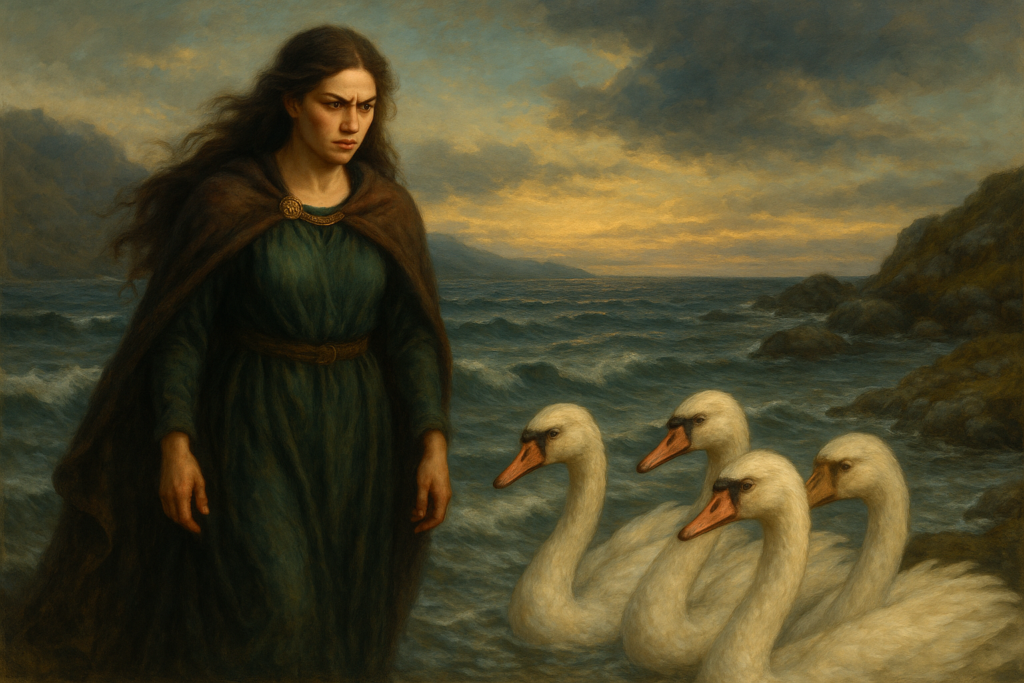
Aoife grows jealous of the children’s place in Lir’s life and in the esteem shown to them by the wider family. In the standard retelling, she drives them out with an enchantment while they are travelling to visit their grandfather Bodb Derg, who is king of the Tuatha Dé Danann. The transformation into swans is the tale’s central act of violence. It is not framed as a fairytale-style spell for spectacle, but as a political and domestic punishment: the household has become the site of rivalry, and the children are forced into exile.
The swan curse on Lough Derravaragh
Aoife’s curse changes the four children into white swans. In some telling she also decrees the length and structure of their exile: three hundred years on Lough Derravaragh, three hundred on the Sea of Moyle between Ireland and Scotland, and three hundred on the western coast. This three-part span is one of the most memorable features of the tale, and it gives the story its rhythm of repeated displacement. The children do not disappear; they are made to endure.
Importantly, Aoife does not entirely silence them. They keep their voices, and their singing becomes part of the story’s emotional power. Their music is so moving that it gathers listeners and turns the place where they rest into a kind of temporary Otherworld. Here the tale touches one of its most characteristic Irish motifs: the boundary between the human world and the realm beyond it is porous, and beauty often arrives in the form of melancholy rather than triumph.
On Lough Derravaragh, the swans draw attention from the people and from the Tuatha Dé Danann themselves. Later, as they move between the Sea of Moyle and the western sea, the story emphasises cold, hunger and endurance. The three exiles are not interchangeable: each period has its own character, and the tale uses geography to make suffering feel real. Water is both their prison and the element that preserves them.
From courtly grief to lonely endurance
The three children do not remain childlike for the whole of the nine hundred years. The tale lingers on Fionnuala, the eldest and the one who speaks most often for the group. She becomes the keeper of memory and the voice of consolation, responsible for her brothers as the centuries pass. That is one reason the story has remained so affecting: it is not only about transformation, but about the work of endurance after transformation has already happened.
Different retellings sometimes vary in emphasis, but the central pattern remains the same. The children pass from the familiar waters of their home territory to harsher seas and then to a final resting place in the west. Their human relationships are never entirely lost, even in swan-form. They stay together, sing together and remember one another. The tale’s emotional force comes from that stubborn continuity of kinship across monstrous time.
Christian ending and medieval context
The most familiar ending belongs to the Christianised medieval version. By the time the curse expires, the children are old, worn and near death. A bell sounds from a Christian house or church settlement, and the swans are drawn towards it. In the commonly read version, they reach a holy man, are baptised and die soon afterwards, finally ending their long exile. This ending matters because it places the old mythic world in relation to Christianity rather than in simple opposition to it. The tale does not present the pre-Christian supernatural as wholly erased, but it does resolve the story through baptism and a Christian framework.
That ending should not be mistaken for a universal ancient Irish belief. It reflects the world of the manuscript redactors and the religious culture in which the tale was copied and read. At the same time, the story’s power does not depend on treating the medieval recorder as its inventor. The swan transformation, the lament and the association with liminal waters all sit comfortably within older Irish narrative habits, even if the surviving form is later.
Why the Children of Lir still matter
The story endures because it combines several concerns that remain easy to feel: jealousy inside a family, the cost of exile, the dignity of survival and the strange consolation of song. It is also one of the best-known Irish myths to connect landscape with memory. Lough Derravaragh, the Sea of Moyle and the western islet of Inishglora are not just settings; they are stages in a long act of remaking.
For modern readers, the Children of Lir can seem to stand for many things at once: national sorrow, the endurance of Irish tradition, or the transformation of grief into art. Those meanings belong to later reception as much as to the medieval tale itself. But the old story remains compelling on its own terms. It gives us a family broken by envy, children preserved by song and a sea that carries memory as stubbornly as it carries birds.
Sources and further reading
- “The Fate of the Children of Lir” — English translation, University College Cork CELT (opens in a new tab)
- “Oidhe Chloinne Lir” — Irish text, University College Cork CELT (opens in a new tab)
- “Sanas Cormaic” — Early Irish Glossaries Database, University of Cambridge (opens in a new tab)
- CELT Translated Texts — University College Cork (opens in a new tab)
Recommended reading
These are affiliate links. If you buy through them, we may earn a commission at no extra cost to you.
Celtic Druidry: Rituals, Techniques, and Magical Practices
Ellen Evert Hopman’s practical guide blends ancient Celtic wisdom with modern Reconstructionism, covering Druidic tools, cosmology, tree lore, and rituals. Packed with seasonal rites, Ogham divination, and protective charms, it offers everything needed to begin the Druid path.
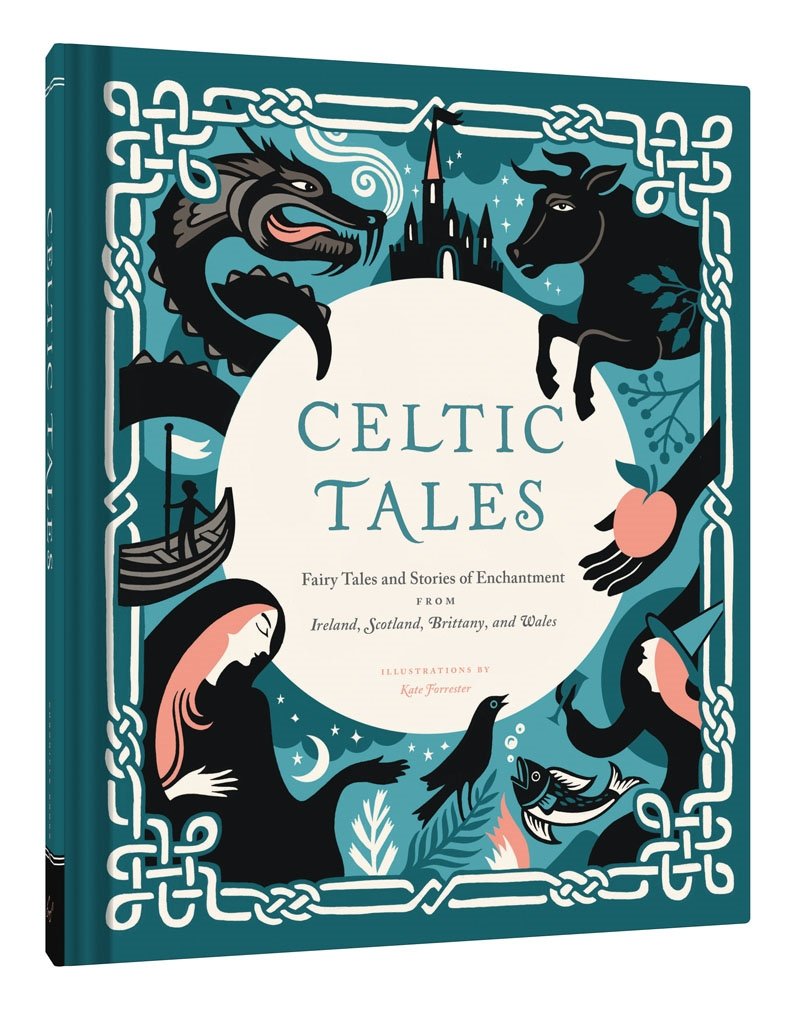
Celtic Tales: Fairy Tales and Stories of Enchantment from Ireland, Scotland, Brittany, and Wales
Gathering tales from Ireland, Scotland, Brittany, and Wales, this illustrated collection features sixteen folklorist-transcribed stories brimming with magical creatures and timeless wit. Enhanced by Kate Forrester’s elegant silhouette artwork, it vividly transports readers to the enchanted realms of Celtic myth.
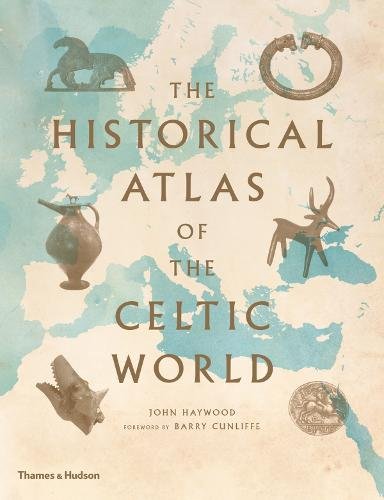
The Historical Atlas of the Celtic World
Featuring 54 vibrant full-color maps, this atlas comprehensively charts 3,000 years of Celtic history from Bronze Age origins to the modern global diaspora. Incorporating the latest research, it explores Continental, Atlantic, and contemporary Celtic cultures to trace their enduring legacy across Europe and beyond.