Loki’s Binding and the Death of Baldr
Loki’s binding and the death of Baldr are among the most haunting stories in Norse mythology. They belong to the great mythological cycle preserved in medieval Icelandic texts, above all the Poetic Edda and Snorri Sturluson’s Prose Edda. These works were written down in Christian times, mainly in thirteenth-century Iceland, and they may preserve older pagan traditions without giving us a direct, unfiltered record of pre-Christian belief. The story of Baldr’s death is especially important because it leads into Loki’s punishment and foreshadows Ragnarök, the end of the gods’ present order.
Baldr the beloved god
In Snorri Sturluson’s Prose Edda, Baldr is presented as the fairest and most admired of the gods, the son of Odin and Frigg. That genealogy matters: Baldr is an Æsir god, part of Odin’s divine family, not a separate hero or a Vanir deity. Snorri’s account places the story firmly within the household of the gods, where family loyalty, prophecy and vengeance will all become central.
Baldr begins to dream of danger and death. Troubled, he tells the Æsir, who gather in council. His mother Frigg then takes oaths from everything in the world that it will not harm Baldr: fire, water, metal, stones, earth, trees, diseases, beasts, birds, poison and serpents. The gods test this protection by throwing weapons and stones at Baldr, and everything misses or fails to hurt him. What looks like perfect security is in fact a carefully prepared trap, because one thing has been overlooked.
Loki discovers the weakness
Loki notices that Baldr’s invulnerability has become a game among the gods, and he resents it. In Snorri’s telling, he changes shape and goes to Frigg in disguise as a woman. Frigg tells the stranger that all things have sworn not to harm Baldr, but adds that she did not ask the young mistletoe growing east of Valhalla, because it seemed too slight to require an oath. That small omission is the hinge on which the whole myth turns.
Loki tears up the mistletoe, fashions it into a missile and returns to the assembly. The scene is not one of grand battle but of cold calculation. At the gods’ mock-game, where Baldr stands protected in the centre, Loki gives the mistletoe to Baldr’s blind brother Höðr. Höðr does not see what he is doing. He throws, and Baldr falls dead. The poem Baldrs draumar also confirms Baldr’s death and the concern it causes among the gods, while the fuller narrative is Snorri’s.
The failed rescue and the journey to Hel
Baldr’s death produces immediate grief among gods and humans alike. The texts describe a splendid funeral: the gods place his body on the ship Hringhorni, and the giantess Hyrrokkin is summoned to launch it when the assembled gods cannot manage the task. Baldr’s wife Nanna dies of sorrow, and she is laid on the pyre with him. Odin places a ring on the pyre as a sign of mourning. Thor consecrates the ship with his hammer. These details belong to Snorri’s account and help explain why Baldr’s death is treated not simply as a murder, but as a cosmic rupture.
Odin’s son Hermóðr then rides to Hel to negotiate Baldr’s release. In Snorri’s narrative, Hel agrees that Baldr may return if every creature in creation weeps for him. The gods send messengers through the worlds, and all things do indeed weep — except one giantess named Þökk, usually understood as Loki in disguise. Because of that refusal, Baldr remains in Hel’s realm. The story leaves the gods with grief, failed justice and the knowledge that even divine plans cannot overcome fate.
The punishment of Loki
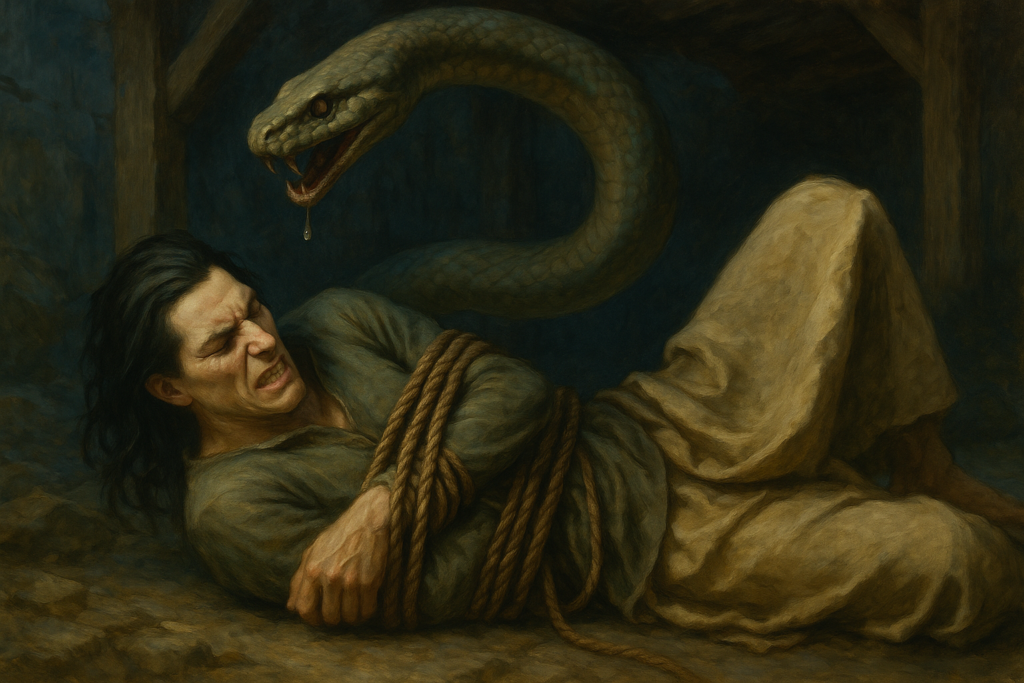
Only after Baldr’s death do the gods turn on Loki. In Snorri’s version, they capture him and punish him with extraordinary severity. One of his sons, Narfi or Nari, is slain; the other, Váli, is transformed into a wolf. The gods then use Narfi’s entrails to bind Loki to three stones. A serpent is placed above him, dripping venom onto his face. Loki’s wife Sigyn sits beside him, holding a bowl to catch the poison, but whenever she empties it the venom falls again and Loki convulses. Earthquakes are explained as the twisting of his pain.
This is the principal retelling used here because Snorri gives the most continuous narrative of both Baldr’s death and Loki’s binding. The Poetic Edda preserves related material, but in briefer and more fragmentary form. The poem Völuspá refers to Baldr’s death and to the terrible future of the gods, while Baldrs draumar focuses on Odin’s descent to question a seeress about Baldr’s fate. The binding of Loki itself is narrated in Snorri, not in a single complete Eddic poem.
Different versions and what they change
There are important differences between the sources. The Poetic Edda preserves older poetic voices, but it does not retell Baldr’s death in the same full sequence that Snorri does. Snorri’s Prose Edda is more explicit and coherent, but it is also a later prose synthesis, shaped by a Christian Icelandic author who systematised older material. In Vǫluspá, Baldr’s death appears as one event within a larger apocalyptic vision; in Snorri, it becomes the centre of a moral and cosmic drama. Saxo Grammaticus tells a different, euhemerised story in the Gesta Danorum, where Baldr and Höðr become rival heroes rather than gods, and Loki is not the same figure at all. Those versions should not be blended into one supposed original myth.
There is also a notable difference in emphasis. Some later retellings, and many modern summaries, make Loki’s binding sound like a direct and immediate punishment for killing Baldr. Snorri does make the connection clear, but the mythic sequence is more layered than that: Baldr dies, the gods seek vengeance, Loki is caught, and the punishment is tied to the larger divine crisis. The story is therefore about grief, guilt, revenge and the breaking point of the gods’ order, not simply about a criminal being locked away.
Why the myth matters
Baldr’s death is one of the clearest examples in Norse mythology of a world moving towards catastrophe. The gods know danger is coming, try to prevent it, and fail because of a small overlooked detail. Loki’s binding answers the murder with vengeance, but it does not repair the world. Instead it holds destructive forces in suspense until Ragnarök. In that sense, the myths of Baldr and Loki are linked not only by plot, but by theme: foreknowledge, fatal error, and punishment cannot prevent the unraveling of divine society.
The surviving texts do not let us hear the whole range of pre-Christian Scandinavian belief. They were written down centuries after conversion, in literary settings shaped by Christian learning and antiquarian interest. Even so, the story of Baldr’s death and Loki’s binding remains one of the most powerful myths from the North: a tale of beauty undone, treachery exposed, and vengeance that cannot restore what has been lost.
Sources and Further Reading
- Penguin Books: The Elder Edda (opens in a new tab)
- Penguin Books: The Poetic Edda, translated by Carolyne Larrington (opens in a new tab)
- Heimskringla.no: Balders död og Helfärd, translation of Snorri’s Baldr narrative (opens in a new tab)
- Cambridge University Press: The Lives and Deaths of the Norse Gods (opens in a new tab)