Lakshmi’s Emergence from the Ocean and the Meaning of Prosperity
When Lakshmi Rises from the Sea
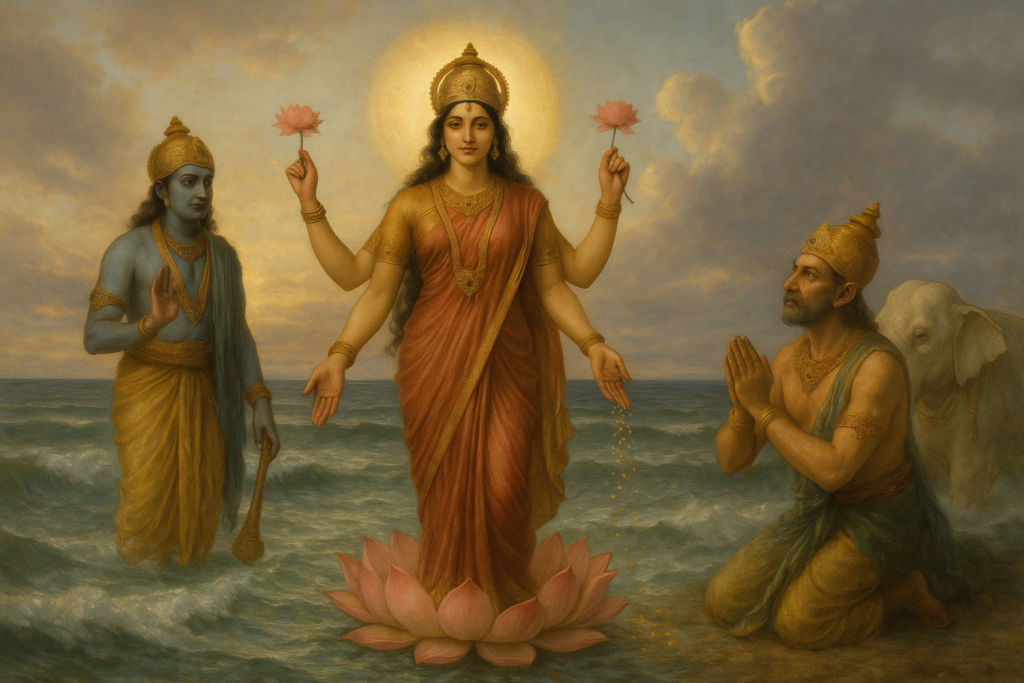
Among Hindu sacred stories, few images are as enduring as Lakshmi emerging from the ocean, seated on a lotus, radiant with beauty and promise. Her appearance in the churning of the cosmic sea is not just a dramatic episode in a larger myth: it is a compact vision of prosperity itself, and of the forces that make prosperity possible. In the best-known telling, preserved in the Vishnu Purana, Lakshmi rises from the Ocean of Milk during the gods’ and demons’ search for amrita, the nectar of immortality. Yet the story is more than a simple origin tale. It links abundance with labour, divine grace, right order and right use.
The churning of the Ocean of Milk
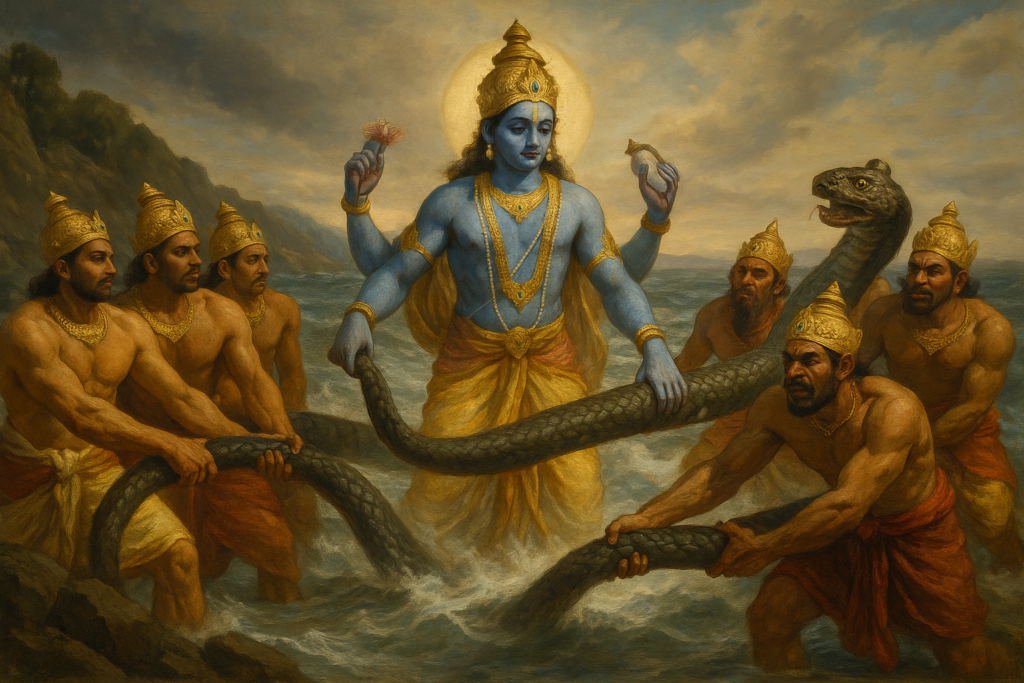
The central narrative comes from the Vishnu Purana, where the gods, weakened and dispossessed, seek a way to recover their strength. Vishnu advises them to join with the asuras, or demons, in churning the Ocean of Milk to obtain amrita. The mountain Mandara is used as the churning rod, the serpent Vasuki as the rope, and the sea is agitated until treasures begin to rise from its depths. The gods and asuras agree to share the work, though not necessarily the reward, and the story moves forward through effort, rivalry and divine intervention rather than through effortless gift.
As the sea turns, a sequence of marvels appears. The precise list varies across texts and retellings, but the Vishnu Purana includes precious things and beings emerging from the churn. Lakshmi comes after the process has already yielded many wonders. Her appearance is therefore part of a wider cosmological event, not an isolated miracle. She is not simply “found”; she is revealed when the ocean is made active, restless and generative.
In this telling, Lakshmi is also not an entirely new figure. The Vishnu Purana says she had earlier been born as the daughter of the sage Bhṛgu and his wife Khyati, and that she then emerged again from the sea at the churning. That double appearance matters. It suggests continuity between an already recognised goddess and the ocean-born splendour of the churning myth. The story is less about inventing Lakshmi than about showing her in a form worthy of universal reverence.
How Lakshmi is described when she appears
When Lakshmi rises from the ocean, she is the embodiment of auspiciousness. She is associated with beauty, fortune, fertility and royal splendour, but not in a narrow or merely material sense. In Hindu devotional language, prosperity can include wellbeing, fertility, good standing, order, success, beauty and the capacity for life to flourish. Lakshmi gathers these meanings together. She is often linked with the lotus, a flower that grows from water yet remains unstained by it, a fitting image for abundance that is present in the world without being reduced to greed or possession.
The Vishnu Purana also connects Lakshmi with Vishnu. In that tradition, she becomes his consort and remains with him as a sign of his completeness and auspicious power. This is an important point, but it should be stated carefully: not every Hindu tradition frames Lakshmi in exactly the same theological way, and not all devotional communities emphasise the same divine relationships. Still, in the Vishnu Purana’s own viewpoint, Lakshmi’s appearance is inseparable from Vishnu’s cosmic role. She does not simply arrive as a prize for the gods; she is recognised as the goddess who belongs with the preserver of the world.
Why the gods and demons both matter
One of the story’s most interesting features is that the gods do not produce prosperity by themselves. They need the asuras’ labour, and the asuras need the gods’ participation. The churning of the sea is a story of collaboration under pressure, even if the collaboration is unequal and unstable. That complexity is part of what gives the myth its force. Prosperity, the narrative suggests, is not merely a matter of divine favour dropped from the sky. It arises through effort, struggle, timing and the ordering of forces that are not naturally in harmony.
This is also why the amrita is so significant. Immortality is sought not as a private reward, but as a way of restoring cosmic balance. Lakshmi’s emergence belongs to this same moral universe. Prosperity is not just wealth in the modern sense. It is the condition in which life is sustained, auspiciousness is present, and the world remains capable of renewal. In that sense, Lakshmi represents a fullness of life rather than a ledger of possessions.
Prosperity as auspiciousness, not greed
The modern English word “prosperity” can suggest money and expansion alone, but Lakshmi’s world is broader. She is a goddess of good fortune, beauty, fecundity and flourishing household life. In religious practice and temple art, she is often honoured for bringing steadiness and wellbeing. This is one reason she appears so frequently in marriage contexts, domestic worship and images of kingship. Prosperity, in the Lakshmi tradition, is not admirable because it is excessive. It is valuable because it supports right living.
That understanding also explains why the myth has remained so resonant. The story does not celebrate riches detached from responsibility. Rather, it imagines abundance as something that should emerge from order and be guided by divine grace. Even Lakshmi’s beauty is inseparable from auspiciousness: she is beautiful because she signifies life’s right unfolding, not because beauty is treated as ornament alone.
Different tellings, same luminous figure
There are other traditions that speak of Lakshmi in related but not identical ways. Some texts and devotional traditions connect her more strongly with Vishnu’s various manifestations; others emphasise her independent power and status. Art from different regions may also show different accompanying figures and symbols. The British Museum, for example, preserves paintings of the churning of the milky ocean in which Lakshmi appears among a wide range of treasures drawn from the sea. Such works remind us that the myth has been retold visually as well as textually, and that artists often expanded the scene to include other wonders of cosmic abundance.
In scholarly and devotional literature alike, Lakshmi is sometimes described as an older fertility goddess whose identity was later articulated through the language of wealth and royal prosperity. That is a useful historical lens, but it should not be treated as a single, settled explanation for all traditions. What matters for readers of the myth is that Lakshmi is consistently understood as a source of auspicious abundance, whether the emphasis falls on fertility, beauty, household wellbeing or divine fortune.
Why the story still speaks clearly
Lakshmi’s emergence from the ocean remains compelling because it joins grandeur with restraint. The sea yields treasures, but only after labour, tension and risk. The goddess arrives not as noise or spectacle, but as a figure of ordered plenty: graceful, calm and radiant. The story offers a persuasive ancient insight into prosperity. It is not merely the possession of riches, but the presence of conditions under which life can thrive.
That is why the image of Lakshmi on the lotus has endured so powerfully in Hindu visual culture and religious imagination. She does not promise a world without effort or conflict. Instead, she embodies the hope that abundance can be made auspicious, shared and sustained.
Sources and further reading
- The Vishnu Purana, translated by Horace Hayman Wilson (Book I, Chapter IX) (opens in a new tab)
- Lakshmi, the Metropolitan Museum of Art (opens in a new tab)
- The Churning of the Milky Ocean, British Museum (opens in a new tab)
- The Arts of South and Southeast Asia, Metropolitan Museum of Art Bulletin (opens in a new tab)
Recommended reading
These are affiliate links. If you buy through them, we may earn a commission at no extra cost to you.
Hindu Myths: A Sourcebook Translated from the Sanskrit
Preserved in ancient Sanskrit texts like the Rig Veda and Mahabharata, Hindu myths date as far back as 1000 BCE. These seventy-five core stories feature Vishnu’s heroic avatars and youthful Krishna, along with tales of minor gods, demons, and sacred animals. Vibrant and expansive, they reflect a worldview encompassing cosmic creation, infinite earthly possibilities, and the universal touch of Death.

The Bhagavad Gita (Deluxe Hardbound Edition)
Compiled from the nine-volume Complete Works, this book brings together Swami Vivekananda's commentary on the Bhagavad Gita, systematically ordered by chapter and verse. Readers can study the original Devanagari verses and their English translations right alongside Vivekananda's illuminated perspective.
The Mahabharata
Rooted in ancient Indian literature, the Mahabharata is a cornerstone Sanskrit epic and a vital text of Hinduism. Beyond its sweeping narrative, it delves into the four key human pursuits—artha (purpose), kama (pleasure), dharma (duty), and moksha (liberation)—exploring how karma and self-identity shape an individual's connection to society and the universe.