The Labours of Hercules
Heracles, or Hercules in Latin, is the Greek hero whose reputation rests on endurance as much as strength. The famous Twelve Labours are not just a set of monster-slayings and feats of muscle: they are a story about guilt, service, ingenuity and survival. In the main mythic tradition, especially the account in Apollodorus’ Library, the labours begin after Heracles is driven into a murderous madness and end with a remarkable descent into the underworld.
How the labours began
The standard prose retelling comes from Apollodorus, though individual episodes also appear in tragedy, lyric poetry and later mythographers. In Apollodorus, Heracles kills his wife and children in a fit of madness sent by Hera. When he comes to his senses, he seeks guidance from Apollo’s oracle at Delphi. The oracle tells him to serve Eurystheus, king of Tiryns, for twelve years and perform the tasks imposed on him; only then will he become immortal. In this version, the hero is not starting a voluntary quest. He is working off a pollution crime and trying to earn a new place among the gods.
Apollodorus also preserves an important detail about the number of labours. Heracles was originally set ten tasks, but Eurystheus later rejected two of them, so the total became twelve. That is why different ancient authors sometimes count the list slightly differently. The familiar Twelve Labours are therefore the result of later adjustment, not a neatly planned package from the start.
The first four trials: lion, hydra, hind and boar
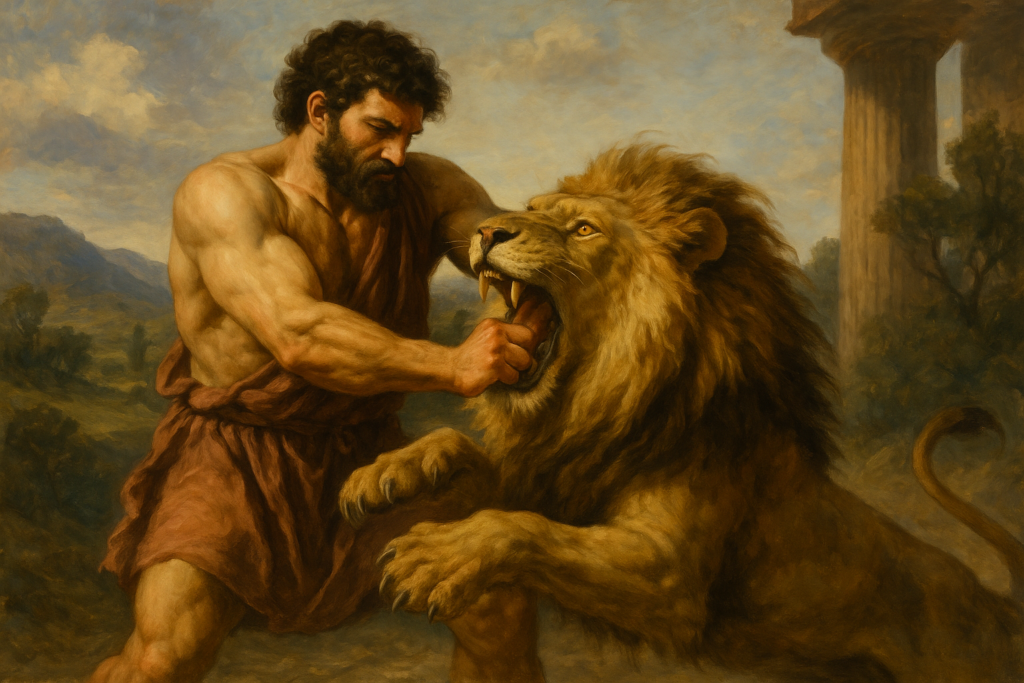
The opening labours establish the pattern. Heracles first brings back the skin of the Nemean lion, a beast whose hide cannot be pierced by ordinary weapons. He kills it by force and then wears its skin as protection, a visual emblem that became one of his defining attributes in Greek and Roman art. Next comes the Lernaean Hydra, a many-headed monster living in the marshes of Lerna. Here Heracles needs help: in Apollodorus, his nephew Iolaus cauterises the necks as they are cut, preventing the heads from regrowing. Eurystheus refuses to count this labour because Heracles had assistance.
The third and fourth tasks are less obviously spectacular but just as difficult. He is sent after the Ceryneian hind, sacred to Artemis and so swift that it can be caught only after a long pursuit. Then he captures the Erymanthian boar, driving it alive to Eurystheus. The king, so the story runs, is frightened by the animal and hides in a storage jar. The humour matters: the labours are not only tests of strength, but opportunities to humiliate the timid king who keeps setting them.
Cleaning, chasing and surviving the middle labours
The middle of the sequence shifts from monster-hunting to harder, more varied labour. Heracles cleans the Augean stables in a single day by diverting a river through them. Ancient sources do not always agree on the exact details, but the basic point is consistent: this is a task of practical intelligence, not brute force. Eurystheus again dismisses the achievement in some versions, arguing that Heracles had bartered for payment or relied on cleverness rather than toil alone.
He then drives off the Stymphalian birds, which are dangerous, metallic creatures in the mythic imagination, and captures the Cretan bull, a beast linked with King Minos and the island of Crete. After that come the horses of Diomedes, man-eating animals belonging to a savage Thracian king. Heracles overpowers them by feeding Diomedes himself to the horses. It is one of the harsher episodes in the cycle, and it shows how often the labours blur the line between civilising the world and matching violence with violence.
The ninth labour takes him to the edge of the known Greek world: he must obtain the girdle of Hippolyta, queen of the Amazons. Apollodorus’ version includes conflict, misunderstanding and the death of Hippolyta in the fighting, but other traditions vary in how much resistance Heracles meets. The tenth labour sends him further still, to the far western cattle of Geryon. There he kills the herdsman Eurytion, the two-headed dog Orthus and Geryon himself, then drives the cattle home across a long and hazardous journey. Later storytellers made much of this westward expedition, but Apollodorus gives it as one episode in a wider series of compulsory tasks.
Apples from the edge of the world
By the time Heracles reaches the eleventh labour, the world of the myth feels more cosmic than heroic. Eurystheus orders him to bring back the golden apples of the Hesperides. In Apollodorus, Heracles first seizes Nereus, the sea-god, and forces him to reveal where the apples are hidden. He also encounters Atlas, who temporarily takes up the burden of the sky while Heracles fetches the fruit. When Atlas tries to leave Heracles holding the heavens forever, the hero tricks him into taking the weight back. This is one of the cleverest stories in the cycle, and it shows how often Heracles succeeds through patience, bargaining or deception rather than force alone.
Here, too, different sources add different details. Some later tellings place more emphasis on Heracles’ journey through Libya or his meeting with the giant Antaeus, while others focus on Atlas. The important point is that the labour is a mythic journey to the edge of the world, where the hero has to find a way through a landscape shaped by divine and monstrous powers.
Descending into Hades for Cerberus
The twelfth and final labour is the most dramatic. Heracles must bring Cerberus, the hound of Hades, up from the underworld. In Apollodorus, he first goes to Eleusis to be initiated into the mysteries, because he needs ritual purification before entering the realm of the dead. He then descends through Taenarum in Laconia, one of the traditional entrances to Hades. There he finds the shades of the dead and, according to the same account, sees Theseus and Pirithous among them.
Cerberus is brought back alive, but only on the condition that Heracles subdues him without weapons. He grapples the beast, overcomes it by strength, and shows it to Eurystheus before returning it below. The labour is complete only because Heracles can enter death’s domain and come back again. That makes it an ending worthy of the whole cycle: the hero has not simply defeated monsters, but crossed a boundary that ordinary mortals cannot survive.
Greek story, Roman name, later retellings
For a general audience it is useful to keep the Greek and Roman traditions distinct. The Greeks called him Heracles; the Romans usually said Hercules. Roman authors such as Ovid retell parts of the cycle with their own emphases, and later art often blends versions together. That does not mean every detail belongs to the oldest Greek tradition. Apollodorus is the most useful single source for the sequence of the labours, but tragic poets, vase-painters and local cult traditions sometimes favour different episodes or add their own colour.
The labours also mattered beyond narrative. They were central to Heracles’ visual identity in Greek art, especially from the archaic period onwards, and they linked the hero to themes of endurance, purification and eventual divine status. In Greek religion he was still a hero, not simply a god, and that tension is part of what makes the story so compelling. Heracles is strongest when he is under pressure, and the labours turn suffering into fame.
That is why the Twelve Labours have lasted so well. They are not only a roll-call of feats, but a story of how a damaged hero is remade through impossible work, until the man who began in pollution ends by standing at the threshold of immortality.
Sources and further reading
- Apollodorus, Library, Book 2 (Perseus Digital Library) (opens in a new tab)
- The Labors of Herakles, The Metropolitan Museum of Art (opens in a new tab)
- British Museum: Sarcophagus depicting the birth and twelve labours of Hercules (opens in a new tab)
- The Labors of Hercules, Perseus Digital Library (opens in a new tab)
Recommended reading
These are affiliate links. If you buy through them, we may earn a commission at no extra cost to you.
Complete Greek Myths: An Illustrated Book of Greek Myths
Featuring detailed retellings, beautiful character illustrations, and cultural background, this comprehensive volume brings the best-known and obscure Greek myths to life for readers of all ages. Complete with maps, a glossary, and a QR code for pronunciation guides and extra resources, it is an essential addition to any family bookshelf.
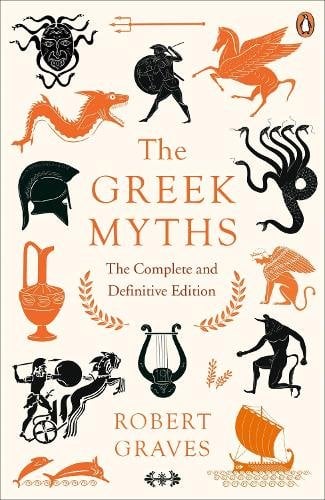
The Greek Myths: The Complete and Definitive Edition
Robert Graves’s definitive edition weaves the classic Greek myths, from the Labours of Hercules to the Trojan War, into one sweeping, authoritative narrative. Perfect for both first-time readers and classicists, this comprehensive volume combines engaging storytelling with detailed scholarly commentary and a complete index of names.
The Odyssey
Homer’s timeless epic The Odyssey follows the hero Odysseus on a perilous decade-long journey home from Troy, facing mythical monsters and divine wrath. Meanwhile, his wife Penelope and son Telemachus defend their kingdom against ruthless suitors in this classic tale of loyalty and endurance.