The Dagda in the Irish Mythological Cycle: Kingship, Plenty and Sacred Power
The Dagda in Irish mythological tradition
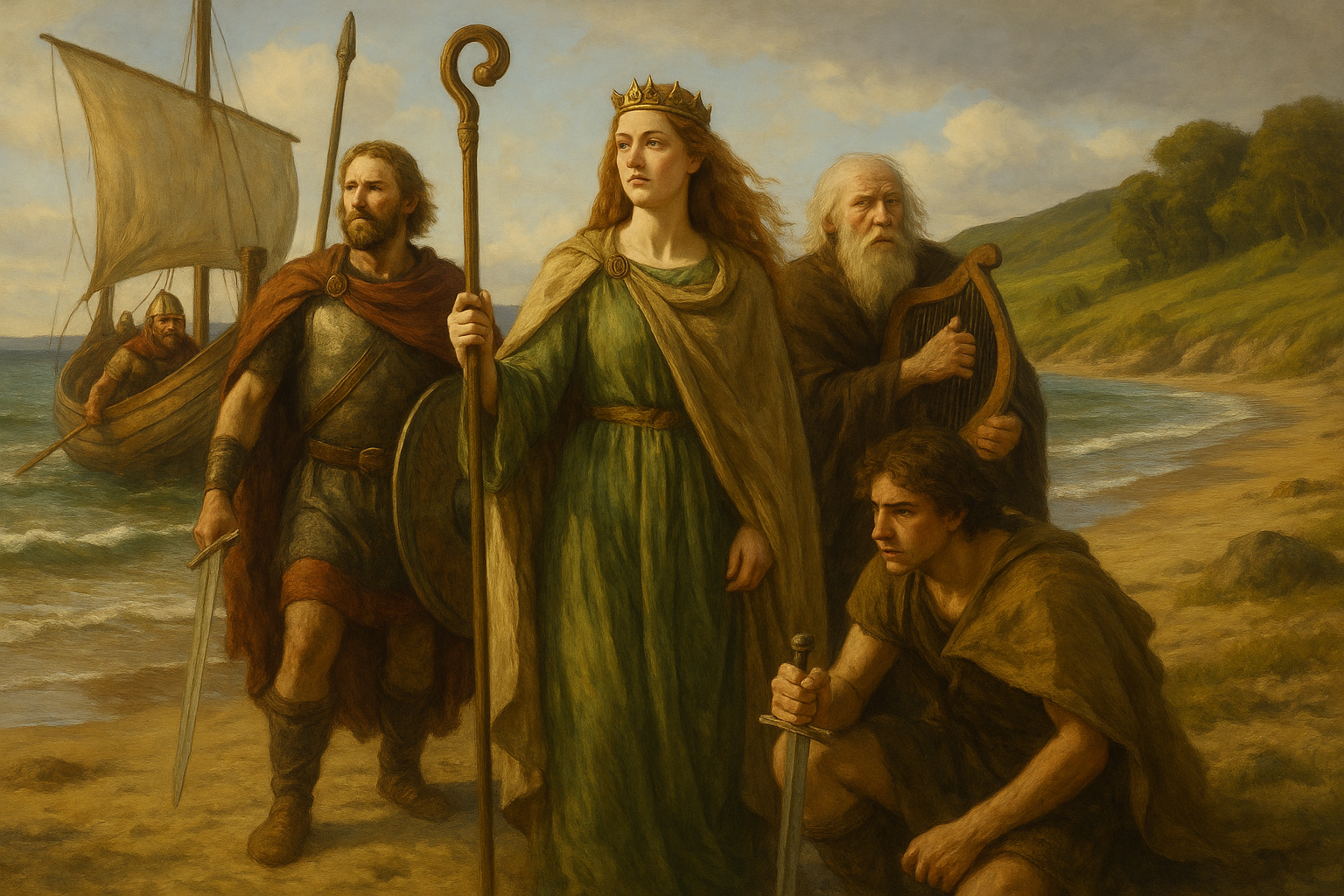
The Dagda is one of the great figures of the Irish Mythological Cycle, the body of medieval Irish narrative that preserves stories about the Túatha Dé Danann, the supernatural people who dominate Ireland’s earliest mythic past. He is usually presented as a god-like ruler, generous provider and formidable magician rather than as a sleek heroic warrior. In the surviving texts he is linked with kingship, plenty, cattle, the land and sacred authority: the powers needed to keep a world in balance.
Because these stories were written down by Christian scribes in the Middle Ages, they do not give us a transparent record of ancient religion. They do, however, preserve a powerful image of a divine figure whose influence reaches from battle and sovereignty to food, fertility and hospitality. The Dagda is not a generic “Celtic” god, but a specifically Irish one, known above all from texts such as Cath Maige Tuired and related learned traditions.
Who is the Dagda?
The name Dagda is commonly understood as meaning “the good god”, though “good” here suggests excellence, abundance or masterful competence rather than simple moral goodness. Medieval Irish sources also call him Eochaid Ollathair, “Eochaid the great father”, which hints at his role as a patriarchal, all-providing figure. He is associated with the Túatha Dé Danann, the principal supernatural community of Irish myth, and he appears as one of their leading members in the Second Battle of Mag Tuired.
In later tradition he is often treated as a father figure. He is linked with Brigit, with Aengus Óg and with other divine or semi-divine descendants in learned genealogies and tales. Those family connections should not be read too literally as a single coherent ancient family tree; they reflect the medieval Irish habit of organising mythic material through kinship, inheritance and learned genealogy.
Leader, labourer and master of the land
In Cath Maige Tuired, the Dagda is not merely a king in name. He is a practical leader who organises resources, negotiates with rivals and gets his hands dirty. Before the great battle against the Fomorians, he is shown working on fortifications and trenches. That detail matters: his authority is not abstract. It is expressed through labour, planning and the ability to make the land itself useful in a crisis.
The text also gives him a clear role in preserving the people’s food supply. When the Túatha Dé Danann prepare for conflict, he is the one who arranges to gather the cattle of Ireland into one place. That act turns him into a guardian of abundance as well as of sovereignty. Kingship in early Irish literature is never only about warfare; it is about ensuring that the land feeds the community, and the Dagda is one of the figures most closely associated with that obligation.
The battle of Mag Tuired and the war with the Fomorians
The principal narrative for the Dagda is the Second Battle of Mag Tuired, a mythological war between the Túatha Dé Danann and the Fomorians. In the surviving tale, the Fomorians represent hostile, disorderly power, while the Túatha Dé Danann stand for rule, skill and restoration. The Dagda’s role is central because he combines force with strategy.
One of the most striking episodes involves his encounter with the Fomorian champion Indech’s men and with the terrifying ruler Bres. The Dagda is not depicted as a swift, polished hero in the style of Cú Chulainn. He is large, powerful and deeply assured. His club is one of his characteristic weapons, and later tradition remembers the path it made through the battlefield as a landmark. The image is of a god whose strength is so great that the land itself bears traces of it.
Before the battle, the Dagda also acts as a negotiator. He goes to the Fomorian camp to seek a truce, and there he encounters a much darker aspect of mythic power: hostility, humiliation and the precariousness of rule. This is not a simple tale of good people defeating bad ones. It is a story about who has the right to command the land, and at what cost that command is secured.
The cauldron, the club and the harp
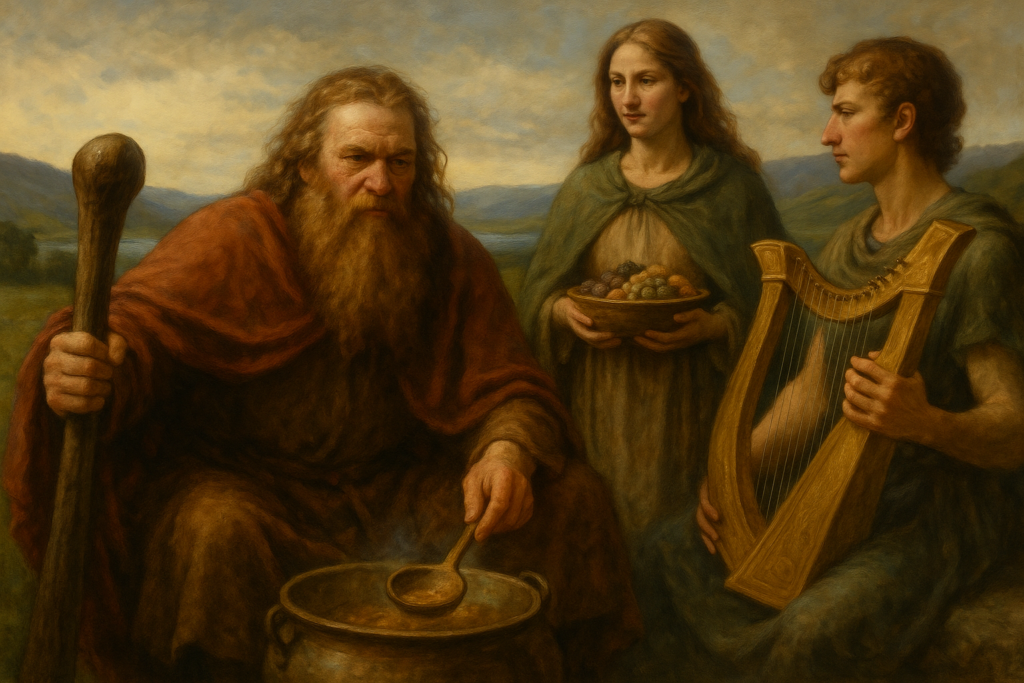
The Dagda is famous for three objects: a cauldron, a club and a harp. Together they sum up his personality in symbolic form. The cauldron is the vessel of abundance. In later interpretation it is often called the “undry” or “never-empty” cauldron, a fitting emblem for a god associated with plenty and hospitality. The club is an instrument of force, capable of killing on one end and restoring life on the other in some later retellings, though that particular function is not always explicit in the oldest narrative materials.
The harp is perhaps the most memorable of the three. In Cath Maige Tuired, the Fomorians seize the Dagda’s harper, Úaithne, and the Dagda later goes to retrieve it. The instrument responds to him with extraordinary obedience: when he calls it, it comes to him, and when he plays it, it can bring about emotional and physical effects among those who hear it. The story turns music into an extension of sovereign power. The Dagda is not only a warrior and provider; he is also the one who can command harmony.
These objects are best read as literary and symbolic expressions of his role. They should not be treated as a museum inventory of “what pagans believed” in any simple sense. Still, they are consistent across the tradition in a way that suggests a durable idea of the Dagda as a figure of provisioning, authority and controlled force.
Boann, fertility and the politics of the Otherworld
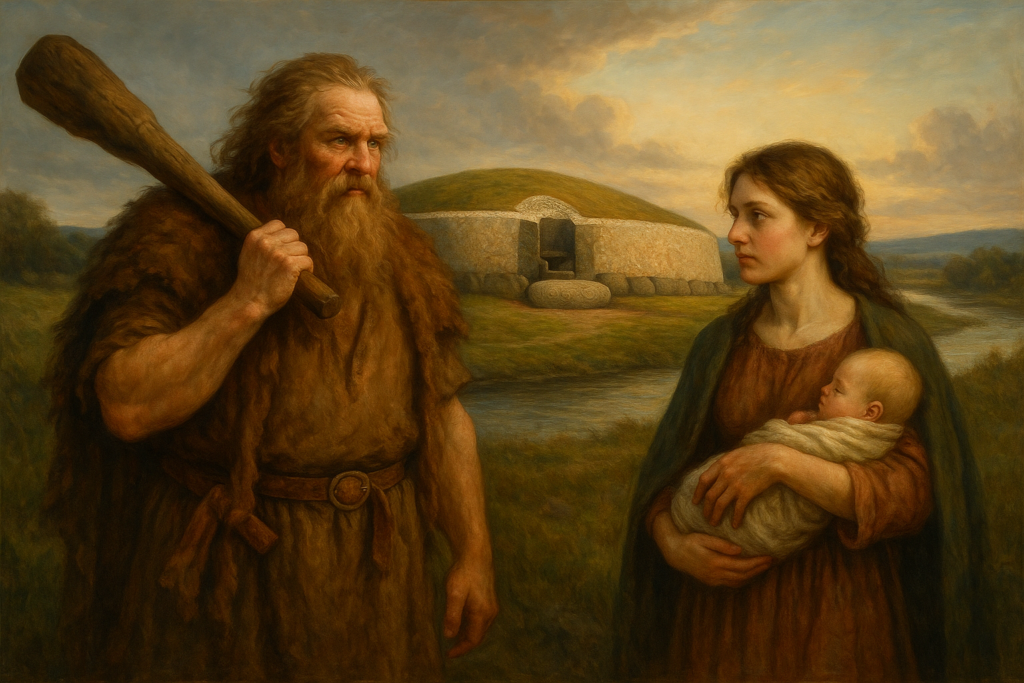
The Dagda’s importance is not limited to war. He is also tied to fertility and the Otherworld, especially in stories associated with Brú na Bóinne, the Boyne valley. One of the best-known traditions connects him with Boann, the river goddess of the Boyne. In medieval narrative and learned verse, their union leads to the conception of Aengus Óg. This is a myth of generation as well as of possession: from the encounter between divine force and the river-land comes a new figure of youth and beauty.
The same broad tradition places the Dagda at the heart of Brú na Bóinne, a place that medieval Irish writers understood as a mythic dwelling of the Túatha Dé Danann. Modern readers often associate this area with Newgrange, but it is important not to collapse archaeological site, medieval story and modern interpretation into a single seamless picture. The literature makes Brú a place of supernatural residence and inheritance; archaeology shows a remarkable prehistoric monument later reimagined through myth.
What the Dagda meant to medieval Irish writers
The Dagda’s literary profile tells us something important about medieval Irish thinking. He is not the detached creator-god of a monotheistic system, nor a one-note fertility spirit. Instead he gathers together several kinds of power that matter in a kingship-based society: command of food, command of land, command of music, command of battle and command of continuity through descent.
That makes him especially useful in stories about sovereignty. A good ruler must protect cattle, secure hospitality, withstand enemies and maintain the conditions in which the community can prosper. The Dagda embodies those duties in mythic form. He is immense, capable and sometimes coarse, but never merely comic. His roughness belongs to his strength; his generosity belongs to his authority.
For that reason he remains one of the most compelling figures in Irish mythology. He stands at the meeting point of plenty and power, of labour and magic, of sovereignty and song. In the medieval Irish imagination, that was a god worth keeping close to the centre of the story.
Sources and further reading
- Cath Maige Tuired: The Second Battle of Mag Tuired, translated by Elizabeth A. Gray (CELT, University College Cork) (opens in a new tab)
- The Winter solstice at Newgrange, National Museum of Ireland (opens in a new tab)
- Lebor Gabála Érenn: The Book of Invasions, edited and translated by R. A. S. Macalister (CELT, University College Cork) (opens in a new tab)
- “Le Dagda, dieu de l’orage du panthéon irlandais ?” by Pierre-Yves Lambert (Persée) (opens in a new tab)
Recommended reading
These are affiliate links. If you buy through them, we may earn a commission at no extra cost to you.
Celtic Druidry: Rituals, Techniques, and Magical Practices
Ellen Evert Hopman’s practical guide blends ancient Celtic wisdom with modern Reconstructionism, covering Druidic tools, cosmology, tree lore, and rituals. Packed with seasonal rites, Ogham divination, and protective charms, it offers everything needed to begin the Druid path.
Celtic Tales: Fairy Tales and Stories of Enchantment from Ireland, Scotland, Brittany, and Wales
Gathering tales from Ireland, Scotland, Brittany, and Wales, this illustrated collection features sixteen folklorist-transcribed stories brimming with magical creatures and timeless wit. Enhanced by Kate Forrester’s elegant silhouette artwork, it vividly transports readers to the enchanted realms of Celtic myth.
The Historical Atlas of the Celtic World
Featuring 54 vibrant full-color maps, this atlas comprehensively charts 3,000 years of Celtic history from Bronze Age origins to the modern global diaspora. Incorporating the latest research, it explores Continental, Atlantic, and contemporary Celtic cultures to trace their enduring legacy across Europe and beyond.