Brú na Bóinne in Irish Mythological Literature: Newgrange, the Dagda and the Boyne Tombs
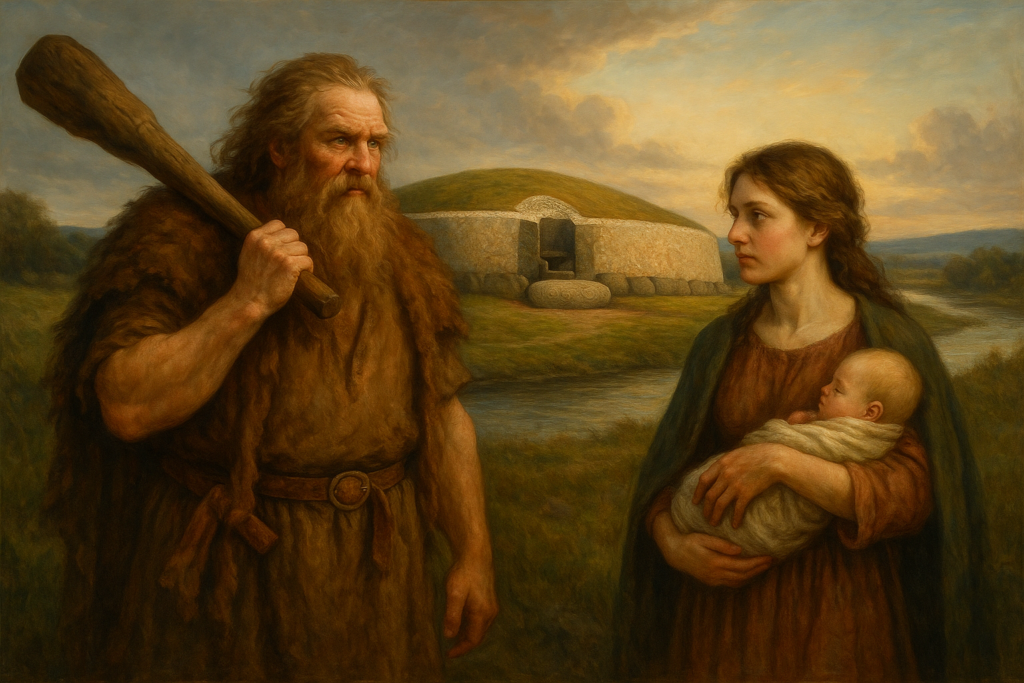
Brú na Bóinne, the great bend of the Boyne in County Meath, is one of the most celebrated places in Irish mythological literature. In medieval Irish narrative, it is not merely a landscape of prehistoric tombs but a powerful Otherworldly centre associated with the Tuatha Dé Danann, the Dagda, Boann and their son Aengus. The best-known literary account is the early Irish tale Tochmarc Étaíne (“The Wooing of Étaín”), where Brú na Bóinne becomes the setting for a sly act of divine possession, a miraculous birth and a struggle over who truly holds the place. That story belongs to medieval Irish literature, recorded by Christian scribes, yet it preserves a vivid memory of how the Boyne tombs were imagined in the mythic past.
The Boyne Tombs in Irish Mythic Geography
The Brú na Bóinne complex includes Newgrange, Knowth and Dowth, monumental passage tombs from prehistory. Irish mythological literature, however, does not present these as archaeological sites in the modern sense. Instead, they are cast as a princely or divine residence: a brú, meaning a dwelling-place, hall or mansion. In the literary imagination, the place belongs to the Tuatha Dé Danann, the supernatural people of Irish tradition, and especially to the Dagda, whose name in the texts is usually glossed as “the good god”. That phrase is a medieval explanation, not proof of a single fixed ancient cult, but it shows how writers understood his status.
This literary Brú is important because it links the surviving monuments to a dense mythic landscape. The Boyne is not treated as a neutral river valley but as a territory of memory, kinship and ownership. The stories attached to it are less about explaining the tombs’ construction than about claiming them for a divine past. That is one reason Brú na Bóinne became so central to later Irish placelore and antiquarian interpretation.
The Dagda, Eochaid Ollathair and the Hidden King
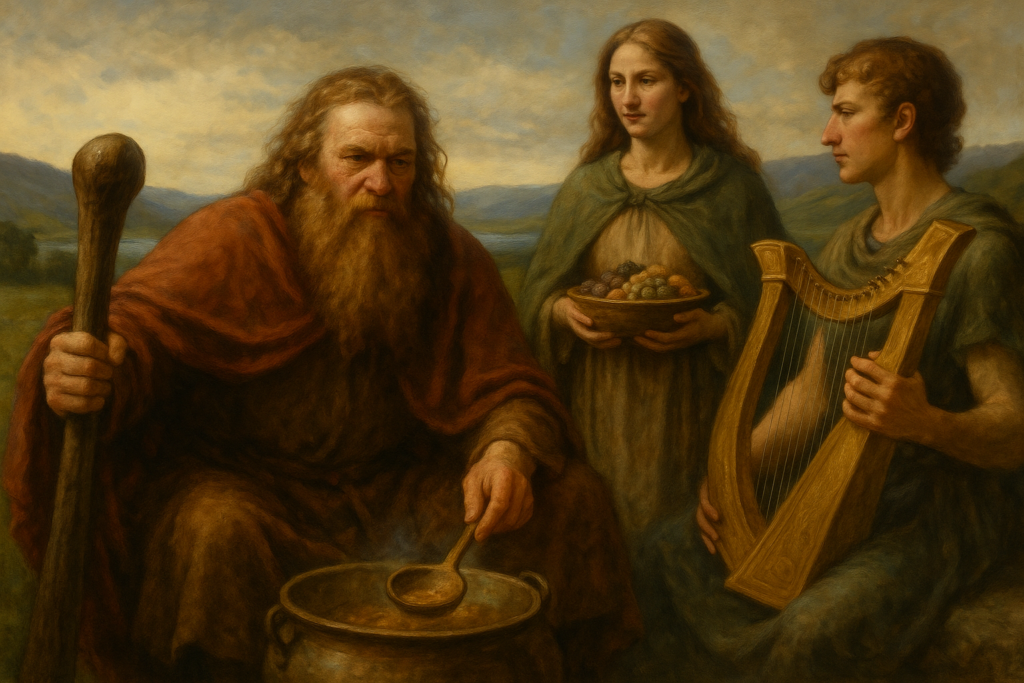
In Tochmarc Étaíne, the Dagda is introduced under another name: Eochaid Ollathair. The tale says he is a king of Ireland among the Tuatha Dé, and that his other name is the Dagda. This is a literary identification within the story, not a direct record of historical kingship. Still, it matters because the tale makes him the figure through whom Brú na Bóinne is first possessed in the mythic narrative. The Dagda is associated with fertility, abundance and power, and the tale connects him to the rhythms of night and day, growth and loss.
The principal version used here is the recension preserved in the CELT text of Tochmarc Étaíne, where the opening movement of the story centres on the Dagda’s desire for Elcmar’s wife, Boann, and on the birth of Aengus. Other summaries and later retellings often compress or rearrange these events, but the medieval tale itself gives a much more specific sequence.
Boann and the Taking of the Brú
The tale begins with Elcmar as the husband who occupies the Brú, and with Boann as his wife. The Dagda desires her and wins her while Elcmar is sent away. In one of the story’s most striking moves, the Dagda uses enchantment so that Elcmar’s absence seems to last a single day, though in truth nine months pass. During that concealed interval, Boann bears the Dagda’s son, Aengus. When Elcmar returns, he does not realise what has happened: Boann has recovered, and the Dagda’s trick has hidden the whole matter from him.
What makes this episode memorable is not simply the erotic intrigue but the issue of possession. The Brú is gained through artifice rather than battle. The Dagda does not storm the place; he outwits its current holder. That style of acquisition suits a tale concerned with sovereignty, fertility and control over sacred space. The divine child born from the union is not just a son but the sign that the Brú has changed hands within the story’s mythic logic.
Aengus and the Claim to the Brú
Aengus, also called Óengus or Mac Óc, is the son whose later role gives the Brú much of its fame. In Tochmarc Étaíne, he is not yet the full protagonist of a separate tradition; rather, he enters as the child born through the Dagda’s deception. Yet that birth is enough to establish him as the future heir of the place. The tale’s logic is straightforward: the Dagda’s son belongs to the Brú because his conception is tied to it, and because the place is already marked as the dwelling of the divine household.
Later Irish tradition often expands Aengus’s importance and treats him as the youthful lord of the síd, the supernatural mound or dwelling. Those later developments should be kept distinct from the core episode in Tochmarc Étaíne. In the principal tale, his significance lies chiefly in the fact that he is born from the Dagda’s liaison with Boann and thereby anchors the Brú in a dynastic and mythic genealogy.
What Tochmarc Étaíne Adds Beyond the Brú Story
Tochmarc Étaíne is not a single tale about Newgrange alone. After the opening Brú episode, it moves into the wider story of Étaín, Midir and Fuamnach, including transformation, loss and rebirth. The Brú narrative therefore belongs to a larger mythological framework in which relationships among the Tuatha Dé Danann, desire and the instability of identity matter as much as place. That wider plot helps explain why the tale preserves the Brú story at all: the location is part of a web of divine kinship and rivalry, not an isolated legend attached to a monument.
Elsewhere in the same tale, the Dagda also helps Midir’s son Mac Óc. This is a reminder that the text presents the Dagda not as a simple father figure but as a powerful, shifting actor in a network of obligations. The Boyne tombs belong within that network because they are tied to inheritance, hospitality and the authority of the supernatural elite.
Myth, Prehistory and Medieval Storytelling
The temptation is to read the myths as direct evidence for Bronze Age religion. That would go too far. The surviving story comes from medieval Irish literature, copied and shaped by Christian scribes, and it cannot be treated as an untouched record of prehistoric belief. At the same time, it would be equally misleading to dismiss the tale as mere invention. Medieval writers were working with inherited placelore, learned tradition and older conceptions of sacred landscape, even when they framed them in literary prose.
For that reason, Brú na Bóinne stands in Irish mythological literature as both place and symbol. It is a real valley with real monuments, but in the literature it also becomes a seat of divine power, a site of concealed birth and a landscape where ownership is won by cunning rather than force. The result is one of the most compelling intersections between archaeology and story in the Irish tradition.
That layered identity is what gives Brú na Bóinne its lasting fascination: not a single fixed meaning, but a meeting point between monument, memory and myth. The tombs stand in the landscape, and the literature keeps finding new ways to make them speak.
Sources and further reading
- Tochmarc Étaíne, translation and edition, CELT, University College Cork (opens in a new tab)
- Tochmarc Étaíne, Irish text and editorial material, CELT, University College Cork (opens in a new tab)
- Brú na Bóinne Visitor Centre, Heritage Ireland (opens in a new tab)
- “The Boyne: A Valley of Kings”, Newgrange.com (opens in a new tab)
Recommended reading
These are affiliate links. If you buy through them, we may earn a commission at no extra cost to you.
Celtic Druidry: Rituals, Techniques, and Magical Practices
Ellen Evert Hopman’s practical guide blends ancient Celtic wisdom with modern Reconstructionism, covering Druidic tools, cosmology, tree lore, and rituals. Packed with seasonal rites, Ogham divination, and protective charms, it offers everything needed to begin the Druid path.
Celtic Tales: Fairy Tales and Stories of Enchantment from Ireland, Scotland, Brittany, and Wales
Gathering tales from Ireland, Scotland, Brittany, and Wales, this illustrated collection features sixteen folklorist-transcribed stories brimming with magical creatures and timeless wit. Enhanced by Kate Forrester’s elegant silhouette artwork, it vividly transports readers to the enchanted realms of Celtic myth.
The Historical Atlas of the Celtic World
Featuring 54 vibrant full-color maps, this atlas comprehensively charts 3,000 years of Celtic history from Bronze Age origins to the modern global diaspora. Incorporating the latest research, it explores Continental, Atlantic, and contemporary Celtic cultures to trace their enduring legacy across Europe and beyond.