Geb and Nut in the Heliopolitan Sky Story
In the Heliopolitan creation tradition, Geb and Nut are not minor background figures. They sit at the heart of one of ancient Egypt’s most enduring ways of imagining the world: earth below, sky above, and a family of gods whose relationships explain why the cosmos is ordered as it is. Geb is the earth; Nut is the sky. Their story, especially as preserved in Heliopolitan and funerary texts, helped Egyptians think about kingship, rebirth and the daily movement of the sun.
The Heliopolitan family of gods
Heliopolis, near modern Cairo, was a major religious centre devoted to the sun-god Atum, later closely associated with Ra. In the Heliopolitan tradition, Atum brought forth Shu and Tefnut, and these two in turn produced Geb and Nut. Egyptian religion was never a single fixed system, and other creation accounts existed elsewhere in Egypt, but this genealogy is the principal one for the Heliopolitan Sky Story.
Within that tradition, Geb and Nut belong to the Ennead, the group of nine gods associated with Heliopolis. They are usually presented as brother and sister as well as husband and wife, a reminder that divine kinship in Egyptian myth does not follow modern family conventions. Their children are Osiris, Isis, Seth and Nephthys, figures who become central to later myths about kingship, death and renewal.
Why sky and earth had to be separated
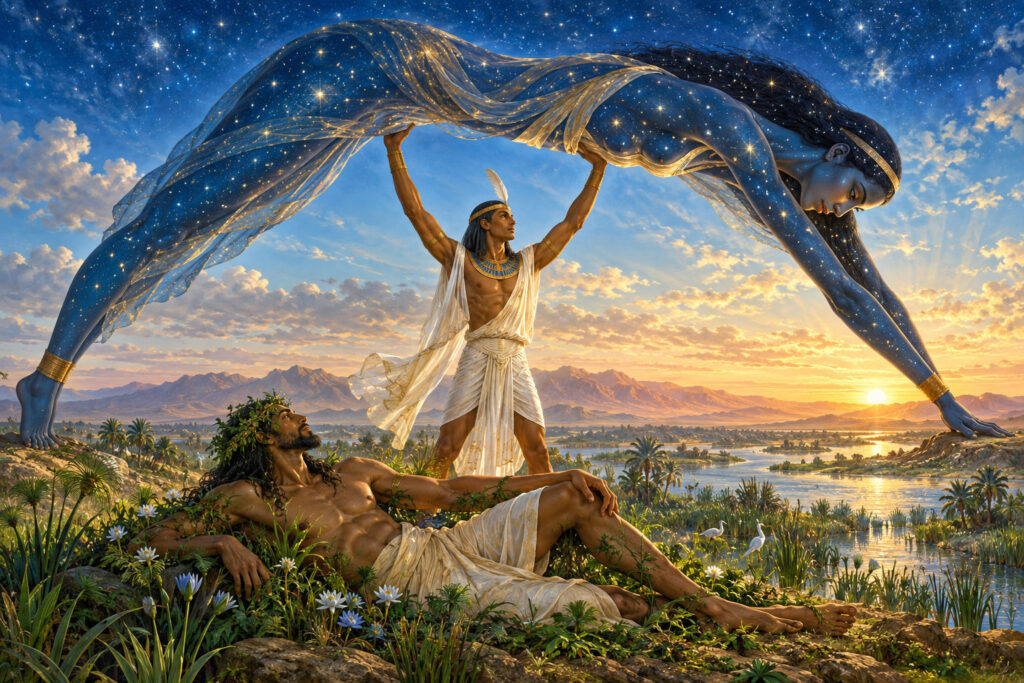
The best-known episode in the story is the separation of Geb and Nut by their father, Shu. In Heliopolitan cosmology, the sky and the earth were once joined in intimacy. Shu, the god of air and space, lifted Nut away from Geb and held her aloft, creating the gap that makes the world inhabitable. This is one of the most important images in Egyptian religious art: Nut arched overhead like a star-speckled vault, while Geb lies beneath her as the earth.
The separation is not a tale of punishment so much as a cosmological necessity. Space had to exist for life, light and motion. In some later artistic and textual traditions, Shu is shown physically supporting Nut, while Geb remains stretched out below. The image is simple, but its implication is large: order depends on keeping the major elements of the cosmos in their proper places.
Nut’s cycle with the sun
Nut is more than a sky dome. She is also a figure of cosmic renewal. In Egyptian funerary and solar belief, she swallows the sun at night and gives birth to it again at dawn. This idea appears in different forms across Egyptian texts and imagery, and it connects the sky goddess with the daily rebirth of light. The cycle is not merely poetic: it expresses a religious understanding of how creation continues every day.
In some funerary scenes, Nut is shown as a protective figure spanning coffins or tomb ceilings, her body covered with stars. This imagery made her especially important in contexts of rebirth and safe passage into the afterlife. The deceased hoped to come under Nut’s protection just as the sun passed through her body and emerged renewed.
Geb as earth, fertility and stability
Geb is usually understood as the male earth god. Egyptian art often depicts him lying on his back, sometimes with plants or birds associated with him, a visual way of showing the living land. The earth was not inert matter in Egyptian thought. Geb could be linked with fertility, vegetation and the annual promise of growth.
He was also associated with authority and inheritance. As the earth beneath human and divine life, Geb could function as a guarantor of legitimate rule, especially in later myths where royal succession becomes important. The earth is what holds, receives and supports; Geb’s role was therefore both material and symbolic. He was part of the stability that allowed Egypt to exist as an ordered world rather than a chaotic one.
The children of Geb and Nut and the next divine drama
Geb and Nut matter not only because they are the parents of the sky and earth’s most famous gods, but because their children drive one of Egypt’s great mythic cycles. Osiris, Isis, Seth and Nephthys emerge from their union, and from them comes the story of Osiris’ murder, Isis’ search for his body, Horus’ struggle for kingship, and the wider drama of death and restoration.
It is worth keeping the stories distinct. The Heliopolitan account of creation does not, by itself, tell the full Osiris myth. That later narrative belongs to a broader and more developed mythic tradition, with versions preserved in different texts and, much later, in Greek authors such as Plutarch. In Egyptian religion, though, the family line from Geb and Nut to Osiris and Isis made the cosmos feel genealogically coherent: the structure of the world and the fortunes of kingship were linked through divine descent.
What the ancient sources actually show
The story of Geb and Nut survives in fragments and repeated images rather than in one neat, continuous narrative. The Pyramid Texts, Coffin Texts and later funerary compositions preserve references to Nut as a sky goddess and to Geb as earth, while Heliopolitan theology places them within the Ennead. The idea of Shu standing between them is especially familiar from artistic and textual tradition, though the exact emphasis varies from source to source.
That variation matters. Egyptian tradition was additive rather than fixed: later texts could elaborate older ideas, and local cults could foreground different divine relationships. So when modern retellings speak of a single “Egyptian creation myth”, they flatten what was actually a family of related but not identical traditions. Heliopolis gave Geb and Nut their classic place in the cosmic order, but it did not erase other Egyptian accounts.
Why the story endured
Geb and Nut remained powerful because their myth was both simple and flexible. It explained the visible world — earth below, sky above, sun moving through darkness and light — while also offering a religious language for regeneration. That made the pair useful in temple theology, funerary art and royal ideology alike.
For the ancient Egyptians, the sky was not empty space and the earth was not dead matter. They were living divine presences in a family that held the cosmos together. Geb and Nut gave that world shape, and in doing so they helped Egyptians imagine that life, death and renewal were parts of one continuing order.