Athena, one of the most revered deities in Greek mythology, embodies a complex interplay of wisdom, warfare, and patronage. As the daughter of Zeus and Metis, she emerged fully grown and armored from her father’s forehead, symbolizing her dual nature as both a warrior and a goddess of wisdom. Her attributes and myths highlight her significance in ancient Greek culture, particularly in the city-state of Athens, where she was celebrated as the city’s patroness.
Wisdom and Knowledge
Athena is often associated with intelligence, strategy, and the arts. Unlike her counterpart Ares, who represents chaotic and brute force in warfare, Athena symbolizes disciplined, strategic combat. Her wisdom extends beyond military matters; she is also the goddess of crafts, particularly weaving. The myth of Arachne serves as a poignant example of her wisdom and just nature; when Arachne, a mortal weaver, challenged Athena to a contest and won, Athena transformed her into a spider instead of punishing her violently, thus teaching a lesson about hubris and reverence for the gods.
Athena’s association with wisdom is further reflected in her role as a counselor. She appears in numerous myths providing guidance and support to heroes like Odysseus, whom she helps navigate the challenges of the Trojan War and his long journey home recorded in Homer’s “Odyssey.” In this epic, her strategic intervention highlights her role as a protector of those who embody cleverness and intelligence.
Warfare and Strategy
Athena’s martial aspect does not glorify the chaos of battle but rather promotes the virtues of strategy, discipline, and justice. In the “Iliad,” she plays a pivotal role in assisting the Greeks against the Trojans, intervening at key moments to turn the tide of battle in favor of those who demonstrate courage and fairness. Unlike Ares, whose presence in battle is often chaotic and destructive, Athena represents a calculated, controlled approach to warfare.
Her iconic armor—the Aegis, a protective cloak adorned with the head of the Gorgon Medusa—serves both as a symbol of protection and a reminder of the consequences of unchecked aggression. The shield is said to inspire fear in enemies, symbolizing her role as a protector of cities and civilization itself.
Patronage of Athens
Athena’s most significant legacy is her patronage of Athens, a city-state that named itself in her honor after she won a contest against Poseidon. The myth recounts how both deities offered gifts to the citizens of the city. Poseidon struck the ground with his trident, producing a saltwater spring, while Athena presented an olive tree, symbolizing peace and prosperity. The citizens chose Athena’s gift, establishing her as the protector of Athens and leading to the establishment of the Parthenon, a temple dedicated to her.
The Parthenon, with its intricate sculptures and grand architecture, stands as a testament to her enduring influence. The temple not only served as a place of worship but also as a cultural symbol of Athenian identity, democracy, and artistic achievement. The regular festivals and offerings made to her, such as the Panathenaea, celebrated her virtues and reinforced her integral role in Athenian society.
Representations in Art and Literature
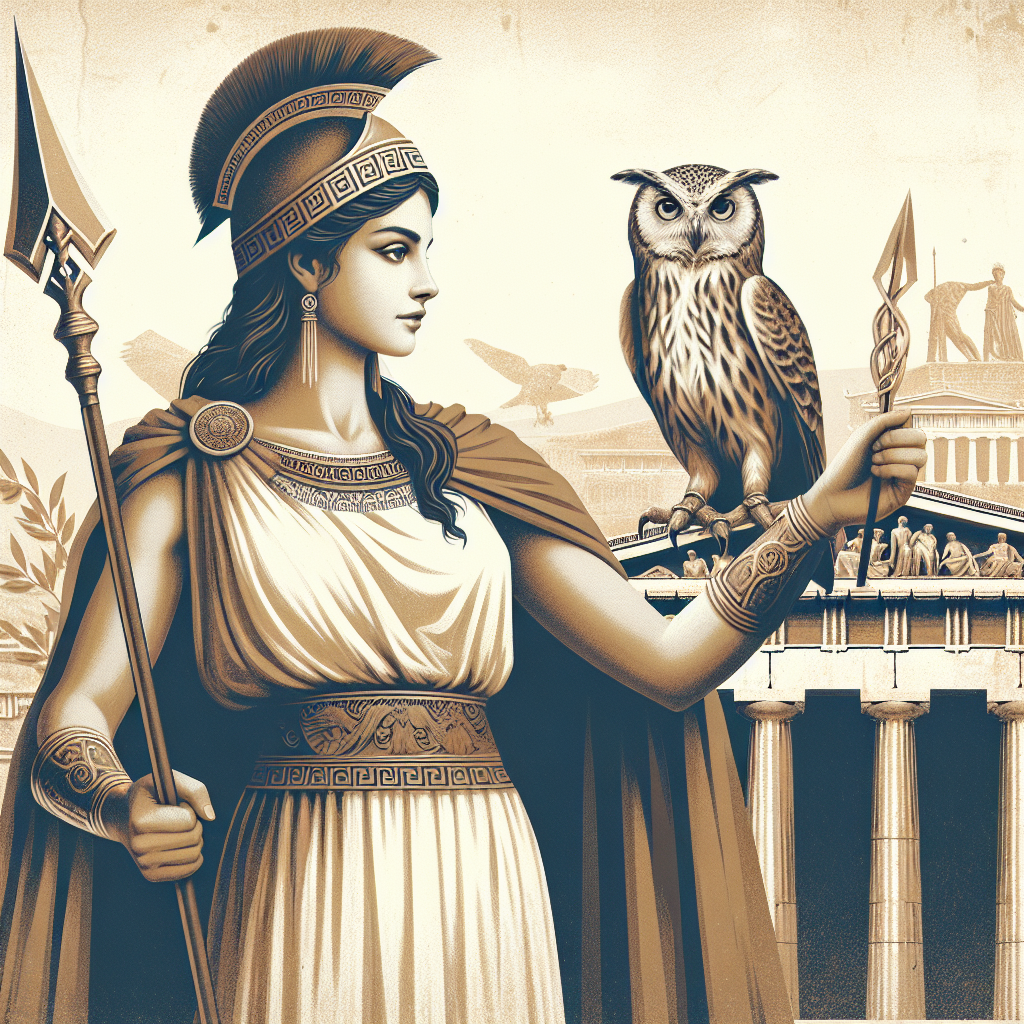
Athena’s imagery in classical art is as diverse as her attributes. She is often depicted wearing a helmet and wielding a spear, her eyes reflecting both wisdom and authority. The famous statue of the Athena Parthenos, created by Phidias, captured her grandeur and strength, standing as a symbol of Athenian values and ideals.
In literature, Athena’s appearances are consistent with her attributes. Her wisdom is often portrayed through her interactions with heroes, her strategic interventions mirroring the values of intelligence and planning that were revered in Greek society. Her role in various myths underscores the fundamental Greek belief in the importance of intellectual prowess and cunning, particularly in times of conflict.
Modern Interpretations and Legacy
The legacy of Athena extends beyond the confines of ancient Greece. In modern times, she continues to be a source of inspiration in various fields. Her representation of wisdom and warfare has found resonance in contemporary discussions about feminine power, leadership, and ethics in conflict. Athena’s embodiment of strategic thinking in politics, law, and the arts serves as a model for modern leaders and thinkers.
Moreover, she remains a prominent figure in popular culture, seen in literature, films, and video games. However, these modern portrayals often reinterpret her character, sometimes eclipsing the nuances of her ancient depictions. Efforts to reconcile these interpretations with the complexities of her character reflect a broader cultural conversation about the role of female figures in both history and mythology.
Conclusion
Athena stands out in the pantheon of Greek mythology as a multifaceted goddess who embodies wisdom, strategic warfare, and patronage. Her legacy, built on a foundation of intelligence, strength, and artistic excellence, continues to inspire admiration and respect. The duality of her nature as a warrior and sage attracts scholars and enthusiasts alike, ensuring that her story resonates across generations.
From her strategic interventions in ancient battles to her role as the guiding spirit of Athens, Athena represents the ideal balance of intellect and power—a balance that remains crucial in today’s world. As civilizations grapple with the complexities of leadership and conflict, the qualities embodied by Athena remind us of the lasting significance of wisdom and strategy in the pursuit of virtue and justice.