
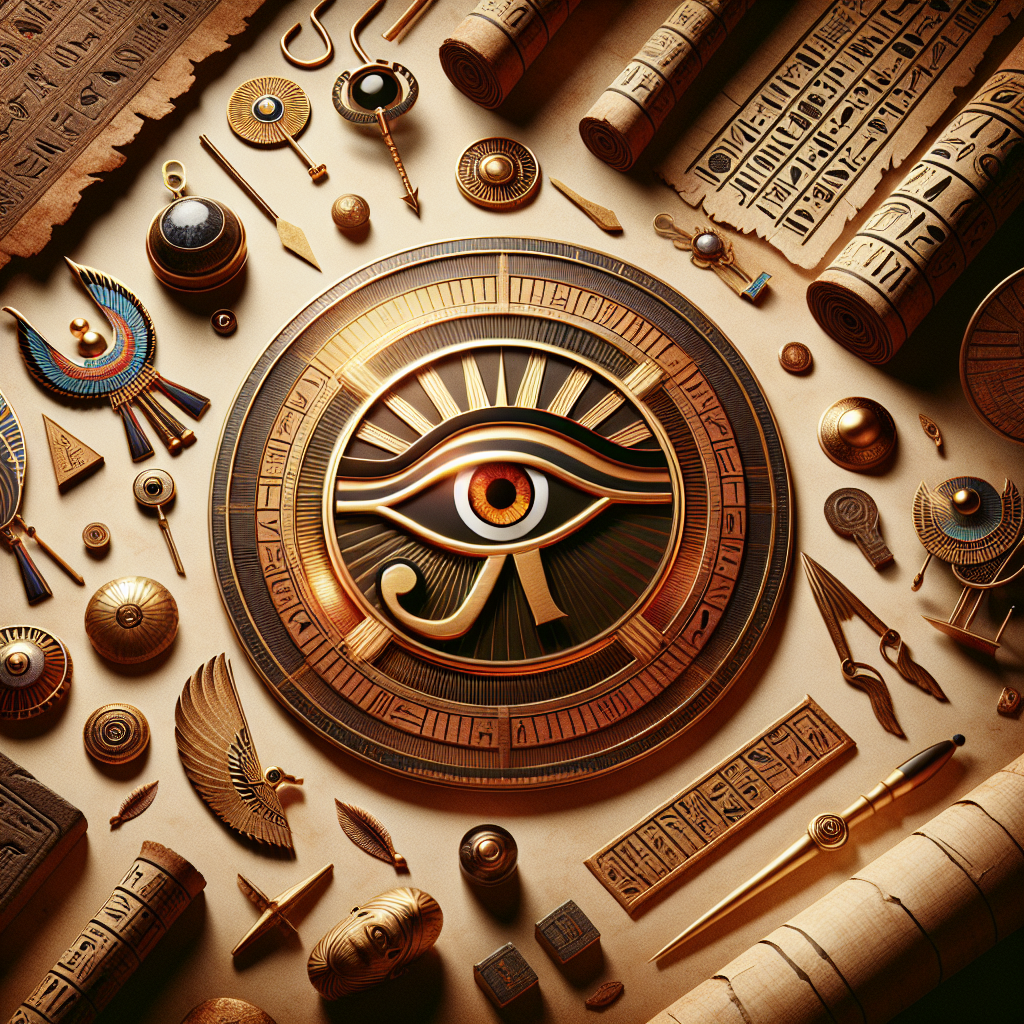
The Symbolism of the Eye of Horus: Protection and Power
The Eye of Horus, an ancient Egyptian symbol, resonates with profound meaning and significance, representing protection, power, and health. This icon has captivated historians, archaeologists, and enthusiasts of mythology for centuries. Often depicted as a human eye with distinct markings, the Eye of Horus holds a prominent place in Egyptian cosmology, art, and culture. This article explores the rich symbolism of the Eye of Horus, its historical context, and its contemporary relevance.
Historical Context
The Eye of Horus originates from Egyptian mythology, where it is associated with Horus, the falcon-headed god of the sky and kingship. Legend has it that Horus lost his left eye during a battle with Set, the god of chaos and disorder. This eye was later restored by Thoth, the god of wisdom and writing, symbolizing completeness and healing. The Eye of Horus thus embodies the dual nature of existence: light and darkness, order and chaos, life and death.
Historically, the Eye of Horus became a powerful amulet for protection in ancient Egypt. It was often worn by pharaohs and soldiers in battle, believed to guard them against evil influences and ill fortune. The symbol also appeared in funerary art and artifacts, intended to help the deceased navigate the afterlife and gain favor in the judgment of Osiris.
Symbolism of Protection
One of the most significant interpretations of the Eye of Horus is its association with protection. The ancient Egyptians believed that the Eye had the power to ward off evil spirits and bring safety to its bearer. This is particularly relevant in the context of funerary practices. Hieroglyphs and illustrations frequently depicted the Eye of Horus on tombs, been seen as a guardian that would watch over the souls in the afterlife.
The eye’s protective qualities extend to more than just physical safety. It is deeply intertwined with the idea of spiritual vigilance. The constant gaze of the Eye of Horus is a reminder to attendees of the eternal watchfulness of the gods, providing assurance and divine protection against the unknown forces of chaos and harm. This vigilant watch is akin to the concept of a guardian angel in other religious traditions.
Symbolism of Power
Beyond protection, the Eye of Horus also symbolizes power and authority. In ancient Egypt, the eye was associated with the ruling elite and the divine right of kings. The pharaohs, viewed as living gods, often utilized the symbol to assert their dominance and connection to the divine. It reinforced the belief that their reign was sanctioned by the gods, enhancing their status and legitimacy among the populace.
In a broader sense, the Eye of Horus reflects human aspirations for strength and control. The struggle for power, whether in political, social, or personal contexts, has been a salient theme throughout human history. The Eye serves as a reminder of the balance needed between power and responsibility; true strength lies not just in might, but in the wisdom to use that power judiciously.
Mathematical Significance
Interestingly, the Eye of Horus also incorporates mathematical association. Its parts—representing fractions of the whole—were used in ancient Egyptian measurements and calculations. Each section of the eye corresponds to a specific fraction: the pupil, for instance, represents 1/2, while other sections represent 1/4, 1/8, 1/16, and so forth, symbolizing the wholeness of life and the interconnectedness of all things. This mathematical symbolism further solidifies the notion of balance in various aspects of life, echoing the dual nature of existence found elsewhere in Egyptian philosophy.
Cultural Relevance
The emblematic significance of the Eye of Horus transcends ancient Egypt and continues to permeate modern culture. In contemporary society, it has become a symbol of protection and insight, frequently appearing in jewelry, tattoos, and artwork. The eye’s ability to evoke a sense of vigilance and awareness resonates with the modern desire for self-protection and empowerment.
Furthermore, the symbol has garnered attention in various spiritual and esoteric traditions. It represents the awakening of consciousness and the journey toward enlightenment. Many people embrace the Eye of Horus as a spiritual tool, using it to invoke protective energies in their daily lives or to navigate personal challenges.
The Eye of Horus in Art and Literature
Throughout history, the Eye of Horus has inspired countless artists and writers, becoming a recurring motif in various forms of artistic expression. In literature, the eye often symbolizes deeper truths, insight, and the quest for knowledge. It invites scholars and aficionados to explore the hidden meanings behind the façade of life and existence.
In visual arts, the eye has been used in countless works to depict themes of protection, vigilance, and divinity. From ancient artifacts to contemporary pieces, artists have harnessed its potent symbolism to communicate complex narratives and ideas.
Conclusion
The Eye of Horus stands as a powerful emblem, rich in symbolism and meaning. Representing protection, power, and insight, it serves as a reminder of the ancient Egyptian understanding of existence—a balance between chaos and order, the visible and the hidden, the mortal and the divine. As we move through our lives, the Eye of Horus continues to inspire us to seek protection against negativity, assert our power thoughtfully, and remain vigilant in our quest for understanding. Its legacy, stretching from the sands of ancient Egypt to modern consciousness, endures as a testament to the human spirit’s eternal struggle for balance and enlightenment. Whether seen as a protective talisman or a representation of power, the Eye of Horus remains a compelling symbol for generations.


