The Tuatha Dé Danann and the Mythic Invasion of Ireland
The Tuatha Dé Danann and the Mythic Invasion of Ireland
The Tuatha Dé Danann are one of the best-known peoples in Irish mythology: a brilliant, otherworldly race who arrive in Ireland in the mythic histories preserved by medieval Irish writers. Their story belongs to the Irish tradition, not to all Celtic-speaking peoples in general, and it survives chiefly in texts written down centuries after the pagan Iron Age. That matters, because these tales are not simple records of ancient belief; they are literary narratives shaped by Christian-era scribes, scholars and poets. Even so, they preserve a vivid and coherent mythic vision of Ireland as a land repeatedly claimed, contested and remade.
A people from the northern isles
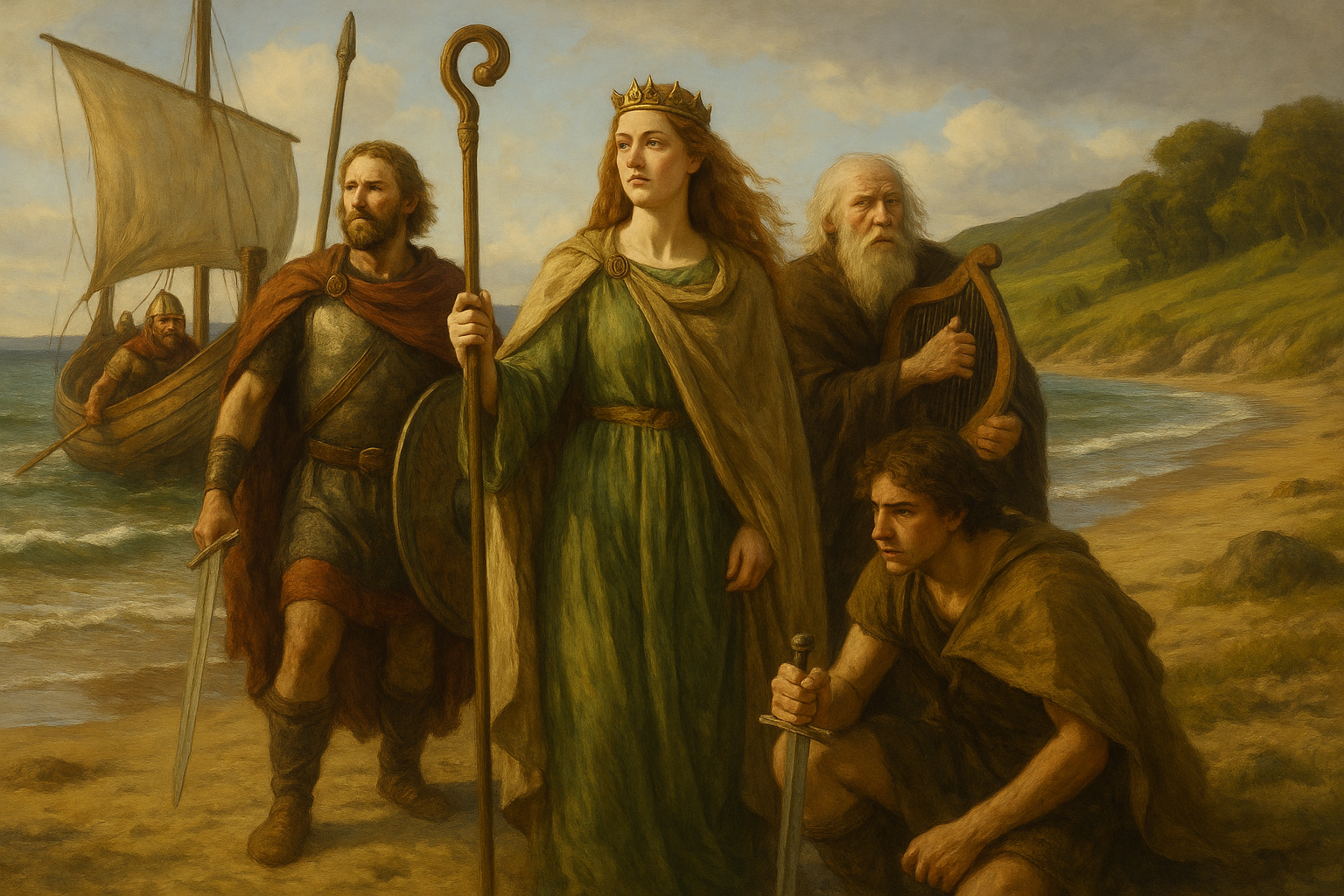
The principal version of the Tuatha Dé Danann’s arrival is found in the Irish pseudo-historical tradition, especially Lebor Gabála Érenn (“The Book of the Taking of Ireland”), with related material in other texts. In that account, the Tuatha Dé Danann come to Ireland from “the northern islands of the world”, bringing with them wisdom, craftsmanship and supernatural skill. Medieval commentators often present them as one settlement among several in a sequence of invasions, but the mythic force of the story lies in the contrast between these newcomers and the people already in the land.
The name itself is often understood as “the peoples of the goddess Danu”, although Danu is not a securely established goddess in the surviving narrative sources. The texts more securely present the Tuatha Dé Danann as a powerful collective of divine or semi-divine beings associated with sovereignty, skill and the Otherworld, rather than as a neatly defined pantheon in the later, classical sense.
The Fir Bolg and the first settlement of Ireland
In Lebor Gabála Érenn, Ireland is first occupied by the Fir Bolg, who hold the island before the Tuatha Dé Danann arrive. The newcomers ask for the island to be shared with them, but the Fir Bolg refuse. What follows is not simply a battle of conquest, but a struggle over rightful possession, kingship and honour. The land itself is the central prize.
The two groups agree to meet at Mag Tuired, the Plain of Towers or Battle-Plain, where the Tuatha Dé Danann defeat the Fir Bolg. Their victory establishes them as rulers of Ireland within the logic of the mythic narrative. Yet the triumph is not entirely straightforward. In some versions of the tradition, the Fir Bolg survive as a separate people after their defeat, which reminds us that these medieval tales often preserve layered and sometimes contradictory memories rather than a single fixed storyline.
Núadu, the broken arm and the problem of kingship
One of the most important figures in the early history of the Tuatha Dé Danann is Núadu, their king. At Mag Tuired he loses an arm in battle. In the social imagination of the tale, this is a serious matter: a king must be physically whole, because bodily perfection and lawful sovereignty are closely linked. Núadu therefore loses the kingship, even though he remains a central figure among his people.
His replacement is Bres, whose rule becomes disastrous. In Cath Maige Tuired (“The Second Battle of Mag Tuired”), Bres is linked by kinship to the Fomorians, another supernatural group who represent hostility, disorder and oppressive force in the story. Under Bres, the Tuatha Dé Danann suffer exploitation and humiliation. The tale famously describes how their labour is exacted and their hospitality diminished. The point is not just that Bres is a bad king, but that bad kingship distorts the proper relation between ruler and people.
The Fomorians and the crisis under Bres
The Fomorians are not simply “the bad side” of a neat mythic divide. In the surviving texts they are a difficult and changing group: sometimes hostile sea-raiders or monstrous adversaries, sometimes relatives or political rivals of the Tuatha Dé Danann. In Cath Maige Tuired, their pressure upon Ireland becomes a test of the Tuatha Dé Danann’s unity and resilience.
Bres’s rule brings the crisis to a head. The Tuatha Dé Danann’s champions are shamed, and the land is burdened by tribute. The story presents this as a social and cosmic imbalance. Kingship without justice cannot last, and prosperity depends on proper leadership as much as on military strength.
Lugh arrives and the battle at Mag Tuired
The turning point is the arrival of Lugh, who comes to Tara and proves his mastery at every art until he is admitted into the court of the Tuatha Dé Danann. He is not merely a warrior; he is a figure of complete competence, associated with many skills and with decisive action. In Cath Maige Tuired, Lugh becomes the leader who can restore order. He asks whether there is anyone with a skill superior to every craft, and his wide-ranging abilities mark him out as the one man capable of confronting the Fomorians.
The Tuatha Dé Danann then prepare for the second battle of Mag Tuired. This is the central martial episode of the tradition. The combat is dramatic and violent, but it is also strategic and symbolic. Craftsmen, healers and warriors all play their part. The Dagda, one of the most important members of the Tuatha Dé Danann, is a major figure in the conflict, and so are Goibniu the smith and Dian Cécht the healer. Their powers matter because the tale is not just about brute force; it is about the whole social body of the people at war.
In the battle, Lugh kills the Fomorian king Balor, whose destructive eye threatens devastation when opened. Balor’s defeat is one of the most striking episodes in Irish mythic narrative, but it should be read as part of the tale’s dramatic economy rather than as a straightforward survival of ancient cult myth. It is a story about the overthrow of oppressive power and the restoration of rightful order. With Balor dead and the Fomorians broken, the Tuatha Dé Danann win control of Ireland once again.
After victory: immortality, retreat and the síd
Even after their victory, the Tuatha Dé Danann do not remain visible rulers in an ordinary historical sense. Later Irish tradition associates them increasingly with the síd — the mounds, hills and hidden places of the Otherworld. This is not the same thing as saying they “became fairies” in the modern sense. Rather, the texts place them in a realm of concealed power, where they continue to exist beyond normal human society. In some stories they are diminished, in others they remain mighty, but in either case they are no longer presented simply as mortal kings on the surface of Ireland.
This shift is important. It allows the medieval tradition to reconcile two impulses at once: to preserve an ancient-seeming past of divine occupants and heroic battles, and to explain why those beings are no longer publicly in power. The Tuatha Dé Danann become part of the deep landscape of Ireland, linked to burial mounds, hidden dwellings and encounters at the edge of ordinary life.
What the story tells us about medieval Ireland
The mythic invasion of Ireland is best understood as a medieval Irish explanation of how the island’s sacred and historical past fit together. Lebor Gabála Érenn tries to organise Irish tradition into a sequence of settlements that can coexist with biblical and learned chronology, while Cath Maige Tuired tells a more focused mythic drama about kingship, skill and renewal. Modern readers often come looking for a lost pagan creation story, but the evidence is more complex than that. What survives is a literary tradition in which old mythic figures are reshaped by learned authors, yet still retain a powerful sense of their own world.
That world is full of rivalry, obligation and dangerous splendour. The Tuatha Dé Danann are not merely magical beings drifting through a folktale landscape. They are the makers and bearers of a civilisation within myth: gifted, divided, vulnerable to bad kingship, and yet still enduring in the hidden places of Ireland. That is why their story has remained so compelling for so long.
Sources and further reading
- “Cath Maige Tuired: The Second Battle of Mag Tuired”, University College Cork CELT (opens in a new tab)
- “The Fate of the Children of Lir”, University College Cork CELT (opens in a new tab)
- “Lebor Gabála Érenn: a digital edition”, University of Oxford Taylor Editions (opens in a new tab)
- R. A. S. Macalister, “Lebor Gabála Érenn” (CELT PDF of the Irish Texts Society edition) (opens in a new tab)
Recommended reading
These are affiliate links. If you buy through them, we may earn a commission at no extra cost to you.
Celtic Druidry: Rituals, Techniques, and Magical Practices
Ellen Evert Hopman’s practical guide blends ancient Celtic wisdom with modern Reconstructionism, covering Druidic tools, cosmology, tree lore, and rituals. Packed with seasonal rites, Ogham divination, and protective charms, it offers everything needed to begin the Druid path.
Celtic Tales: Fairy Tales and Stories of Enchantment from Ireland, Scotland, Brittany, and Wales
Gathering tales from Ireland, Scotland, Brittany, and Wales, this illustrated collection features sixteen folklorist-transcribed stories brimming with magical creatures and timeless wit. Enhanced by Kate Forrester’s elegant silhouette artwork, it vividly transports readers to the enchanted realms of Celtic myth.
The Historical Atlas of the Celtic World
Featuring 54 vibrant full-color maps, this atlas comprehensively charts 3,000 years of Celtic history from Bronze Age origins to the modern global diaspora. Incorporating the latest research, it explores Continental, Atlantic, and contemporary Celtic cultures to trace their enduring legacy across Europe and beyond.