Osiris and Isis in Royal Mortuary Belief
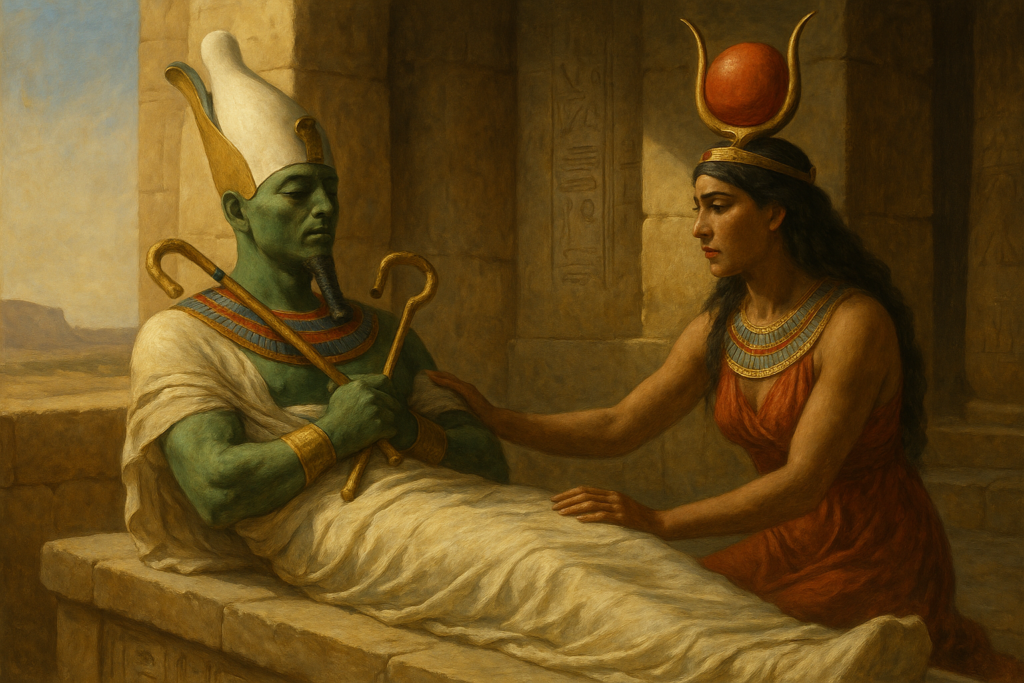
In Egyptian royal mortuary belief, Osiris and Isis are not just figures from a famous myth. They are the divine language of kingship, death, preservation and renewal. The king’s burial was imagined as more than the end of a life: it was a passage into the realm of Osiris, with Isis as the protective power who helps restore what death has broken. That idea appears across funerary texts and images from different periods, though never in quite the same way everywhere.
Osiris as the model of the dead king
Osiris is best understood as the exemplary dead ruler. In royal funerary thought, the deceased king did not simply vanish; he became Osiris, or at least entered Osiris’s condition. The Old Kingdom Pyramid Texts, written on the walls of royal pyramids, already present this logic in a scattered, ritual form rather than as a single continuous story. They invoke Osiris in spells for ascent, protection and transformation, showing that kings hoped to share in his restored state.
By the time of the Coffin Texts and later the Book of the Dead, this Osirian pattern had widened beyond royalty, but it remained especially important for the king. Osiris was the ruler of the dead, yet also the figure who had passed through dismemberment and reassembly into renewed life. That made him a powerful image for a buried monarch whose body had to be preserved and whose identity had to endure.
Isis as mourner, magician and restorer
Isis belongs at the centre of this mortuary theology because she is the goddess who restores order after rupture. In Egyptian sources she appears as a mourner, a protector and a magical healer. In the funerary world, she is often paired with her sister Nephthys, standing at the head and foot of the corpse or coffin, guarding the dead and lamenting Osiris.
This is not merely sentimental grieving. Isis’s role is active and effective. She is the one who protects the body, gathers what has been broken, and helps reverse the damage caused by death. In some funerary imagery, she is shown literally sheltering Osiris with her wings. In such scenes, her power is not separate from kingship: she helps secure the continuation of royal being after death.
The Osiris myth in mortuary thought
The full story of Osiris’s death and restoration is not preserved in one early Egyptian narrative. The best-known continuous version comes much later, in Plutarch’s On Isis and Osiris, a Greek account from the Roman period. Egyptian evidence is older but more fragmented. It gives us references, ritual actions and divine titles rather than a single literary plot. For that reason, the “myth” in royal mortuary belief should be understood as a tradition assembled from different texts, images and ceremonies rather than as one fixed story.
In the broad outlines shared by later Egyptian and classical tradition, Osiris is killed and deprived of his bodily integrity, Isis searches for him, and through mourning and magic the god is restored enough to become lord of the dead. The point for royal belief is not melodrama but transformation. Death does not end divine kingship; it changes its form. The dead king follows Osiris into a renewed existence, while Isis’s role confirms that restoration requires ritual care, speech and protection.
Royal burial as an Osirian transformation
Egyptian royal burial rites were shaped by this theology. The body had to be made fit for survival, and many mortuary practices were understood as helping the deceased become Osiris. Research at the British Museum and elsewhere has shown that black resinous or oily substances used in coffins and burial equipment were not random decoration: they formed part of ritual treatment connected with preservation and transformation. Such practices belong to real funerary work, not just mythic imagination.
Royal objects often express the same idea visually. Osiris is commonly shown as a mummiform figure, tightly wrapped and holding the crook and flail of kingship. That is a striking pairing: the dead king is not stripped of authority, but enthroned in a different register. The body is immobilised, yet the office remains. Isis’s wings or protective presence around Osiris, seen on funerary objects and papyri, reinforce the idea that the dead ruler is guarded within divine order.
From king to every dead person
Although this article is about royal mortuary belief, it is important to note that Osirian ideas gradually expanded beyond the king. By the Middle Kingdom and later, ordinary elite burials increasingly borrowed language and imagery once reserved for royalty. The dead person could be described as Osiris, not because all Egyptians thought alike, but because the royal model had become broadly influential in funerary religion.
That wider development should not be projected backwards too neatly. In the Old Kingdom, the Pyramid Texts remain royal texts, designed for kings and their afterlife. Later, when Osirian belief appears in coffins and papyri for non-royal dead, we are seeing a long process of adaptation. The core royal pattern remains recognisable: death is a passage into Osiris’s sphere, and Isis is one of the powers who makes that passage possible.
Different centres, different emphases
Egypt was never religiously uniform, and mortuary belief developed in dialogue with local traditions. Heliopolis, Memphis, Hermopolis and Thebes each contributed different theological emphases, whether on the sun god, creative speech, divine craftsmanship or underworld restoration. Osiris and Isis became especially important in funerary contexts, but they did not erase every other divine framework.
That matters because Egyptian religion did not offer one neat, universal genealogy. Osiris and Isis could be central in a royal tomb at one time and place, while solar theology or other local forms remained equally significant elsewhere. The survival of different textual traditions — Pyramid Texts, Coffin Texts, later funerary papyri and temple inscriptions — is a reminder that royal mortuary belief was a conversation across centuries, not a single creed.
Why Osiris and Isis mattered so much
What made Osiris and Isis enduringly compelling was the balance they offered between frailty and renewal. Osiris embodied the dead ruler, but not a defeated one: he was the dead who still reigned. Isis embodied devotion, magic and restoration, but not as a passive helper: she is the power that protects the body and re-establishes order. Together they gave royal death a structure that was at once political, ritual and hopeful.
In that sense, Osiris and Isis are not simply figures of mourning. They belong to an Egyptian vision in which preservation, legitimacy and rebirth were bound together. The dead king did not leave kingship behind; he entered its sacred continuation, guarded by Isis and rooted in the enduring order of the gods.
Sources and further reading
- UCL Digital Egypt for Universities, “Pyramid Texts” (opens in a new tab)
- UCL Digital Egypt for Universities, “Book of the Dead” (opens in a new tab)
- The Metropolitan Museum of Art, “Osiris” (opens in a new tab)
- British Museum, “Molecular analysis of an ancient Egyptian burial residue” (opens in a new tab)