Frigg, Foreknowledge and the Fate of Baldr
Frigg’s foreknowledge and the fate of Baldr belong to one of the most haunting myths in Norse tradition: the story of a death that is foretold, resisted and yet cannot be prevented. The fullest medieval prose retelling survives in Snorri Sturluson’s Prose Edda, especially Gylfaginning, while the poem Baldrs draumar (“Baldr’s Dreams”) offers an older, shorter and more enigmatic vision of the same crisis. Both were written down in Christian Iceland in the thirteenth century, preserving older material but not a transparent record of pre-Christian belief.
Frigg, Óðinn and Baldr
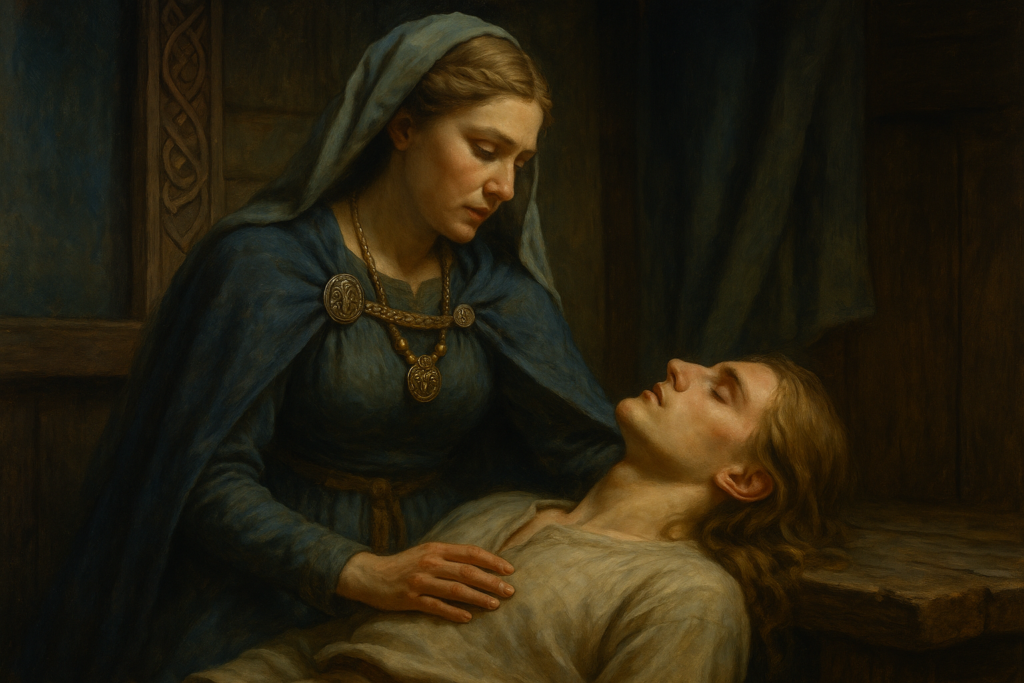
In the standard Old Norse family of the gods, Frigg is Óðinn’s wife and Baldr’s mother. Snorri also presents her as the foremost of the goddesses, dwelling in Fensalir. In the same mythic world, Baldr is the beloved son whose beauty and goodness make his death a catastrophe for gods and humans alike. The sources do not always give identical family lists or divine titles, but on this point the medieval tradition is consistent enough to treat Frigg as Baldr’s mother and Óðinn as his father.
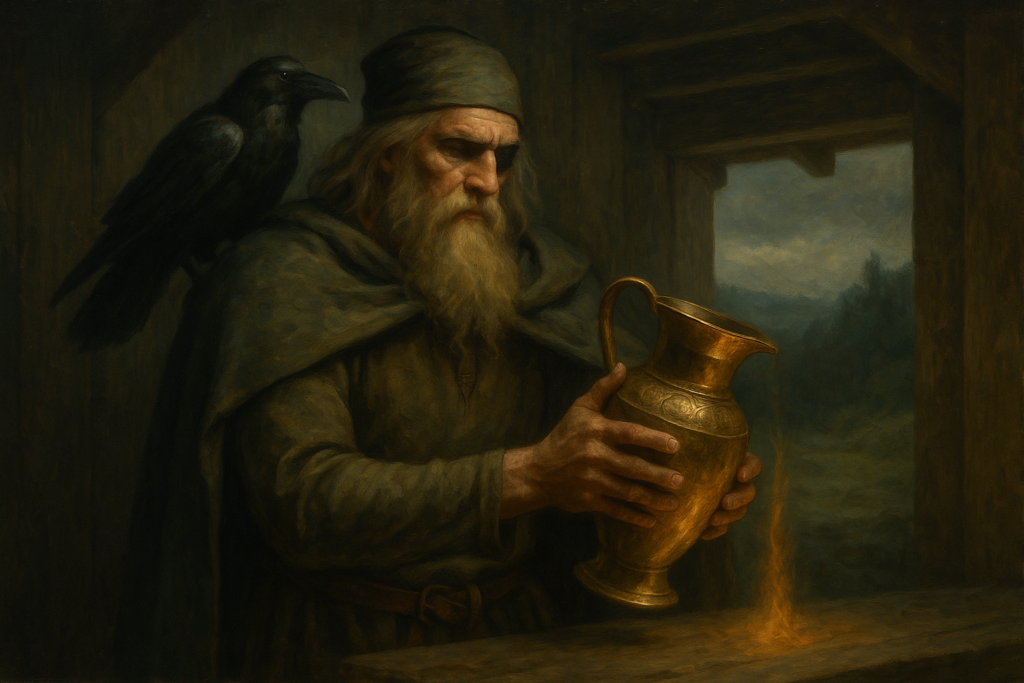
Frigg’s role is crucial because the story begins not with violence, but with knowledge. Baldr has disturbing dreams that seem to foretell his death. In Baldrs draumar, Óðinn rides to Hel to consult a völva, who warns him that Baldr’s doom is already set in motion. Snorri tells the same basic story from a different angle: Baldr’s dreams alarm the gods, and Frigg responds by seeking protection for him from all things.
Baldr’s dreams and the goddesses’ warning
Snorri’s account makes the dreams the first public sign that something is terribly wrong. The gods hold counsel, and Óðinn rides to the dead seeress to learn what the dreams mean. In the poem Baldrs draumar, this questioning is more stripped down and mysterious, but the answer is the same in substance: Baldr is doomed, and his death is bound up with the coming of Ragnarök. The poem presents a world in which fate can be known before it can be stopped.
Frigg’s reaction in Snorri is both practical and tragic. She exacts promises from fire and water, iron and metals, stones and earth, trees, sicknesses, beasts, birds, venom and serpents that none will harm Baldr. This catalogue is one of the best-known passages in the myth. It shows both her determination and the breadth of her anxiety: she leaves as little as possible untried. At the same time, the text reveals a fatal flaw in human and divine foresight. Frigg secures oaths from almost everything, but not from the mistletoe, which she regards as too young and harmless to need such attention.
The fatal exception: mistletoe and Loki’s trick
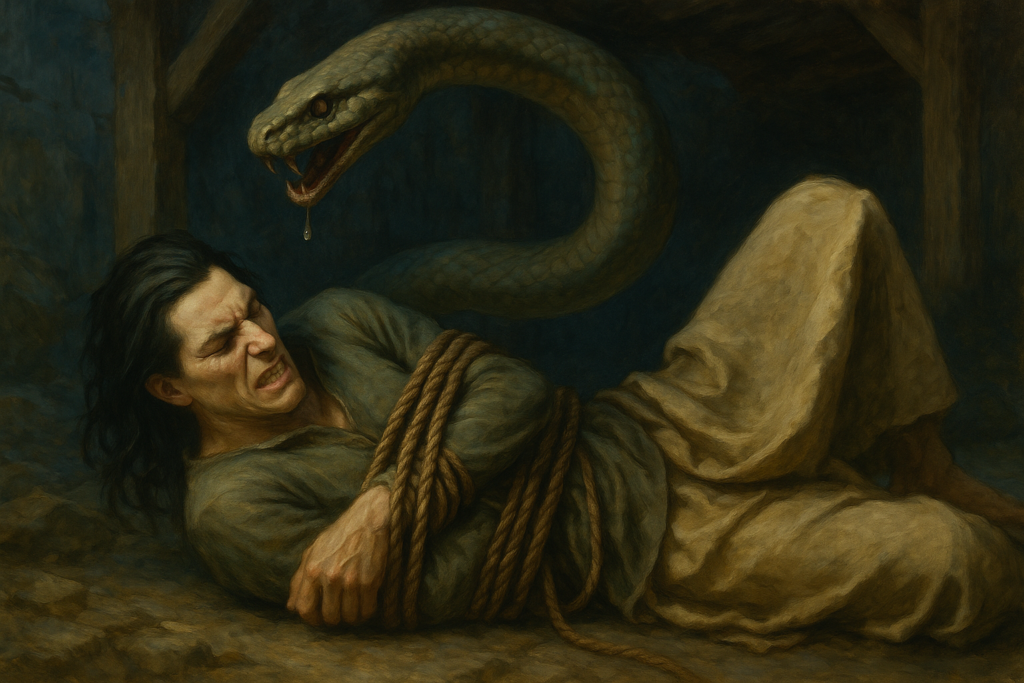
What happens next in Snorri is devastating in its logic. The gods turn Baldr’s invulnerability into a game. He stands among them while they throw weapons and stones at him, confident that nothing can hurt him. Then Loki, hearing of the goddess’s omission, fashions a dart or arrow from mistletoe and places it in the hands of Baldr’s blind brother Höðr. When Höðr throws it, Baldr falls dead.
This is the central event of the myth, and Snorri narrates it with deliberate force. The killing is not a straightforward battle or revenge, but an act of deceit carried out within the godly family. Loki does not kill Baldr openly; he exploits the one thing Frigg overlooked. The tragedy depends on the tension between foreknowledge and misjudgement. Frigg knows enough to fear danger, but not enough to identify every form it will take. Her precautions are real, yet insufficient.
Grief, burial and the failed rescue
After Baldr’s death, Snorri describes grief spreading among gods and men. Baldr’s body is laid on his ship, Hringhorni, and his funeral becomes one of the most memorable scenes in Norse myth. His wife Nanna dies of grief and is laid on the pyre beside him. The god Hermóðr then rides to Hel to attempt a ransom: if all things in the world will weep for Baldr, he may return. Hel agrees on this condition, but one giantess, Þökk, refuses to weep, and Baldr remains in the underworld.
Snorri’s version clearly links Baldr’s fate to the wider destiny of the gods. His death is not only a family tragedy but also a sign that the order of the world is breaking apart. Yet the rescue story is not present in quite the same way in every source. It belongs to Snorri’s prose retelling; readers should not assume that every detail appears in Baldrs draumar, which is shorter and far less expansive.
What Frigg knows, and what she cannot change
Frigg is often described as a goddess of foreknowledge, but the surviving evidence is more careful than that simple label suggests. The myth shows her as informed, alert and capable of divinatory action, yet not omniscient. She senses the danger, acts to avert it and still fails. That failure is the emotional heart of the story. It is not that Frigg does nothing; it is that knowledge does not guarantee mastery over fate.
Some later modern interpretations turn Frigg into a figure of hidden wisdom or even a cosmic foreseer of all events. The medieval sources are less absolute. They show a goddess who takes oaths from all creation, but whose understanding remains partial. In this sense, the myth is not simply about prophecy, but about the limits of prophecy. Even divine foreknowledge does not equal control.
Poetic Edda and Prose Edda: two related tellings
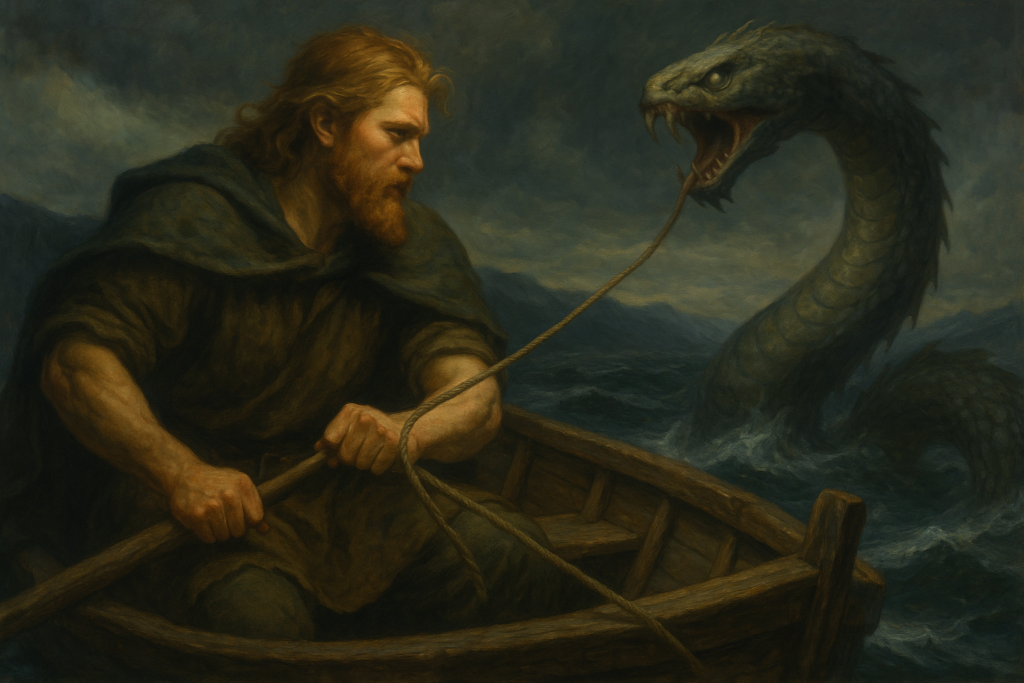
The main narrative of Baldr’s death is best known from Snorri’s Prose Edda, but Baldrs draumar adds an older, more compressed layer of tradition. The poem focuses on Óðinn’s descent to the dead seeress and the inevitability of Baldr’s doom. Snorri, by contrast, gives the full sequence of Baldr’s dreams, Frigg’s oaths, Loki’s deception, the funeral and the failed return from Hel.
There are also differences in emphasis. The poem is sparse, oracular and eerie; the prose is explanatory and narrative. They are related but not interchangeable, and they should be treated as distinct witnesses to Norse myth rather than one flat, unified source. Later scholarship has also suggested that some details may have circulated in oral tradition before either text was written down, but the written record we possess is medieval and shaped by Christian Icelandic authorship.
Frigg’s foreknowledge does not save Baldr, but it gives the myth its tragic depth. The story asks what knowledge can do when fate is already in motion. In answering that question, the Norse tradition makes Baldr’s death not merely a plot point, but a meditation on loss, warning and the painful limits of even divine foresight.
Sources and Further Reading
- Snorri Sturluson, Gylfaginning in The Prose Edda, Internet Sacred Text Archive (opens in a new tab)
- Henry Adams Bellows, translation of The Poetic Edda, Project Gutenberg (opens in a new tab)
- Heather O’Donoghue, “Eddic Poetry and Mythology”, in A Handbook to Eddic Poetry, Cambridge University Press (opens in a new tab)
- John Lindow, “Baldr” and related discussions in scholarly treatments of Norse myth, Cambridge University Press (opens in a new tab)