Juno and the Protection of Marriage in Roman Religion
Juno is one of the most recognisable figures in Roman religion, but her role in marriage is more layered than the familiar label “goddess of women” suggests. She could stand for the dignity of the Roman matron, the legal and ritual order of marriage, the welfare of mothers and children, and, in state religion, the collective strength of the Roman people. That combination made her far more than a domestic patron: in Roman thought, marriage was not only private life but part of the fabric of society itself.
Juno and the Roman idea of marriage
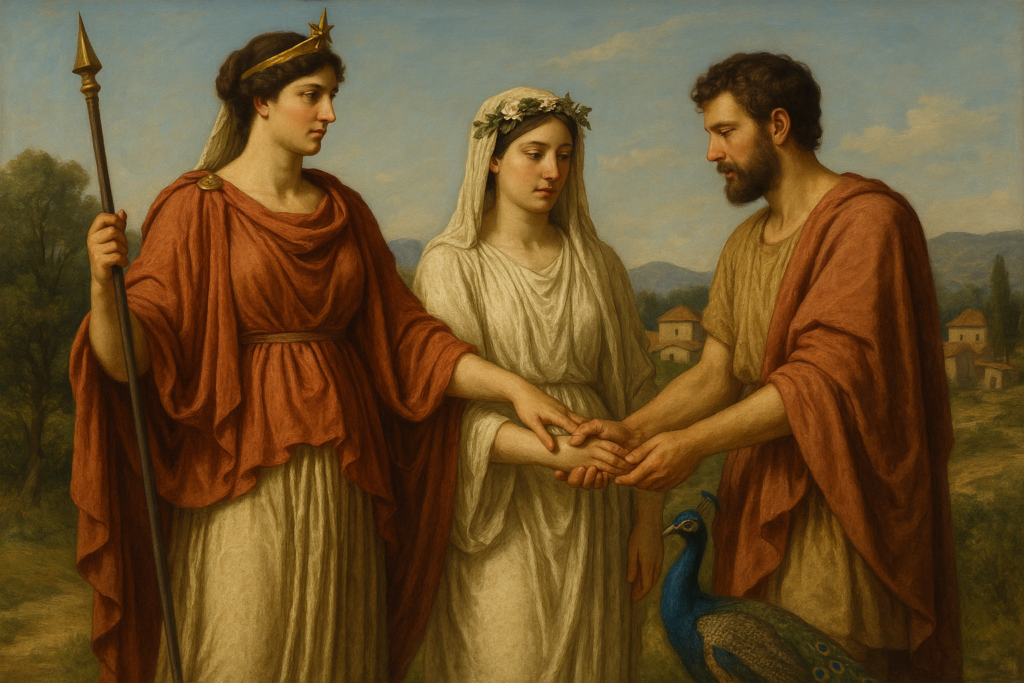
In Roman religion, Juno appears under several titles that show how closely she was linked to female life stages and household order. As Juno Pronuba she presided over weddings; as Juno Cinxia she was connected with the bride’s girdle; as Juno Lucina she brought children into the light of birth; and as Juno Matrona or Iuno Regina she could represent the respected, married woman and the goddess in her queenly form. Ancient writers do not treat these as separate goddesses so much as different roles or powers of one divine figure.
This matters because Roman marriage was not simply a romantic union. It was a public, social, and religious arrangement that bound families together and helped reproduce the citizen body. Juno’s presence at marriage therefore made symbolic sense: she guarded not just the ceremony itself, but the stability and legitimacy that followed from it. Modern comparisons with Greek Hera are useful, but only up to a point. Roman authors often identified the two goddesses, yet Juno’s cult in Rome had its own emphases, especially in relation to the state, women’s ritual life, and the transition from girlhood to matrimony.
The wedding goddess in Roman ritual
Much of what we know about Juno and weddings comes from literary sources rather than direct evidence for a single, fixed ceremony. Roman weddings seem to have involved a recognised sequence of acts: the bride’s dress and veil, a formal escort to the groom’s house, prayers and offerings, and household rites after arrival. In this context, Juno’s role was to bless and protect the transition from one household to another.
Ancient authors preserve several of her wedding epithets. Pronuba means the female attendant or “bridesmaid” who presides over the rite; Cinxia is linked with the girdle, which suggests the untying of a symbolically significant knot; and Domiduca appears as the goddess who leads the bride home. These names are valuable because they show Roman religious thinking at work: the goddess was not abstractly “for marriage” in the modern sense, but active at precise points in a bride’s movement from maidenhood to wifehood.
The best-known literary picture of Juno at a wedding is in Virgil’s Aeneid, where she appears as Juno Pronuba in the cave episode of Dido and Aeneas. Virgil describes Juno and Earth giving the sign for the union. But this scene is not a straightforward record of Roman practice. It is a poetic, and highly problematic, pseudo-wedding: Virgil uses marriage language to underline Dido’s tragic situation and Aeneas’ failure. It is a literary reworking, not evidence that Romans believed Juno routinely officiated in caves.
Matronalia: the feast of Roman wives
The clearest annual celebration of Juno’s connection with marriage was the Matronalia, held on 1 March. Ovid’s Fasti is the principal ancient source for the festival. He links it with Juno Lucina and with married women, or matronae, who honoured the goddess for childbirth and the continuation of the household. Ovid offers more than one origin story for the feast, which is a reminder that Roman festival traditions could have several aetiologies at once rather than a single agreed explanation.
One tradition connected the Matronalia with the reconciliation after the Sabine women intervened between the Romans and the Sabines in Rome’s foundation legend. That story belongs to Rome’s mythic past, not to recoverable history, but it helps explain why the festival was associated with married women and household peace. Another connection runs through Juno Lucina, whose temple on the Esquiline was a focal point of female prayer and offering. The festival was evidently important enough for Ovid to treat it as one of the Roman calendar’s key moments for women, yet the precise rituals behind it are not fully recoverable.
Juno Lucina and protection in childbirth
Marriage in Rome was closely linked to childbirth, and Juno’s protection extended naturally from one to the other. As Lucina, she was invoked by women in labour and by families hoping for safe delivery. The name is usually connected with light, fitting a goddess who brought the child “into the light” at birth. In practical terms, this made Juno a guardian of continuity: she protected not only the bride’s entry into married life, but the next stage in which the marriage might produce children and sustain the family line.
This is one reason why Juno’s cult speaks so clearly to Roman social values. A successful marriage was not merely a matter of personal happiness, but of legitimacy, descent, and the formation of the next generation of citizens. The divine protection of childbirth therefore belonged alongside the divine protection of the wedding itself. Juno’s power, in other words, began before the bridal veil was lifted and continued long afterwards.
Queenly Juno and the wider Roman state
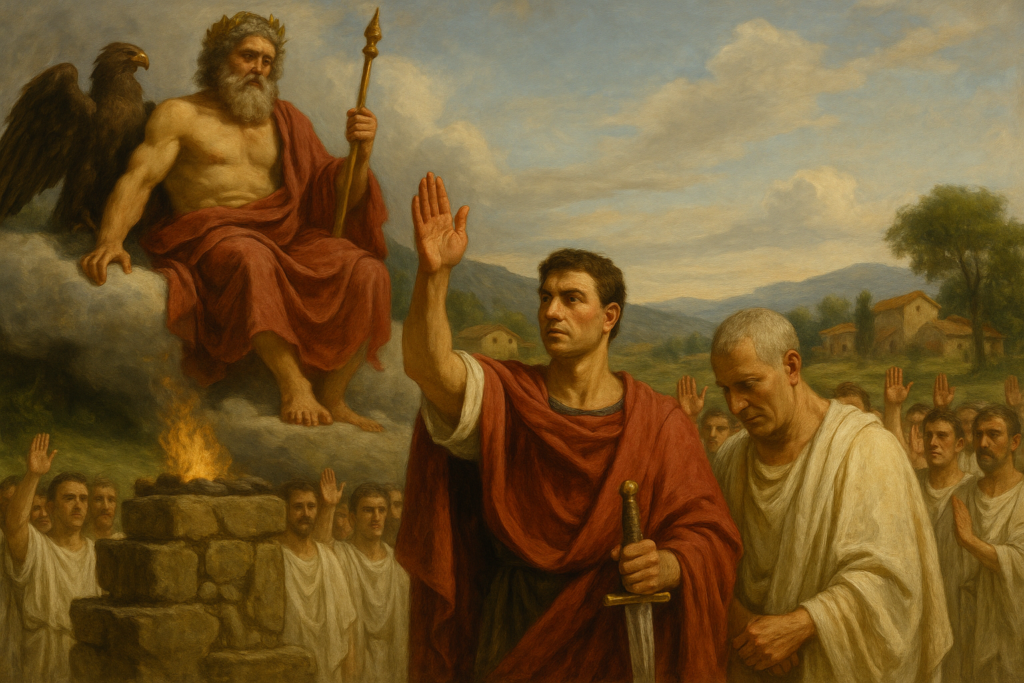
Juno’s marriage role cannot be separated from her status as a major state goddess. Her great public cult, especially as Juno Regina, tied her to Rome’s political life as well as to women’s ritual concerns. Roman tradition also remembered her as one member of the Capitoline triad with Jupiter and Minerva, which placed her at the centre of civic religion. In this setting, her partnership with Jupiter was not simply a mythological marriage borrowed from Greece; it was part of the Roman habit of expressing divine power through public institutions and collective identity.
That broader setting helps explain why Juno’s protection of marriage carried such weight. The stability of households mirrored the stability of the state. A goddess who safeguarded matrons, brides, and mothers could also stand for Roman order itself. Even when Roman poets and mythographers borrowed Greek patterns, they adapted them to Roman needs: marriage was a divine and civic matter at once.
Why Juno still matters in Roman religion
Juno’s association with marriage is one of the clearest examples of how Roman religion connected ritual, family, and public life. She was not only a lofty queenly goddess but also a presence at concrete moments of change: the wedding, the household transition, pregnancy, childbirth, and the annual honours of the Matronalia. Ancient literature sometimes gives her a dramatic role, as in Virgil, and sometimes a devotional one, as in Ovid. Taken together, these sources show a goddess whose importance lay in making social bonds durable and sacred.
That is what makes Juno compelling. She was not just the divine “wife” of Jupiter, nor merely a Roman version of Hera. She was the goddess who watched over the difficult and meaningful thresholds of Roman womanhood, and over the continuity of the community itself.
Sources and further reading
- Ovid, Fasti, Book 3 (Perseus Digital Library) (opens in a new tab)
- Virgil, Aeneid, Book 4 (Perseus Digital Library) (opens in a new tab)
- Oxford Classical Dictionary, “Matronalia” (opens in a new tab)
- Judith Evans Grubbs, “Gods of the Roman Wedding” in The Roman Wedding (Cambridge University Press) (opens in a new tab)