The Story of Demeter and Persephone
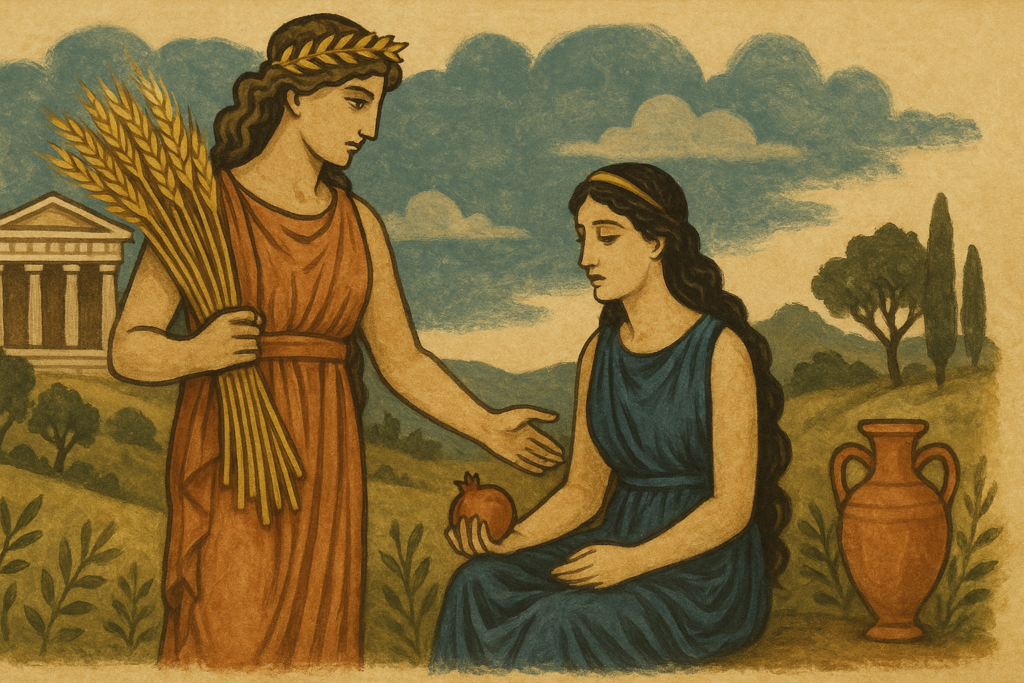
Demeter and Persephone stand at the centre of one of the most enduring myths in Greek mythology: the story of a mother’s loss, a daughter’s return, and the changing cycle of the seasons. Ancient Greeks told this tale not simply as a family drama among the gods, but as an explanation for fertility, harvest, and the uneasy boundary between life and death. It was also tied to important religious practices, especially the Eleusinian Mysteries, a major cult connected with Demeter’s worship.
The Abduction of Persephone
The story begins with Persephone, also called Kore, meaning “maiden” or “girl”. She is usually presented as the daughter of Demeter, the goddess of grain, agriculture, and the nourishing power of the earth. In the best-known version, preserved in the Homeric Hymn to Demeter, Persephone is gathering flowers in a meadow when Hades, ruler of the underworld, emerges and carries her off into his realm. Zeus, her father, has a part in the plan in some accounts, though the Hymn is careful and indirect about exactly how much he knew. What is clear is that Persephone is taken without her mother’s consent.
The setting matters. Persephone is not seized in a battlefield or palace, but in a flowery landscape filled with growth and beauty. Ancient audiences would have understood the contrast immediately: the girl of spring is suddenly removed into the hidden world beneath the earth. The earth itself is shaken by the event, and Persephone’s cry is heard by only a few. The Homeric Hymn treats the abduction not as romance but as violent disruption.
Demeter’s Search
When Persephone disappears, Demeter begins a desperate search. For nine days and nights she wanders the world carrying torches, asking after her daughter but finding no answer. In the Homeric Hymn, the goddess is portrayed in raw grief: she refuses food and drink, and her sorrow is so intense that it affects the natural world. The image of a mourning mother is central to the myth’s emotional force.
At last, Demeter learns the truth. In some versions, Helios, the sun god who sees all things, reveals that Hades has taken Persephone and that Zeus approved the marriage. This revelation intensifies the conflict, because Demeter’s grief is now joined by anger at the gods’ silence. She abandons Olympus and travels among mortals in disguise, taking the form of an old woman. This wandering phase is important because it shifts the myth from divine household drama into the world of human dependence on crops, rain, and divine favour.
Demeter at Eleusis
Demeter’s search leads her to Eleusis, near Athens, where she is received by the family of Celeus and Metaneira. In the Homeric Hymn to Demeter, she is welcomed as a nurse to the infant Demophon. Demeter tries to make the child immortal by anointing him with ambrosia and placing him in the fire at night, but Metaneira interrupts the ritual in alarm. The attempt fails, and Demeter reveals her divine identity.
She then orders that a temple be built for her at Eleusis and teaches the people rites that, according to the Hymn, later became the basis of her worship there. This section of the myth is crucial because it links the story of Persephone to actual cult practice. The Eleusinian Mysteries were among the most famous religious rites in the Greek world, and although much about them remained secret, ancient sources consistently associated them with Demeter and Persephone.
At Eleusis, Demeter’s grief also becomes cosmic. She withholds fertility from the earth, causing famine among humankind. Without grain, people cannot offer the gods proper sacrifices, so Zeus is forced to act. The myth therefore turns divine sorrow into a crisis of order: if Demeter does not release the earth’s abundance, both mortals and gods suffer.
The Return and the Pomegranate
Zeus sends messengers to persuade Hades to release Persephone. Hades agrees, but before she leaves the underworld he gives her food there. This detail becomes the hinge on which the rest of the myth turns. In many versions, Persephone eats pomegranate seeds; because she has consumed food from the underworld, she cannot remain permanently in the upper world.
Ancient sources do not always agree on the number of seeds or the precise consequences. Some versions say she eats one seed, others several; some emphasise trickery, while others frame it as a binding act of marriage. The Homeric Hymn is the foundational narrative for the pomegranate motif, though later authors elaborate it differently. What remains consistent is that the act creates a legal or cosmic tie between Persephone and Hades.
A compromise is reached. Persephone will spend part of the year with her husband in the underworld and part with her mother on earth. The precise division varies in later retellings. Some sources imply a third of the year below and two-thirds above; others speak more generally of seasonal alternation. The important point is that Demeter’s joy at her daughter’s return restores fertility to the earth, but Persephone’s necessary descent ensures that winter and barrenness are not abolished.
What the Myth Explains
To Greek audiences, the story of Demeter and Persephone helped explain why the earth is fruitful for part of the year and apparently dead for another. It does not present a scientific theory in the modern sense; rather, it gives a divine narrative to agricultural change. Grain rises from buried seed, just as Persephone rises from the underworld. The connection between burial and new growth made the myth especially powerful for people whose lives depended on the harvest.
Demeter is sometimes described as a more earthly, maternal deity than the bright Olympians often featured in epic tales. Her power lies not in battle but in cultivation, nourishment, and withholding. Persephone, by contrast, belongs to both worlds: she is the maiden of spring and the queen of the dead. This dual identity is central to the myth and to her later worship.
It is also worth noting that Greek religion did not treat the story as a single fixed text. Local cults, poets, and ritual traditions could emphasise different elements. Some versions stress Demeter’s suffering; others highlight Persephone’s new role below ground. The story was flexible enough to serve both agricultural explanation and mystery religion.
Ancient Worship and the Eleusinian Mysteries
The most important cult associated with the myth was at Eleusis. Ancient writers such as the Homeric Hymn to Demeter, later poets, and historical authors like Herodotus and Pausanias all point to Eleusis as the centre of Demeter’s worship. The Mysteries themselves were secretive initiation rites, and initiates were forbidden to reveal many of their details. As a result, modern knowledge is incomplete and must be handled carefully.
What can be said with confidence is that the cult honoured Demeter and Persephone together and promised a special relationship with the goddesses through initiation. The rituals likely involved sacred objects, torches, processions, and the telling or performance of myths connected with Demeter’s grief and Persephone’s return. Because the rites were secret, later writers sometimes speculated about their contents, but the safest evidence is the repeated ancient association between Eleusis, fertility, and blessed afterlife expectations.
The myth’s religious importance can be seen in the way it connected ordinary agriculture with divine presence. Grain was not merely food; it was a sign that Demeter remained active in the world. Persephone’s return did not cancel death, but it did suggest that descent and return were part of the divine order.
Later Interpretations and Artistic Afterlife
Later Greek and Roman authors continued to retell the myth. In Roman literature, especially in Ovid’s Metamorphoses, the story appears with vivid narrative detail, though shaped by Roman literary interests. Latin writers generally use the names Ceres and Proserpina, the Roman equivalents of Demeter and Persephone, but the underlying story remains recognisable. These later versions often heighten the pathos or the dramatic detail, yet they build upon the older Greek tradition.
Artists in antiquity also found the myth compelling. Vase paintings, reliefs, and sanctuary art often depict the moment of abduction, Demeter’s grief, or Persephone’s return. The most common visual language emphasises motion and separation: the girl is carried away, the mother searches, and the reunion is delayed. Such images kept the story alive not as a literary plot alone, but as a sacred and visually recognisable narrative.
The myth of Demeter and Persephone endures because it brings together loss, renewal, and the conditions of human life in a landscape of divine power. In ancient Greek thought, it was never just about a daughter taken underground. It was also about the grain in the field, the turning of the seasons, and the mysteries that made the world both generous and threatening at once.
Recommended reading
These are affiliate links. If you buy through them, we may earn a commission at no extra cost to you.
Complete Greek Myths: An Illustrated Book of Greek Myths
Featuring detailed retellings, beautiful character illustrations, and cultural background, this comprehensive volume brings the best-known and obscure Greek myths to life for readers of all ages. Complete with maps, a glossary, and a QR code for pronunciation guides and extra resources, it is an essential addition to any family bookshelf.
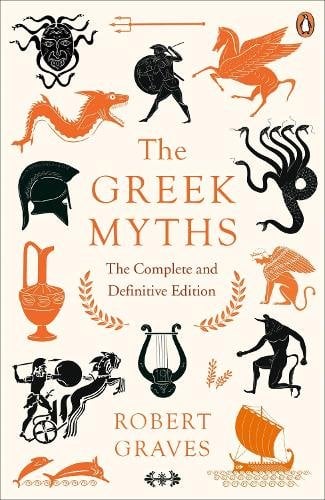
The Greek Myths: The Complete and Definitive Edition
Robert Graves’s definitive edition weaves the classic Greek myths, from the Labours of Hercules to the Trojan War, into one sweeping, authoritative narrative. Perfect for both first-time readers and classicists, this comprehensive volume combines engaging storytelling with detailed scholarly commentary and a complete index of names.
The Odyssey
Homer’s timeless epic The Odyssey follows the hero Odysseus on a perilous decade-long journey home from Troy, facing mythical monsters and divine wrath. Meanwhile, his wife Penelope and son Telemachus defend their kingdom against ruthless suitors in this classic tale of loyalty and endurance.