Horus the Elder and the Falcon God
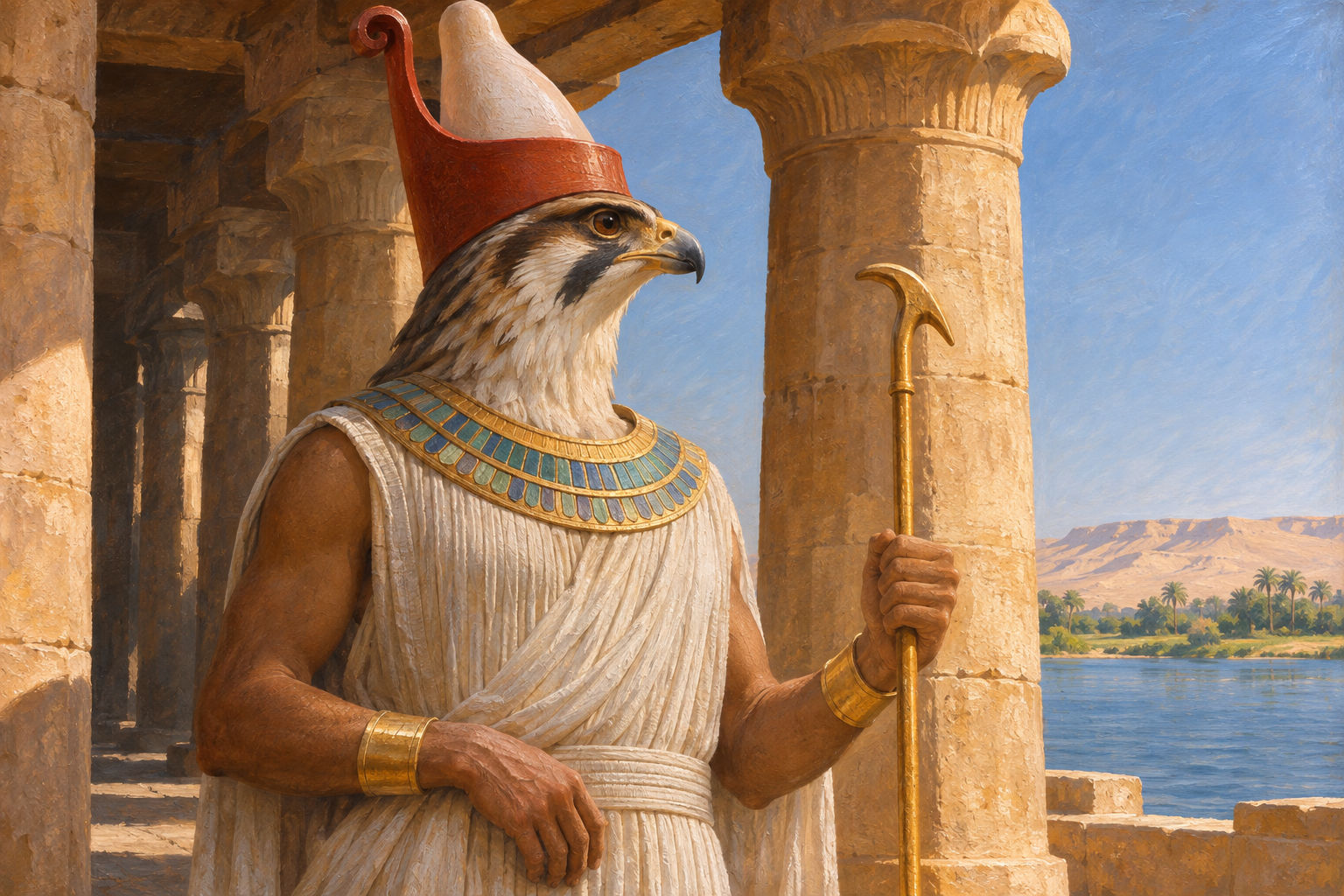
Horus the Elder: the older Horus of Egyptian religion
Among the many forms of the falcon god Horus, one of the most intriguing is Horus the Elder — a divinity often understood as “Great Horus” or “Haroeris” in Greek sources. He is not the better-known child of Isis and Osiris, but a separate and older manifestation of Horus, one that belongs to the sky, kingship and divine power rather than to the later family drama of the Osiris myth. Ancient Egyptian religion did not keep every god in a single, tidy family tree, so the safest way to read Horus the Elder is as one important Horus among several, shaped by different local traditions over time.
A falcon god before the family drama
Horus appears very early in Egyptian religion as a sky and royal god, commonly shown as a falcon or as a man with a falcon head. In one of his oldest roles, he is a protector of the king and a sign of legitimate rule. The pharaoh’s identity with Horus was so strong that “Horus” became part of royal titulary: the living king was understood as a Horus on earth. This early royal Horus is the background against which Horus the Elder should be understood. He is not merely a character in a later myth, but part of the older language of divine kingship and cosmic order that reaches back to the earliest periods of Egyptian state formation.
Museums and reference works sometimes describe Horus the Elder as a primordial or sky god whose eyes were the sun and moon, but that sort of summary blends several traditions. What is secure is that he was a falcon deity associated with the heavens, protection and kingship, and that his image remained durable across Egyptian history.
Why “the Elder” mattered
The label “Horus the Elder” is helpful because Egyptian texts and later writers did not always distinguish neatly between different Horuses. A common later distinction separated this older falcon god from Horus the son of Isis, who appears in the Osiris cycle as the child and heir of Osiris. In Greek and Roman-era writing, especially in the tradition known through Plutarch, these figures can be more sharply differentiated than in earlier Egyptian sources. That does not mean the Egyptians themselves always imagined them as unrelated gods; rather, it reflects the way religious language changed, and the way later readers tried to organise an older and more flexible divine world.
In practice, this means that “Horus” could point to several overlapping ideas: the sky falcon, the divine king, the victorious heir, the child protected by Isis, and the avenger of Osiris. Horus the Elder belongs most securely to the first two of these. He is the sky god and royal protector, not the infant hidden among the papyrus reeds.
Horus in the oldest texts and temple traditions
Egyptian evidence for Horus the Elder is scattered rather than a single continuous story. The Pyramid Texts, Coffin Texts and later temple inscriptions preserve allusions to Horus in different forms, but they do not give us one fixed biography. That is important: Egyptian religion was not a single creed, and the god’s role varied by place and period. In some traditions Horus is linked strongly with Nekhen, the major cult centre of Upper Egypt; in others, he appears in wider royal and cosmic contexts. Later temple religion could merge him with solar theology, producing forms such as Ra-Horakhty, “Ra-Horus of the Two Horizons”, a combined divine name that should be read as a theological synthesis rather than as simple identity.
The result is a god who is both recognisably the falcon of the sky and yet capable of joining with other divine powers. That flexibility is one reason Horus remained so prominent. He was not a narrowly local spirit; he could stand for the king, the daytime sky, and the ordered world itself.
How Horus the Elder differs from Horus son of Isis
The popular story of Horus usually comes from the Osiris cycle: Osiris is killed, Isis protects their son, Horus grows up, and the young god eventually contests Seth for the throne. That is the Horus most readers encounter first. But Horus the Elder is not the child in that story. He is older, more remote and less dramatically individualised.
The distinction became especially useful in later religious writing, when Egyptian authors and foreign interpreters alike needed to separate the venerable falcon god from the younger heir of Osiris. The two were sometimes related in interpretation, sometimes distinguished, and sometimes allowed to overlap. Egyptian religion tolerated that sort of complexity. A god could be both ancient and newly articulated, both singular and multiple, depending on the context. Horus the Elder shows that flexibility at work.
Protecting kings, order and the living world
Horus the Elder was not chiefly a god of the dead. His place was broader and more life-affirming: kingship, protection, the sky, and the maintenance of order. In art he appears as a falcon, often poised and alert, an image that suits a deity associated with vigilance and authority. Objects from later periods, including amulets and statues, show how deeply the falcon form continued to matter in personal devotion and protective magic. The Eye of Horus, one of the best-known Egyptian protective symbols, also belongs to this wider Horus-world, though it is not limited to Horus the Elder alone.
This matters because Egyptian religion is often reduced to funerary belief, when in fact deities such as Horus were central to the governance of daily life, public power and cosmic stability. Horus the Elder stands for the idea that the world should remain rightly ordered: the king should rule, the sky should turn, and danger should be checked by divine authority.
Reading Horus the Elder without flattening Egyptian religion
Modern summaries sometimes make Horus the Elder sound like a single, clearly defined figure with a fixed myth attached to him. The evidence is more interesting than that. Egyptian religion developed over millennia, and local theological traditions did not simply collapse into one universal system. Horus the Elder is best understood as a stable but adaptable divine form: an ancient falcon god of the sky and kingship, later distinguished from the son of Isis, and occasionally merged with solar theology in temple religion.
That complexity is not a problem to be explained away. It is part of what makes Horus such a striking Egyptian god. Long before he became a familiar figure in later myths, he already embodied the power of the sky, the authority of the king and the promise that order could prevail over disorder. Horus the Elder is the older face of that enduring idea.