Mars Before Empire: The God of War in Early Rome
Mars before empire
Long before Mars became the polished god of imperial triumphs and marble monuments, he stood at the rougher edge of Roman life: a power who could protect the fields, strengthen the household and, above all, help Rome prevail in war. In early Roman tradition he is not simply a Roman version of the Greek Ares. The two were later identified, but Mars had his own place in Roman religion, and his earliest associations are broader and older than the stereotype of a bloodthirsty war god. Roman sources and modern museum and scholarly references alike stress that Mars was linked not only with warfare but also with agriculture, civic identity and the founding myths of Rome itself.
A god for war, fields and the Roman people
One reason Mars matters so much in early Rome is that his cult seems to reflect the priorities of a society that was both agrarian and militarised. Mars could guard crops and livestock, yet he also presided over the violence of war and the success of arms. Older scholarly tradition, including the standard classical dictionaries, describes him as a god of war, husbandry, shepherds and the Roman people’s ancestry; more recent museum material likewise places him at the centre of Roman public religion and military victory. The point is not that these functions are contradictory. In early Roman life, protecting a farm and defending a state were closely related concerns.
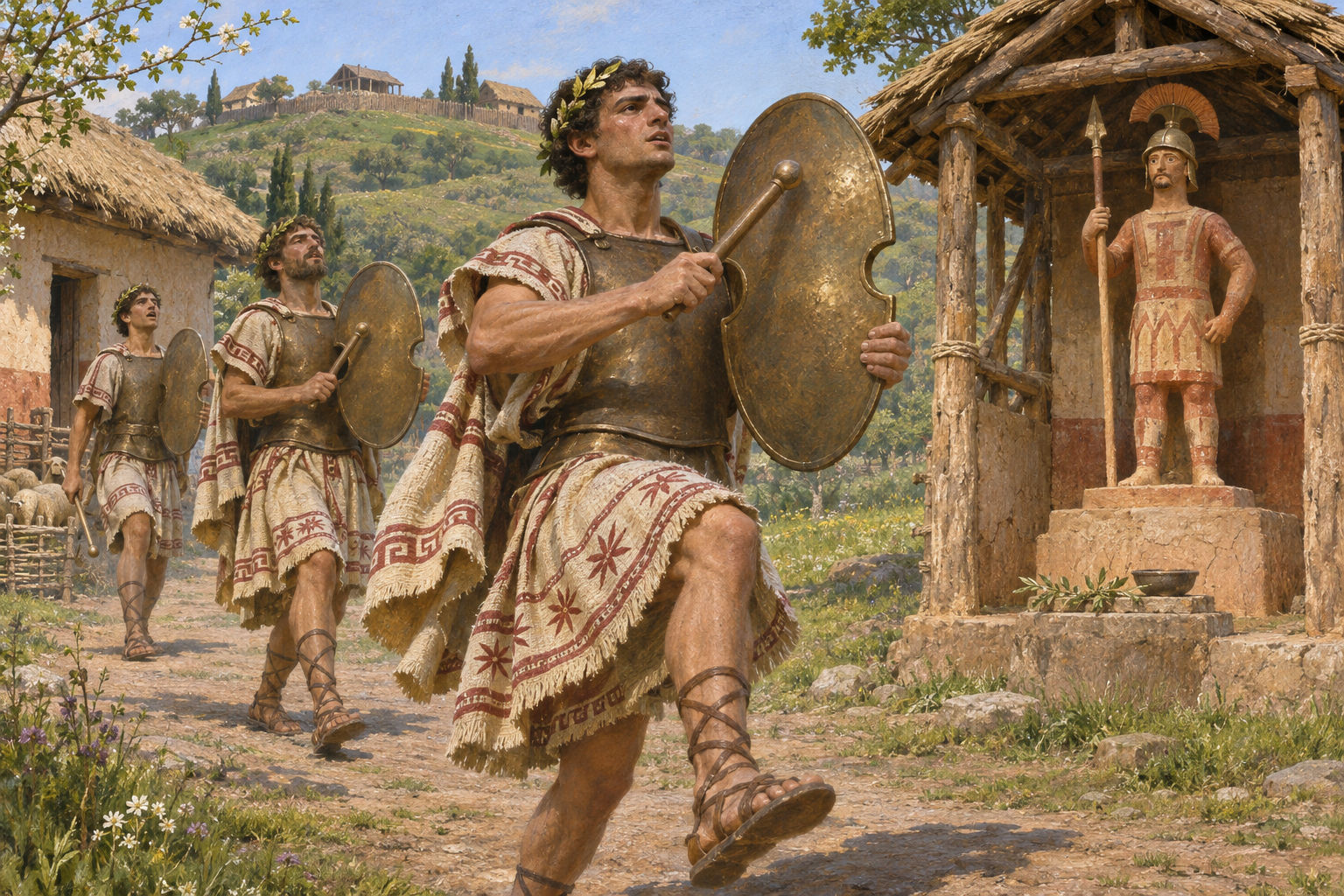
That broad profile helps explain why Mars appears in some of Rome’s oldest religious settings. The early calendar preserved major festivals for him, and Roman ritual often treated him as a god to be awakened, propitiated or armed for action. One well-known later scholarly summary notes the ritual shaking of Mars’s sacred spears in the Regia before war, while another ancient tradition links him with the Salii, the priestly dancers in armour. These are best treated as literary and ritual traditions rather than as fully recoverable “facts” about the earliest Republic, but they do show how deeply Mars was embedded in Roman ideas of ordered violence and divine protection.
The spear, the dance and the old Roman calendar
In early Roman religion, Mars was not worshipped mainly through the kind of elaborate mythology later readers often expect. He was a god of action, ritual and timing. The old calendars marked his month, March, at the beginning of the campaigning season, and that seasonal logic mattered. Before armies could march, the gods had to be made favourable; before a community could go to war, the war god had to be properly addressed. Roman religion was highly public and civic, and festival, priesthood and calendar were all part of that system. Oxford’s reference on Roman religion emphasises exactly this intertwining of cult, priesthoods, festivals and civic life.
That practical quality is one reason Mars remained so important. He belonged not only to temple worship but to the public rhythm of Roman life: the start of war, the maintenance of peace, the fertility of the land, and the security of the city. In later periods he would be splendidly reimagined in art and politics, but early on he was already the sort of god a community could turn to for protection without making him abstract or distant. He was present where Rome’s survival seemed to be at stake.
How Mars became the father of Romulus
The most famous early Roman story about Mars is also one of the most important. In the foundation legend preserved by Livy and retold by later authors, Mars fathers Romulus and Remus through Rhea Silvia, the Vestal virgin. This is not a historical claim but a foundational myth: a story Romans told about themselves in order to explain their city’s beginnings and their god’s special attachment to Rome. In Livy’s version, Amulius has forced Rhea Silvia into the Vestal order so that she will remain childless. She nevertheless becomes pregnant, and the children are then set adrift before eventually being saved. Livy’s account is one of the principal ancient tellings of this tradition.
The exact manner of Mars’s involvement varies by source, and that difference matters. In Livy, the divine paternity is part of the inherited legend but not dramatized at length; in Ovid’s Fasti, by contrast, Mars is much more directly and poetically present. Ovid tells the story in a way that foregrounds the god’s desire and the miraculous conception of the twins. A third version, preserved in later mythographic and commentary traditions, is even more explicit about Mars overpowering Rhea Silvia in a sacred grove. Because these accounts do not match perfectly, it is best to treat Livy as the main narrative and to note that Ovid and later tellings elaborate the divine encounter more vividly.
Rhea Silvia, the twins and a divine ancestry
Whatever form the story takes, the function is clear. Mars becomes the ancestor of Rome’s founders. This is a powerful claim: Rome is not merely a city favoured by a god of war, but a people descended from him. That ancestry gave the Romans a divine parent who could legitimate martial success while also tying the city to the ancient past of Alba Longa and the wider Trojan line traced through Aeneas. In Roman mythmaking, ancestry was politics. To say that Romulus was the son of Mars was to say that Rome’s rise was built into the fabric of the gods.
Yet the myth does not make Mars gentle or domestic. If anything, it presents a god whose force is dangerous as well as life-giving. He fathers the city’s founder, but the story of Rome’s foundation still includes exposure, abandonment and fratricide. Livy’s narrative of Romulus and Remus ends with Romulus killing his brother after the boundary of the city is violated. Mars does not cause that final act in any simple sense, but his presence shadows the entire tale. Rome’s origin is inseparable from violence, and Mars is the divine name for that fact.
Mars and Ares: similar, but not the same
Greek and Roman authors often equated Mars with Ares, and in later art the two can seem almost interchangeable. But Roman religion does not simply copy Greek mythology under a Latin name. Ares is usually the more negative and marginal figure in Greek myth, while Mars is embedded in Roman civic life and in the story Romans told about their own beginnings. The Met Museum’s Roman collection description captures this difference neatly: Mars shares many attributes with Ares, but he is also tied to the imperial cult and Roman public monuments in ways that make him characteristically Roman.
That distinction helps explain why Mars remained central as Rome changed from city-state to empire. Even before the imperial age, he already stood for more than battle. He represented disciplined force, community protection and a claim that Rome’s expansion was sanctioned by the gods. The Greek comparison is useful, but it should not blur the specifically Roman Mars who emerges from the early tradition.
Why early Rome kept Mars close
Mars endured because he answered to several Roman needs at once. He protected crops, guarded warriors, sanctioned public ritual and gave Rome a divine ancestor. In early Roman religion, that combination was not unusual; it was precisely what made a god powerful. Later emperors would emphasise Mars in monuments of victory, but his importance was already established in the older city. To understand early Rome, it helps to see Mars not as a cartoonish warlord but as a god who stood at the meeting point of ploughed land, armed men and ancestral memory. That is where Rome first found him — and where Rome kept him.
Sources and further reading
- Livy, History of Rome, Book 1 (Perseus) (opens in a new tab)
- Ovid, Fasti, Book 3 (Perseus) (opens in a new tab)
- The Metropolitan Museum of Art: Marble relief fragment with the head of Mars (opens in a new tab)
- Elaine Fantham and Emily Fairey, “Roman Religion”, Oxford Bibliographies in Classics (opens in a new tab)