Medusa and the Gorgons
Medusa and the Gorgons: the monster, the sisters and the hero
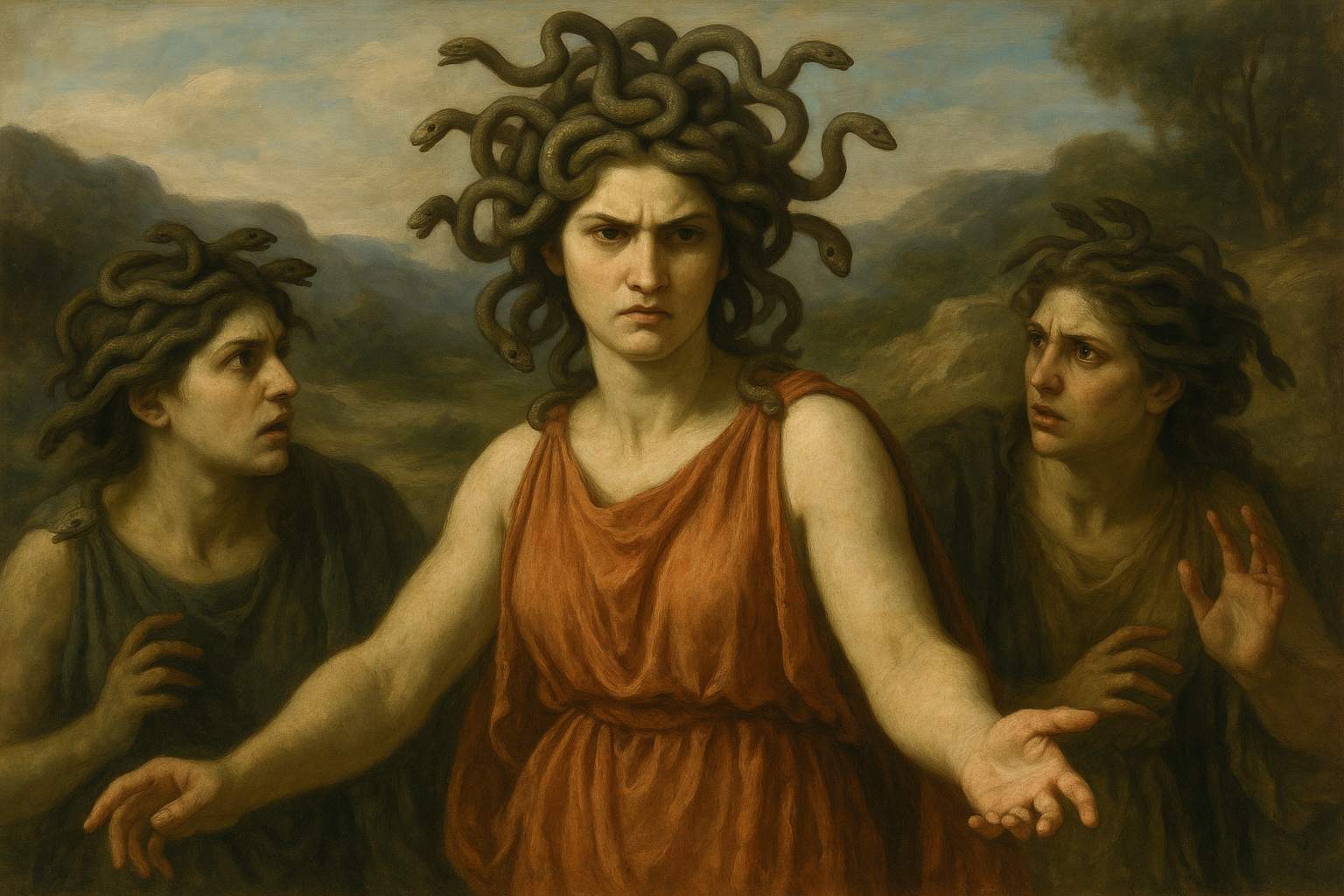
Medusa is one of the most recognisable figures in Greek mythology: the Gorgon whose gaze could turn people to stone, and whose severed head remained dangerous even after death. But the story is more layered than the familiar image suggests. In the oldest Greek sources, the Gorgons are not a single character but a family of monstrous sisters, and Medusa is only one of them. Later Greek and Roman writers reshaped her story in very different ways, turning a terrifying monster into a tragic figure, a warning image, and an enduring symbol of power.
Who the Gorgons were in early Greek myth
In Hesiod’s Theogony, one of the earliest surviving Greek accounts, the Gorgons are daughters of the sea deities Phorcys and Ceto. There are three sisters: Stheno, Euryale and Medusa. Hesiod places them at the far edge of the world, beyond Ocean, in a remote, nightward region. Of the three, only Medusa is mortal; the others are immortal. That detail matters, because it makes Medusa the one sister whose death can be narrated in a myth of heroic conquest.
Hesiod does not give Medusa a long backstory. She is already a Gorgon, already part of a monstrous genealogy. In this early version, there is no human maiden turned into a monster, no temple violation, and no moralising explanation for her condition. She simply belongs to the world of primordial beings and monstrous offspring that stand outside ordinary human life.
Perseus, Athena and the head that could still kill
The best-known retelling of Medusa’s death comes from later mythological handbooks, especially Apollodorus’ Library. Here, Perseus is sent on the perilous task of bringing back Medusa’s head. The details of the quest are familiar: the hero receives divine help, most importantly from Athena and Hermes, and uses a polished shield to avoid looking directly at the Gorgon. He approaches while the Gorgons sleep and decapitates Medusa.
Apollodorus’ version also explains what comes next. From Medusa’s neck spring Pegasus, the winged horse, and Chrysaor, a figure whose name means something like “golden sword”. The pursuing Gorgons wake and try to follow Perseus, but he escapes with the help of divine gifts. In this telling, Medusa’s death is not the end of the story; her body becomes the source of new beings, and her head remains a weapon in Perseus’ hands.
That head does important work in the myth. Perseus uses it to turn enemies to stone, and eventually it comes into Athena’s possession. In Greek art and literature, the Gorgon’s head becomes a protective emblem, the gorgoneion, appearing on shields, armour, buildings and small objects as an apotropaic image meant to ward off harm. The terrible face of the monster is therefore not only a sign of fear, but also a device of defence.
What Hesiod says, and what later authors add
Hesiod’s account and Apollodorus’ version overlap, but they are not identical. Hesiod gives the genealogy of the Gorgons and mentions that Medusa was mortal, then says that when Perseus cut off her head, Pegasus and Chrysaor sprang from her. He does not spell out the whole adventure of Perseus, nor does he linger over the hero’s route, the hidden approach, or the use of Athena’s shield. Those are later narrative details, important to the myth, but not part of Hesiod’s brief and archaic presentation.
There is also a crucial distinction between Greek and Roman treatment of the subject. Ovid, writing in Latin in the Metamorphoses, supplies the famous version in which Medusa was once a beautiful maiden and was transformed after sexual violation in Athena’s temple. That story has had a long afterlife, but it is not the same as the older Greek tradition found in Hesiod. If Ovid is used, he should be read as a Roman poet offering his own adaptation, not as a simple witness to what all Greeks believed.
Medusa before Ovid: the monster, not the maiden
Because Ovid’s account has become so influential, it is easy to project it backwards into earlier Greek myth. But the older evidence points in a different direction. In archaic Greek poetry and art, Medusa is generally a monstrous being from the start, not a tragic victim who becomes monstrous later. The emphasis falls on her dangerous body, her deadly gaze and her place in a wider family of sea-born monsters.
That does not mean the Greeks lacked sympathy or nuance in their treatment of her image. Ancient art sometimes shows the Gorgon in startlingly varied ways, from grotesque mask-like faces to more human-looking versions. But the literary tradition that survives from early Greece does not tell a single, standard story of Medusa as a wronged woman. The simpler, older narrative is that she is one of the Gorgons, and the mortal one at that.
The Gorgoneion in Greek art and religion
Long before Medusa became a modern cultural icon, her face was used as a protective symbol in Greek visual culture. The gorgoneion could appear on shields, roof tiles, pottery, coins and jewellery. Its function was not decorative alone. In Greek religious thinking, frightening images could repel danger. The Gorgon’s stare, transposed into an image, became a way of holding evil at bay.
This helps explain why Medusa remained so visible in Greek and later Roman art even when the literary myth changed. Artists did not simply repeat one story; they worked with a figure whose image carried its own force. The monster’s head could be displayed, copied and worn precisely because it was believed to protect as well as terrify.
Why Medusa still matters
Medusa and the Gorgons endure because their story combines several powerful mythic elements at once: monstrous birth, divine intervention, heroic danger and a body that remains potent even in death. The myth also shows how flexible Greek tradition could be. A single figure could be both a monster at the edge of the world and a protective emblem at the centre of domestic and public life.
For modern readers, it is worth keeping the versions separate. Hesiod gives the early Greek framework; Apollodorus preserves the familiar heroic plot; Ovid provides the later Roman transformation. Taken together, they show not one fixed Medusa, but a figure whose meaning changed over time while never losing her unsettling power.
Sources and further reading
- “Medusa in Ancient Greek Art”, The Metropolitan Museum of Art (opens in a new tab)
- Hesiod, “Theogony”, Center for Hellenic Studies (opens in a new tab)
- Apollodorus, “Library” Book 2, Theoi Classical Texts Library (opens in a new tab)
- “Dangerous Beauty: Medusa in Classical Art”, The Metropolitan Museum of Art (opens in a new tab)
Recommended reading
These are affiliate links. If you buy through them, we may earn a commission at no extra cost to you.
Complete Greek Myths: An Illustrated Book of Greek Myths
Featuring detailed retellings, beautiful character illustrations, and cultural background, this comprehensive volume brings the best-known and obscure Greek myths to life for readers of all ages. Complete with maps, a glossary, and a QR code for pronunciation guides and extra resources, it is an essential addition to any family bookshelf.
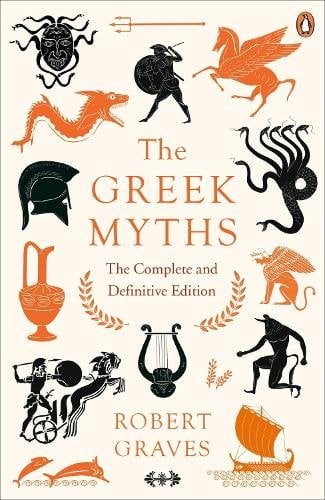
The Greek Myths: The Complete and Definitive Edition
Robert Graves’s definitive edition weaves the classic Greek myths, from the Labours of Hercules to the Trojan War, into one sweeping, authoritative narrative. Perfect for both first-time readers and classicists, this comprehensive volume combines engaging storytelling with detailed scholarly commentary and a complete index of names.
The Odyssey
Homer’s timeless epic The Odyssey follows the hero Odysseus on a perilous decade-long journey home from Troy, facing mythical monsters and divine wrath. Meanwhile, his wife Penelope and son Telemachus defend their kingdom against ruthless suitors in this classic tale of loyalty and endurance.