Minerva in Roman Worship, Craft and Statecraft
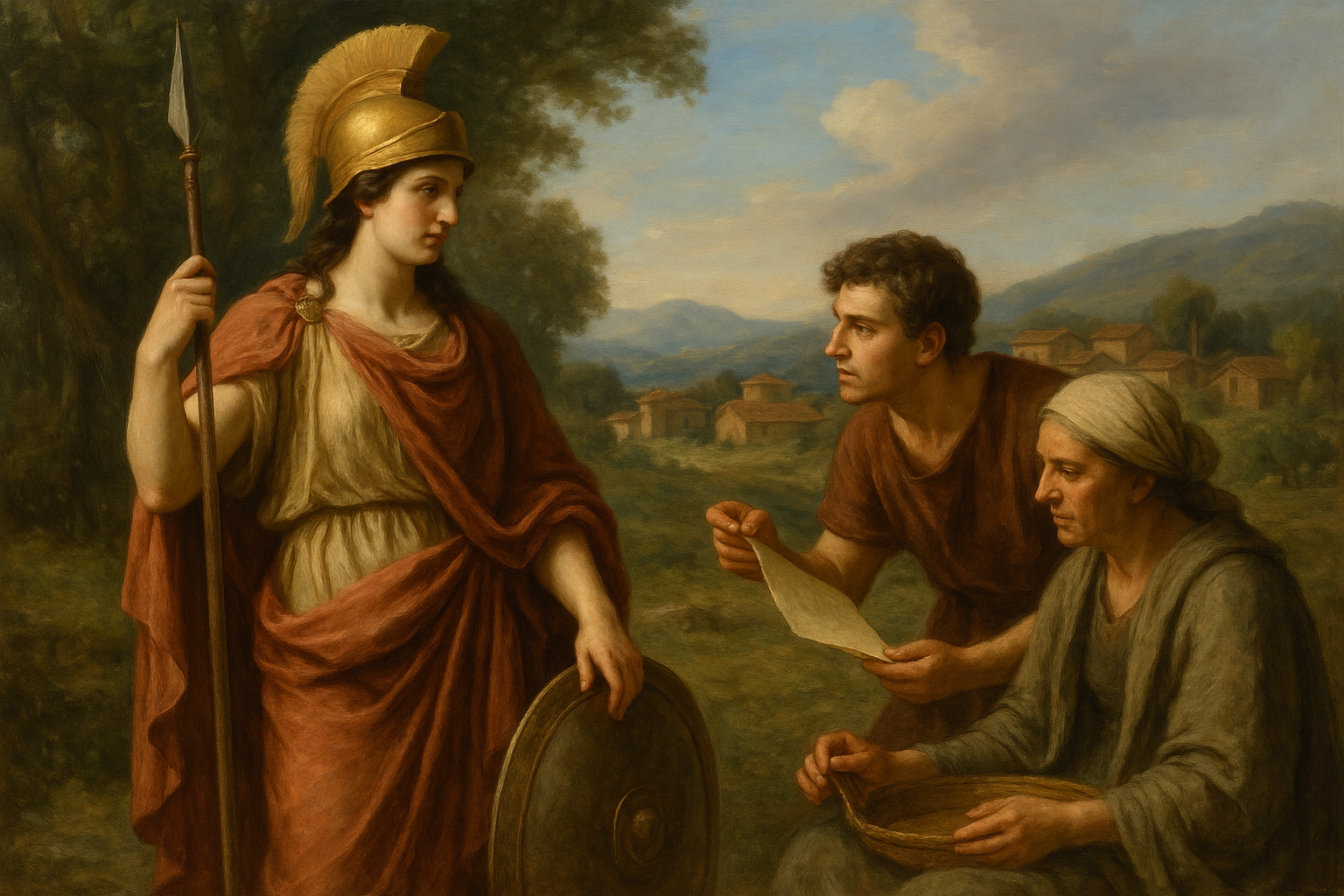
Minerva is one of the most revealing Roman gods to follow through the sources, because she sits at the meeting point of worship, practical skill and political meaning. Romans knew her as a goddess of crafts, learning, medicine and, in some settings, strategic warfare. Yet she was not simply a Roman copy of Athena. The Romans adapted Greek ideas about her, but they also gave Minerva a distinct place in Roman religious life: in festivals, in the Capitol, in guilds of craftsmen, and in the language of state power.
From Italic goddess to Roman Minerva
The name Minerva almost certainly belongs to an older Italic religious tradition rather than coming straight from Greece. By the historical period, however, Roman writers regularly identified her with Athena, and the two goddesses were often represented in similar visual forms. That identification should not erase the Roman side of the story. The Roman Minerva had her own cult, her own festivals and her own public role. She was especially associated with skill, intelligence and disciplined action, qualities that Romans could value in craftsmen, teachers, physicians and commanders alike.
An important clue to her religious status is her place in the Capitoline Triad, alongside Jupiter and Juno. This was one of Rome’s most prestigious divine groupings, housed in the great temple on the Capitoline Hill. The triad belongs to Roman civic religion rather than to Greek myth, and it made Minerva part of the religious architecture of the state itself. In that setting, she was not just a goddess of private devotion but one of the divine powers believed to stand behind Rome’s public order.
The Quinquatria and Minerva’s festival calendar
Minerva’s best-known festival was the Quinquatria, celebrated from 19 to 23 March. Ovid’s Fasti gives the fullest literary account of the festival’s timing and character. He says the first day was marked by ritual quiet and then the following days became a time for games and public celebration. His poem also presents Minerva as especially dear to schoolchildren, teachers, artisans and wool-workers. Those themes fit the goddess’s Roman profile well, though Ovid is a literary source, not a festival handbook, so his account should be read as a poetic explanation of religious custom rather than a neutral record of every rite.
The Quinquatria mattered because it tied Minerva to work and craft as well as to ceremony. Ancient and later Roman sources connect her with spinning, weaving and the skilled use of tools. In a society where household production, textile work and artisanal labour were essential, this gave the goddess a practical relevance. She was not a remote abstraction: she belonged to people who made things with their hands, and to those who needed knowledge, technique and careful judgement to do so well.
What Minerva meant to craftsmen, teachers and physicians
Minerva’s sphere was unusually broad. Roman sources and later antiquarian tradition associate her with handicrafts, learning and medicine, and in some places she appears as Minerva Medica. This title suggests healing or medical protection, though the exact cult practice behind it is not always easy to recover. What matters is that Romans could invoke Minerva not only for intellectual work but for practical expertise.
That breadth made her especially attractive to occupational groups. Craftsmen could see in her the divine patron of exact technique; teachers and students could look to her as a source of disciplined knowledge; physicians could connect her to healing skill. The pattern makes sense in Roman terms: Minerva was not merely the goddess of abstract wisdom, but of intelligence applied to a task. Her favour was something to be earned by competence.
Weaving, women’s work and the household sphere
One of the clearest Roman associations of Minerva is with weaving and textile production. Ovid explicitly tells women to honour Pallas if they want to learn to soften wool and work the loom. This is not a casual decorative detail. It reflects a long-standing Roman understanding that domestic textile labour was central to household virtue and order. Minerva, in that context, becomes a goddess of productive discipline, linked to the daily labour that sustained Roman homes.
Here again it helps to keep Roman and Greek traditions distinct. Athena is famous in Greek myth for weaving, particularly in the story of Arachne in Ovid’s Metamorphoses, where Minerva appears as a divine judge of artistic pride. Romans adapted that myth into their own literary culture, but Minerva’s connection to textile work also had a specifically Roman social dimension. She belonged not only to mythic contests of artistry but to the everyday economy of making cloth, clothing and household goods.
Minerva and the power of the state
Minerva’s political significance is easy to miss if she is treated only as a goddess of wisdom. In Roman religion, intelligence and victory were never entirely separate, and Minerva could stand for the strategic side of warfare rather than the brute force personified by Mars. Ovid’s Fasti presents her as a deity whose festival eventually included public games and military associations, and Roman art often shows her armed, with helmet, shield and spear.
Her link to statecraft is also visible in the Capitoline Triad. A goddess who stood beside Jupiter and Juno on the Capitoline was necessarily a public goddess. In Roman thought, successful rule depended on foresight, craft and ordered action, not on violence alone. Minerva could therefore embody the intelligence that makes institutions function: the judgement of magistrates, the precision of administrators, the planning of commanders and the skill of those who served the state through labour rather than office.
Mythic Minerva in Roman literature
Roman poets often borrowed Greek stories to explore what Minerva represented. Ovid’s Metamorphoses gives the best-known Roman version of the contest with Arachne. Minerva appears in disguise, tests the mortal weaver, and then reveals herself when Arachne refuses to yield. After Arachne’s tapestry insults divine authority, Minerva punishes her and transforms her into a spider. That story is Greek in origin, but Ovid uses it to think about Roman themes: excellence, pride, punishment and the danger of challenging superior order.
In another well-known episode from Metamorphoses, Minerva appears in the contest between herself and Neptune for Athens, again in a Greek setting. These are not Roman foundation stories, and they should not be confused with Roman civic ritual. But they mattered because Roman readers saw in Minerva a deity whose authority included judgement, rivalry and the control of technique. Literary myth deepened the goddess’s profile without replacing her Roman cult.
Why Minerva mattered to Romans
Minerva endured because she joined two things Romans prized: usefulness and authority. She stood for the trained mind, the skilled hand and the ordered state. That combination made her unusually adaptable. She could be honoured by schoolchildren, artisans, healers and magistrates; she could belong to festival calendars and to state temples; she could appear in myth as a divine rival, and in worship as a dependable protectress of work well done.
For Romans, that was not a contradiction. It was the point. Minerva was a goddess for people who believed that good judgement, patient skill and public order belonged together.