The Birth of the Japanese Islands in the Kojiki and Nihon Shoki
The first islands in Japanese myth
The opening chapters of the Kojiki and the Nihon Shoki tell a story that is both cosmological and political: how the world took shape, how the Japanese islands emerged from the primeval sea, and how the line of the emperors was placed within that sacred order. These are not the same text, and they do not tell the story in exactly the same way. But each preserves a vivid account of creation in which the deeds of the kami — beings best translated as “deities”, “spirit powers” or “sacred presences”, depending on context — establish the land and the divine ancestry of rule.
Why the Kojiki and Nihon Shoki matter together
The Kojiki was compiled in 712, followed by the Nihon Shoki in 720, both at the court of the early Japanese state. They were shaped by political as well as religious concerns: the Yamato court wanted an authoritative record of origins, genealogy and legitimacy, and both works help provide one. The Kojiki is generally the more compact and mythic of the two; the Nihon Shoki is more expansive, more overtly courtly, and often preserves several alternative versions of the same event. For the birth of the islands, the Kojiki gives a relatively coherent narrative, while the Nihon Shoki sets out a principal account and then records variants alongside it.
Izanagi and Izanami stir the sea
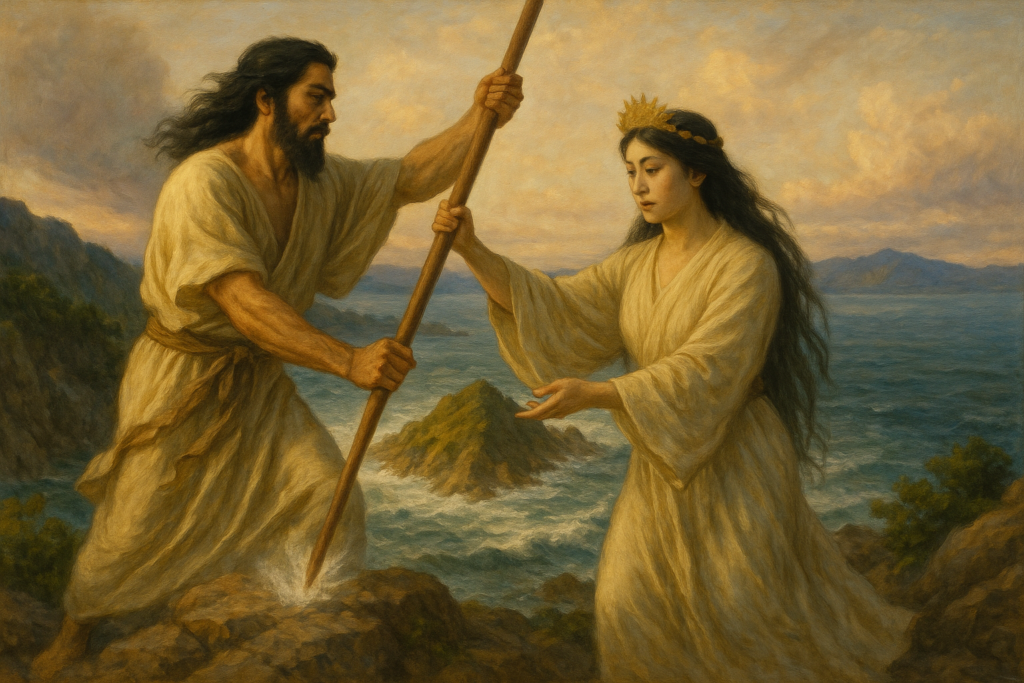
In the principal Kojiki version, the first stage of creation belongs to a divine pair, Izanagi and Izanami. They are often rendered in English as “He-Who-Invites” and “She-Who-Invites”, though the names are better left in their familiar forms. The text places them after an earlier generation of heavenly kami and gives them the task of making order out of a world that is still unstable and formless. Standing on the floating bridge of heaven, they receive a jeweled spear. When they stir the brine below, drops fall from the blade and congeal into land.
That first piece of land is Onogoro, the self-forming island. Izanagi and Izanami descend to it and make it the site of their divine marriage. In the story as the Kojiki tells it, they circle a central pillar in opposite directions and, after the proper exchange of greetings, begin the work of producing the islands and the kami. This is one of the most important features of the myth: land, kinship and sacral authority are joined from the start. The islands are not merely found; they are brought into being through ritual action.
From one island to eight great islands
The couple’s first births, however, go wrong. In the Kojiki, their earliest child is described as malformed because the woman spoke before the man in their marriage exchange. Only after repeating the rite correctly do they succeed in creating the island sequence that becomes Japan. The order differs slightly depending on the text, but the result is the same: the archipelago is imagined as the offspring of a divine union, not as a random scattering of land.
The “eight great islands” are a traditional way of referring to Japan as a complete realm. The number eight is not a precise cartographic claim; it is a sacred and comprehensive number, a way of saying “all the principal lands”. As the story proceeds, Izanagi and Izanami also generate a host of other kami connected with the world’s features — sea, wind, trees, mountains, fire and other powers. In this sense the creation myth is not only about geography. It is also a genealogy of the sacred landscape.
Death enters the story with the fire kami
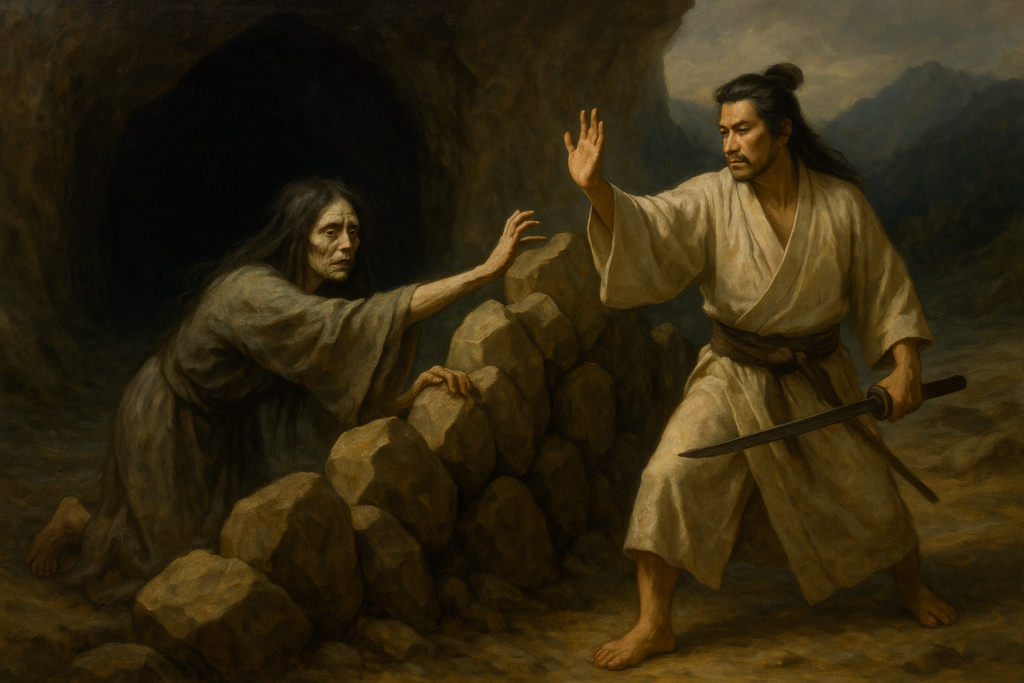
One of the most striking moments in the Kojiki is the birth of the fire kami. Izanami gives birth to Kagutsuchi, and the act burns her so severely that she dies. This episode matters because it breaks the creative sequence and introduces death into the world of the gods. The text then tells of Izanagi’s grief and rage: he kills the fire kami, and from the parts of the slain deity new kami emerge. Creation in the Kojiki is not gentle or serene. It is tied to injury, loss and the dangerous power of birth itself.
After Izanami’s death, the story turns towards separation between the living and the dead. Izanagi goes in search of her, entering the realm of Yomi, the underworld. Although that journey belongs to the wider creation cycle rather than to the island-bearing episode alone, it is important for understanding the emotional shape of the myth. The world that has been made now contains mortality, pollution and boundary-crossing, and the actions of the kami must be understood in relation to those realities.
What the Nihon Shoki adds and varies
The Nihon Shoki repeats the broad outline — heavenly origins, the spear, the island of Onogoro, the divine pair, the birth of the land — but it handles the material differently. Its principal narrative is often more formal and more cosmological, and within the same work it preserves alternative accounts of the beginning. Some versions differ over the earliest generations of kami; others alter the sequence or wording of the island-making episode. One version, for example, places greater emphasis on the ritual correctness of the divine couple’s actions, while another gives a slightly different account of how land first appears.
That variety is not a flaw in the text. It is part of what the Nihon Shoki is doing. By recording competing tellings, the compilers preserved a range of inherited materials while also arranging them within a court-sponsored framework. For readers today, the result is valuable but also complicated: the “creation story” is not one fixed tale, but a cluster of related versions with a shared centre.
Shinto, kami and sacred geography
These narratives are usually discussed in relation to Shinto, Japan’s indigenous religious tradition, though that term covers a wide field of practices and beliefs rather than a single creed. The early chronicles do not define Shinto in the later, organised sense, but they do present a worldview in which kami inhabit and enliven the world. A kami is not simply a god in the Greek or Christian sense. The word can refer to a divine being, but also to a presence, force or numinous quality associated with places, phenomena or ancestral lines.
Read this way, the island-birth myth is not just a tale of origins. It is a map of sacred relationships. Land emerges through divine cooperation; proper conduct matters; disorder has consequences; and the natural world is full of presences that must be approached with care. Later shrine traditions, regional tellings and medieval commentary developed these ideas in many directions, but the core narrative in the Kojiki and Nihon Shoki remains the point of departure.
A creation story shaped by court history
It is also worth remembering why these texts were written down in the first place. The early Japanese court was consolidating authority, organising genealogies and linking political order to sacred history. The creation of the islands by Izanagi and Izanami is therefore both a mythic beginning and a statement about legitimacy. That does not make the story less meaningful. On the contrary, it helps explain its enduring power: it joins territory, ritual and rule in a single imaginative frame.
That is why the birth of the Japanese islands in the Kojiki and Nihon Shoki still feels so compelling. It is a story about land made from sea, but also about the fragile, generative moment when a world gains its shape, its deities and its sense of place.
Sources and further reading
- Basil Hall Chamberlain, “The Kojiki” (Internet Sacred Text Archive) (opens in a new tab)
- W.G. Aston, “Nihongi: Chronicles of Japan” (Internet Sacred Text Archive) (opens in a new tab)
- Japanese Text Initiative, University of Virginia Library: “Kojiki” (opens in a new tab)
- The British Museum, “Feminine power the divine to the demonic” exhibition guide (opens in a new tab)