Izanagi’s Journey to Yomi and the Birth of Purification Rites
Izanagi’s descent to Yomi and the birth of purification
The story of Izanagi’s journey to Yomi is one of the most arresting episodes in early Japanese sacred narrative: a grief-stricken deity enters the realm of the dead, loses what he hoped to recover, and returns to the living world carrying the burden of death’s pollution. In the Kojiki, that return becomes the starting point for a new and enduring ritual logic. From Izanagi’s cleansing come some of the best-known kami, including Amaterasu, Tsukuyomi and Susanoo, and the story also helps explain why purification lies so close to the heart of Shinto practice. Here kami can mean divine or sacred beings, though no single English word captures the term exactly.
The couple who shaped the islands
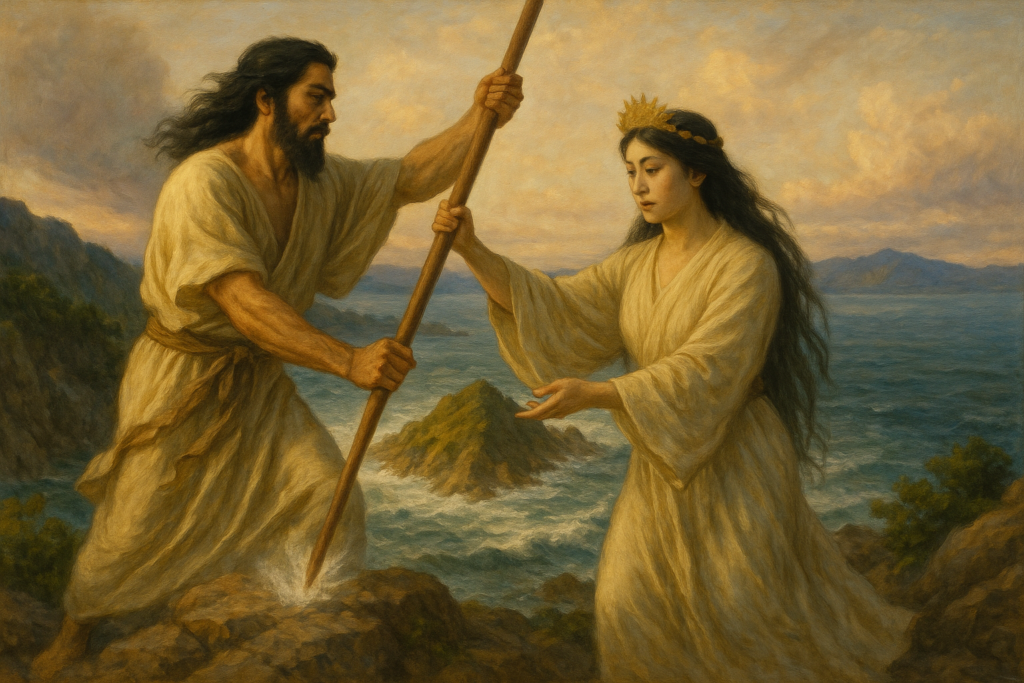
The Kojiki, compiled in 712 in the political world of the Yamato court, presents Izanagi and Izanami as divine partners entrusted with ordering the floating land and giving it shape. Their early work belongs to the larger creation cycle, in which they stir the sea with the jewelled spear, form the first islands and begin to generate both land and deities. The same text then turns to a rupture that matters for the rest of the narrative: when Izanami gives birth to the fire deity Kagutsuchi, she is mortally burned. Izanagi, overcome with grief, kills Kagutsuchi, and the death of his consort opens the way to the descent into Yomi.
In the Kojiki, Yomi is the land of the dead, but it is not presented as a place of moral judgement in the later, developed sense familiar from some other religious traditions. It is instead a realm marked by separation, danger and contamination. That distinction matters, because the story is not simply about loss; it is also about what death does to the living body and what must be done after contact with it.
Why Izanagi goes to Yomi
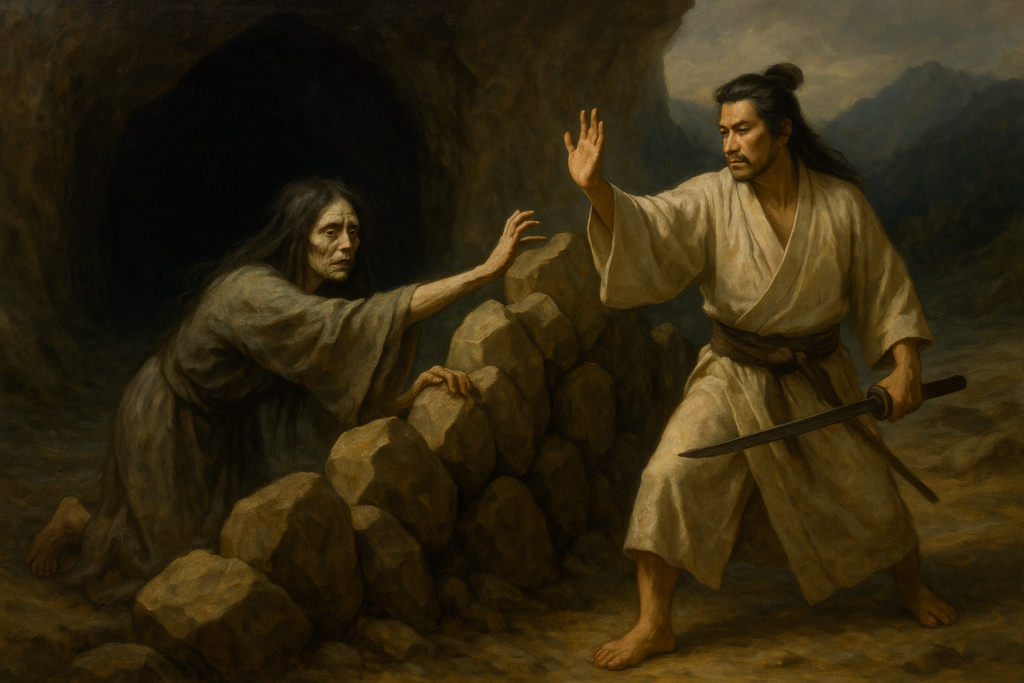
Still longing for Izanami, Izanagi follows her to Yomi in the principal telling of the Kojiki. He reaches the doorway of her dwelling and calls out, but she warns him not to look at her. Curious and anxious, he breaks that instruction and sees her transformed by death. The text’s horror lies not in melodrama but in the contrast between the remembered spouse and the corpse-like figure now before him. Once he has seen her, there is no simple return to the earlier relationship.
Izanami is offended by the breach and sends beings from Yomi in pursuit. Izanagi flees, and the chase gives the story its pace and its tension. At the border slope of Yomi, he blocks the passage with a huge boulder, sealing the realms apart. The image is memorable because it is both physical and cosmic: one act of closure creates a permanent boundary between the living and the dead. From that point on, the story explains, the two cannot freely cross back and forth.
The separation of living and dead
The closing of the Yomi passage is more than a plot point. It is the moment in which the narrative gives shape to a fundamental concern: how the living keep faith with the dead while still acknowledging the danger of death’s taint. Izanami remains in Yomi, and the bond between the two deities is now defined by distance and prohibition rather than reunion. The tale does not linger over ethical blame. Instead, it emphasises the irreversible consequences of contact with the underworld.
This emphasis fits the wider ritual world of early Japanese tradition. In Shinto, impurity or pollution is often discussed through the paired ideas of tsumi and kegare, terms that are not always easy to render in English. They can involve wrongdoing, disturbance, misfortune or the kind of contamination associated with death. The Yomi story gives narrative form to that logic without reducing it to a simple moral allegory.
Izanagi’s ablutions at Awagihara
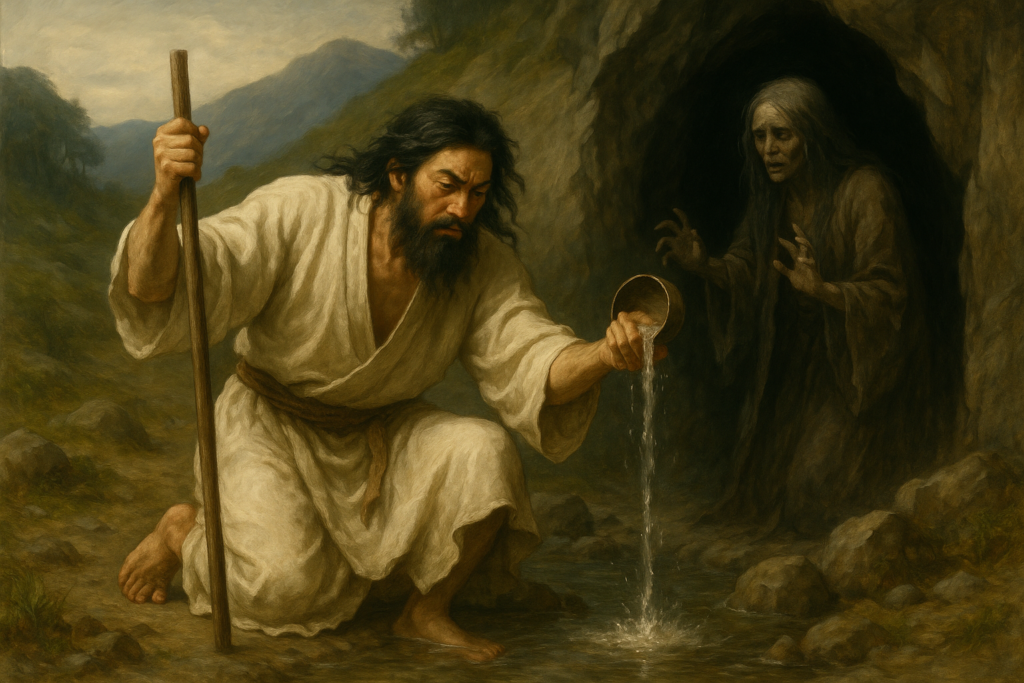
After escaping Yomi, Izanagi reaches a place called Awagihara, where he performs ablutions and ritual purification. In the Kojiki, this is the crucial turning point. He declares the land he has visited foul and hateful, then washes away the pollution from his body. The act is practical within the story, but it is also generative: the cleansing itself produces new kami.
As Izanagi removes items from his body and washes his face and body, the text links purification with creation. Amaterasu is born from his left eye, Tsukuyomi from his right eye, and Susanoo from his nose in the best-known version of the Kojiki account. This is not a casual flourish. The narrative presents purification as fertile, not merely restorative. Order emerges from the removal of defilement. In that sense, the story connects death, washing and divine generation in a single sequence.
The Encyclopedia of Shinto explains that misogi, the washing of the whole body, and harae, broader ritual purification, are related but originally distinct practices. Later they are often linked together as misogi-harae. The myth of Izanagi’s purification is one reason these rites are so closely associated with Shinto life, from shrine entry to formal ceremonies.
What the story means for purification rites
Because the Kojiki was compiled at court, its myths are not neutral records of everything early Japanese people believed. They also serve a political and ritual order, especially by connecting the divine genealogy to the house that ruled. That context helps explain why the purification scene matters so much: it does more than cleanse one deity. It establishes a sacred pattern in which impurity is removed through rite, and renewal follows.
The story has had a long afterlife in religious practice. The Kokugakuin University Encyclopedia of Shinto notes that harae remains one of the most important ceremonies in the tradition, performed at the start of rituals and on specific calendrical occasions. Misogi, meanwhile, still refers to water-based cleansing practices, sometimes before shrine worship and sometimes as a more intensive devotional exercise. It would be misleading to treat every modern practice as a direct survival from the ancient text, but the Yomi narrative remains a key charter story for the idea that purification restores a person to a state fit to approach the kami.
How the Nihon Shoki differs
The Nihon Shoki, compiled a few years after the Kojiki in 720, preserves related material but not always in the same form. It includes alternative accounts, and readers should not assume a single seamless story across both chronicles. In some versions within the Nihon Shoki, the emphasis falls less on the dramatic descent into Yomi and more on Izanagi’s purification after deathly contact, with variations in place and sequence. The chronicles overlap, but they are not identical.
That difference is worth keeping in view. The broad pattern is stable: encounter with death, separation from the dead, and ritual cleansing that restores order. But the details depend on the source. When the Kojiki is taken as the principal retelling, Yomi is the dramatic heart of the story; in the Nihon Shoki, the same mythic complex can appear in alternative forms that shift the emphasis.
A story about boundaries, not just beginnings
Izanagi’s journey to Yomi endures because it speaks to several concerns at once: grief, separation, the danger of death and the need for renewal. It is also a story about boundaries, physical and ritual alike. The boulder at the border of Yomi, and the washing that follows, mark the point at which contact becomes distance and pollution gives way to purification. That is why the narrative still matters, not as a frozen relic, but as part of a living religious and literary tradition in which the act of cleansing remains charged with meaning.
Sources and further reading
- Kojiki English Translation, Kokugakuin University (opens in a new tab)
- “Misogi,” Encyclopedia of Shinto, Kokugakuin University (opens in a new tab)
- “Harae, Harai, Nakatomi no harae, O-harai, Shubatsu, Misogi-harae,” Encyclopedia of Shinto, Kokugakuin University (opens in a new tab)
- W. G. Aston, Nihongi: Chronicles of Japan from the Earliest Times to A.D. 697, Sacred Texts Archive (opens in a new tab)