Izanami in Yomi: Death, Separation and the Boundaries of the Underworld
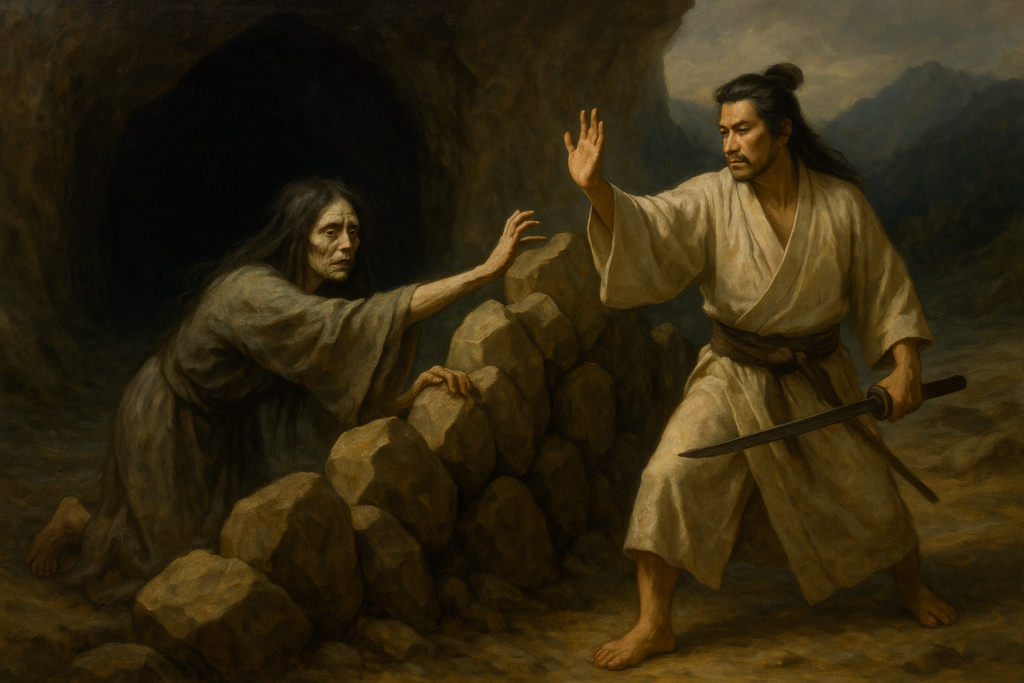
Izanami’s journey into Yomi is one of the most arresting episodes in early Japanese sacred narrative: a story about love, rupture, death and the dangerous boundary between the living and the dead. In the Kojiki, compiled at court in 712, it becomes a dramatic turning point in the lives of Izanami and her consort Izanagi, and a key explanation for why death, pollution and purification matter so deeply in Shinto traditions. Here, Izanami is not a distant abstraction but a kami whose story is bound up with creation itself. “Kami” does not have a perfect single English equivalent; it can suggest a deity, spirit or sacred presence, but the term is broader than any one of those words.
From creation to calamity
The principal retelling in the Kojiki begins with Izanami and Izanagi joining the heavenly command to shape the drifting land. After their first attempts at creating children fail, they perform the well-known ritual around the heavenly pillar and successfully give birth to the islands of Japan and to many other deities. The sequence matters: creation comes through union, right conduct and shared action.
That order is broken when Izanami gives birth to Kagutsuchi, the fire kami. In the Kojiki, the birth burns her genitals and she falls ill. As she dies, further kami emerge from what has happened to her body, including deities associated with metal, earth, water and wood. The myth is not simply a tale of tragedy; it links death to further sacred generation, while also marking a profound loss in the relationship between the divine pair.
Izanagi responds with rage and grief. In the Kojiki, he kills Kagutsuchi with a ten-hand-long sword. The text does not present this as a neat resolution. Instead, Izanami’s death opens the road to Yomi, the underworld or land of the dead, and the story turns from creation to separation.
Izanagi enters Yomi
Still longing for her, Izanagi goes after Izanami into Yomi. This is the version told in the Kojiki, and it is the main source for the familiar story of the journey to the underworld. When he reaches the entrance, Izanami tells him not to look at her. She says she has already eaten the food of Yomi, which makes a return to the world of the living impossible. In some later retellings this detail becomes especially prominent; in the Kojiki, the emphasis is on the broken boundary rather than on any doctrine of punishment or moral judgement.
Izanagi cannot keep his promise. He enters the house or chamber and sees Izanami’s transformed body, already associated with decay. The shock is immediate. The text keeps the scene stark rather than lurid: the key point is not horror for its own sake, but the taboo of looking upon what should remain hidden. In the logic of the story, this sight creates a breach that cannot be repaired.
When Izanami realises what has happened, she is furious and ashamed. She sends the hags of Yomi after him, and later the eight thunder deities and an army of Yomi. Izanagi escapes by casting down objects that transform into food or growth, buying time while he runs. At the Yomi slope, Yomotsu Hirasaka, he hurls peaches at the pursuers; in East Asian tradition peaches can have apotropaic force, and here they help drive back the powers of death. This is one of the clearest places where the story shows the underworld as an active, dangerous realm rather than a vague shadowland.
The stone that seals the world apart
The final act is not a victory but a boundary. Izanagi blocks the Yomi passage with a huge boulder, and the two stand on opposite sides of it. They exchange words of separation, and the relationship is broken for good. The Kojiki describes Izanami as the “great kami of Yomi” and, in another designation, the road-pursuing great kami. These names underline her new status: she is no longer merely the dead consort of a creator god, but a powerful presence at the threshold between worlds.
The story then gives the exchange between life and death a grim structure. Izanami threatens to cause the deaths of a thousand people each day; Izanagi replies that he will cause fifteen hundred births each day. Read within the narrative, this is a mythic accounting of the world’s balance: death is real, relentless and daily, but so is renewal. The text is not offering a scientific explanation; it is shaping a sacred understanding of why human life proceeds through mortality and continuation together.
Purification after Yomi
After escaping, Izanagi performs ablutions to cleanse himself of the pollution of Yomi. This purification is crucial. The story presents death as a source of kegare, a ritual contamination that must be removed, rather than as a moral stain in the Christian sense. Izanagi’s washing is followed by the birth of major kami, including Amaterasu, Tsukuyomi and Susanoo, when he cleanses himself in sequence. In the Kojiki, this is one of the most important transitions in the whole narrative: from contact with death to renewed divine potency through purification.
That emphasis on cleansing helps explain why the Izanami episode has remained so influential in discussions of Shinto. It is often read as a foundational myth for purification practices, but it should not be reduced to a simple origin story for one ritual. The broader point is that dangerous contact with death requires careful removal and renewal. The story gives narrative form to a religious concern that remains meaningful in living traditions today.
Kojiki first, Nihon Shoki second
The Kojiki is the principal source for the continuous Yomi narrative told above. The Nihon Shoki, compiled in 720 in a different court context, preserves related material but not in exactly the same way. It is an official chronicle with multiple alternative accounts, and those versions should not be blended silently into one story. In the Nihon Shoki, Izanami’s death and burial may be placed differently, including an alternative tradition that locates her burial in Kumano rather than in the Kojiki’s Mount Hiba tradition. The chronicle also preserves variant tellings of early divine events, which reminds us that early Japanese sacred narrative was transmitted in more than one form.
That difference matters. The Kojiki gives a coherent dramatic sequence centred on Yomi; the Nihon Shoki presents a courtly compilation in which alternative accounts stand side by side. Both belong to the early textual world of eighth-century Japan, where compilers shaped older traditions in ways that served political and historiographical aims. Reading them together is valuable, but the versions should remain distinct.
Why Izanami’s story still resonates
Izanami’s descent into Yomi endures because it is about more than death. It is about the moment a shared world becomes divided: husband from wife, living from dead, purity from pollution, order from breach. The myth gives that separation a name, a place and a boundary stone. It also grants Izanami lasting significance. She is not simply the lost partner of a male creator deity, but a kami whose transformed power helps define what lies beyond human life.
For readers approaching ancient Japanese mythology for the first time, the episode is a useful reminder that these narratives are not neat moral allegories. They are living sacred stories, preserved in particular texts and traditions, and shaped by the concerns of ritual, kinship and authority. In Izanami’s story, the underworld is not the end of meaning; it is the place where the boundary between worlds becomes impossible to ignore.
Sources and further reading
- “Studies on the Kojiki: Chapter 9, The Land of Yomi (1)” — Kokugakuin University (opens in a new tab)
- “Kojiki” — translated by Donald L. Philippi (opens in a new tab)
- “Izanami” — Encyclopedia of Shinto, Kokugakuin University (opens in a new tab)
- “Yomi-no-Kuni and Amaterasu Ōmikami” — Jinja Honchō (opens in a new tab)