Vesta and the Sacred Fire of Rome
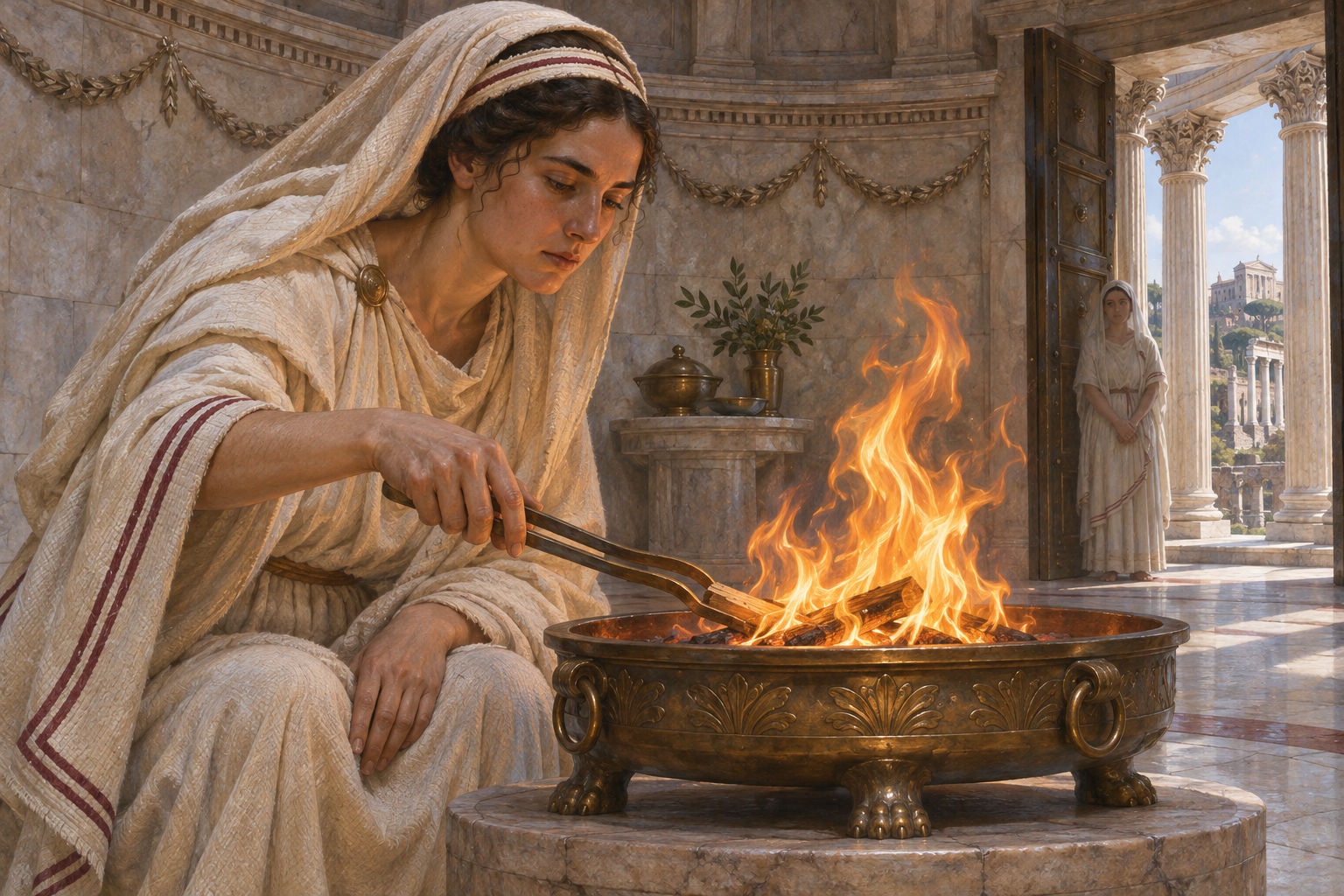
Vesta was one of Rome’s most enduring divine presences: less a mythic adventurer than the guardian of the city’s life itself. Her sacred fire, kept in a round shrine in the Forum, was believed to stand for the continuity of Rome and the safety of its people. Unlike many Roman gods, Vesta is best understood not through a dramatic cycle of stories but through ritual — and through the careful work of the Vestal Virgins, who maintained the flame and embodied the city’s religious order.
Vesta’s place in Roman religion
In Roman religion, Vesta was the goddess of the hearth. That makes her superficially comparable to the Greek Hestia, but the Roman cult developed its own emphases and institutions. Roman writers could connect the two, yet Vesta in Rome was not just a domestic goddess: she was a public power, linked to the state as well as to the household. The Roman hearth was both a family centre and a civic symbol, and Vesta belonged to both spheres.
The best-known image of her cult was the sacred fire in the Temple of Vesta, a shrine in the Roman Forum that was circular in form and did not house a cult statue in the way many temples did. Ancient authors such as Ovid and Dionysius of Halicarnassus associate the goddess with the flame itself, and modern museums and scholarly reference works still stress that Vesta was represented by the fire rather than by an image in the usual sense. That is one reason her cult feels so distinctively Roman: the goddess was present in an active ritual element, not simply in stone or bronze.
The sacred fire at the heart of Rome
The fire in Vesta’s shrine was meant to burn without interruption. In Roman thought, its endurance mirrored the endurance of the city. If the hearth of Rome went out, that was more than a practical failure; it was a religious crisis. Ancient evidence suggests that the flame was treated as central to the welfare of the state, and the temple’s setting in the Forum made the symbolism impossible to miss. Rome’s public life gathered around Vesta’s fire just as a household gathered around its own hearth.
Our clearest literary guide to this aspect of the cult is Ovid’s Fasti, a poem on the Roman religious calendar. Ovid presents Vesta as a goddess closely identified with the hearth and the flame, and he gives the sacred fire an origin story tied to Rome’s legendary beginnings. Those verses are valuable, but they are still poetry, not a temple record; they tell us how an educated Roman author imagined the cult, rather than proving every detail of its earliest practice.
How the Vestal Virgins tended the flame
The fire was guarded by the Vestal Virgins, six priestesses chosen for long service. Their role was unusually prominent for Roman women, and ancient and modern sources alike emphasise the prestige and responsibility attached to the office. They maintained the flame, performed rites on behalf of the Roman people, and protected sacred objects kept in the shrine. Their status was exceptional, though the details of their privileges and restrictions varied over time and according to the author describing them.
Their virginity was not a decorative moral ideal but part of the religious logic of the office. Roman tradition linked the purity of the priestesses to the security of the flame, just as the flame itself represented a protected civic order. This is one of the striking features of Vesta’s cult: it combined public authority with ritual restraint, and female priesthood with state religion. In a society where most formal public religion was male-dominated, the Vestals were an important exception.
Where the cult came from: tradition and foundation legend
Roman tradition gave Vesta an ancient pedigree. Livy, in his account of Rome’s early kings, links the goddess’s cult to Numa Pompilius, the second king, who is credited with shaping much of Rome’s religious life. Ovid, by contrast, connects the cult’s establishment with Alba Longa in the legendary past before Rome’s rise. These accounts are not identical, and they should not be smoothed into a single story. Together, they show that Roman writers wanted Vesta to seem older than the city itself, rooted in Italy’s sacred past and in Rome’s earliest memory.
There is also a foundation legend involving Aeneas and Trojan ancestry in some Roman traditions, but that belongs to the wider Roman myth of origins rather than to the core cult story of Vesta herself. It matters because Roman authors often folded gods into national history: a goddess of the hearth could become a guardian of the city’s destiny, and a ritual fire could be imagined as part of Rome’s earliest inheritance. But the literary versions should be kept distinct. Livy, Ovid and later writers do not all tell the same story, and none should be read as if they were reporting a modern historical archive.
Why fire, purity and continuity mattered so much
Vesta’s cult made sense in a Roman world that understood religion as a set of obligations sustaining the community. Fire was practical, but it was also symbolic: it cooked food, warmed the home, and marked the enduring life of a household. In the state cult, those meanings expanded into civic ideology. The flame at Vesta’s shrine signified Rome’s continuity, while the Vestals’ care for it represented disciplined service to the whole people.
Some ancient writers also explored a more philosophical reading of Vesta. Dionysius of Halicarnassus, for example, reports interpretations that connect her with the earth or with the central fires of the cosmos. These are not the most important explanations for a general reader, but they remind us that Roman religion was never only practical. It could also be reflective and speculative, especially when authors tried to explain why a public flame should matter so much.
The temple, the rites and what survives
Archaeology and later visual evidence help us picture the cult, even where the earliest practice remains elusive. The Temple of Vesta in the Forum was repeatedly rebuilt and restored, and its circular plan made it instantly recognisable. Yet the surviving ruins cannot tell the whole story by themselves. Much of what we know comes from texts, coins and later artistic representations, all of which must be handled with care.
What emerges most clearly is the blend of domestic symbolism and state religion. Vesta was not a remote thunderer or a conquering war god. She presided over the humble but essential act of keeping a fire alive, and Rome elevated that act into a civic duty of the highest order. That is why her cult endured for so long and why her name still suggests steadiness, guardianship and home.
Vesta’s sacred fire was one of Rome’s simplest religious symbols, but also one of its deepest. In tending it, the Vestals were not merely keeping a flame alight; they were maintaining a vision of Rome itself — continuous, protected and bound together by ritual care.
Sources and further reading
- Ovid, Fasti, Perseus Digital Library (opens in a new tab)
- Livy, History of Rome, Book 1, Perseus Digital Library (opens in a new tab)
- “Vesta, Vestals” in Oxford Classical Dictionary (opens in a new tab)
- The Metropolitan Museum of Art, “Portrait of a Young Woman as a Vestal Virgin” (opens in a new tab)