Amaterasu’s Retreat into the Rock Cave and the Return of Light
When Amaterasu, the bright kami of the sun, withdraws into the Heavenly Rock Cave, the world in the old Japanese court chronicles falls into darkness and disorder. What follows is one of the most memorable episodes in early Japanese mythology: not a simple rescue scene, but a carefully staged recovery of light, balance and authority. In the Kojiki, compiled in 712, the story forms part of a wider genealogical and political account of the divine age; the later Nihon Shoki retells it with variations and alternative versions, reflecting the courtly context in which both works were assembled. In Shinto usage, kami are not reducible to “gods” in a narrow sense: the word can cover divine presences, powers, and revered beings whose character may shift from text to text.
Susanoo’s violence and the breaking of order
The main version in the Kojiki begins after a dispute in the High Plain of Heaven, Takamanohara, between Amaterasu and her brother Susanoo. Susanoo has already behaved destructively, and the crucial escalation comes when he wrecks Amaterasu’s sacred spaces and commits shocking acts in the hall where she is engaged in weaving. In the Kojiki, this assault is the immediate cause of her retreat; the text presents the event as an outrage against ritual order, not just a family quarrel. The result is cosmic: when Amaterasu shuts herself inside the rock cave, heaven and the land below are plunged into darkness.
That sequence matters because it is not merely about light disappearing. In the chronicle’s logic, Amaterasu’s withdrawal signals a breakdown in the relations that hold the world together. The world does not end, but it becomes dangerously unbalanced. The other kami respond as if to a state crisis, gathering to think through a remedy. This is one reason the story has remained so compelling: it joins a vivid image with a broader concern for purification, restoration and legitimate rule.
The consultation of the kami
The assembled kami do not rush the cave. Instead, they plan. In the Kojiki, the solution is proposed by Omoikane, the thoughtful deity associated with strategy and wise planning, while Ame no Tajikarao stands by the cave door ready to act. The choice of helpers is meaningful: one kami devises, another provides force, and others prepare sacred objects for the rite. The story turns not on individual heroics alone, but on coordinated action and ritual intelligence.
Here the Kojiki places Ame no Uzume at the centre of the recovery. She is often described as a kami linked with performance and later with ritual arts. In the classical narrative, she becomes the figure who first breaks the mood of fear and silence. The text also connects her with the Sarume lineage, underscoring how court myth could be woven into ancestral claims.
Ame no Uzume’s dance before the cave
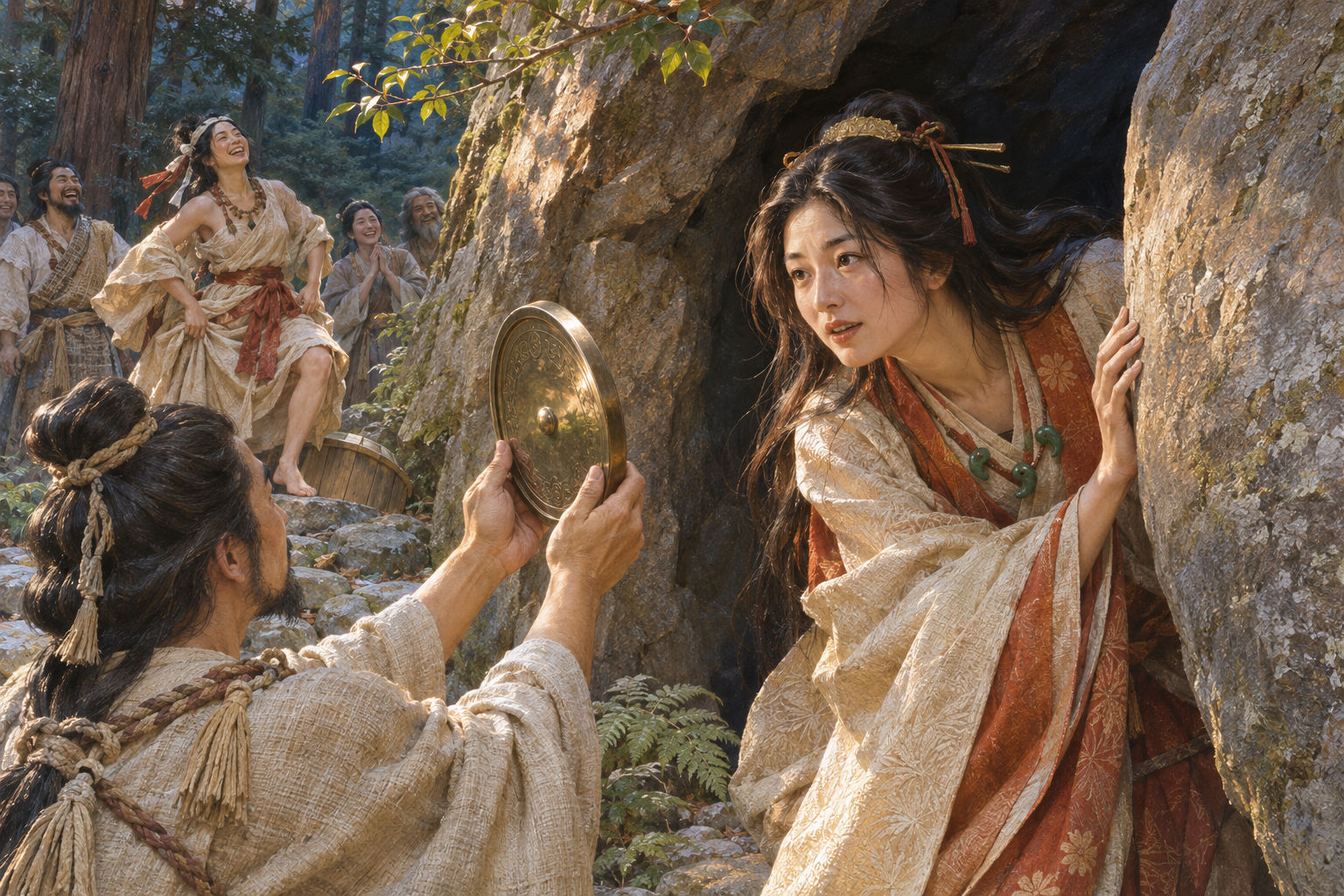
The Kojiki describes Uzume adorning herself with heavenly plants, overturning a tub, and stamping upon it in a manner that startles and delights the gathered kami. Her performance is unruly in appearance, yet it is precisely this controlled disruption that helps restore order. The other kami laugh aloud. That laughter is important: it breaks the atmosphere of dread and suggests that light may return not through force alone, but through the reanimation of communal life. Uzume’s conduct in the Kojiki is more explicit and bodily than in the Nihon Shoki; the latter preserves alternative tellings in which some details differ, including the kinds of implements used and the treatment of her performance.
At this point the mirror and the sacred branch are set out near the cave entrance. The mirror is especially important in the story’s later religious life, because it belongs among the imperial regalia associated with Amaterasu. In the narrative itself, however, it functions first as part of the lure: a means by which Amaterasu can be enticed into looking outward again. The tale is careful to show that the gods do not drag her out by brute strength while she remains unwilling. Instead, they create the conditions for her curiosity.
Amaterasu peeks out, and light returns
Drawn by the disturbance outside, Amaterasu opens the cave door just enough to ask what is happening. In the Kojiki, the explanation given to her is that another august kami has appeared. When she leans out, she sees her own shining image in the mirror. Curious and cautious, she steps farther forward. At that moment Tajikarao pulls her fully from the cave, and the gods close the entrance behind her. The world is illuminated again. Darkness recedes not because it is defeated in battle, but because the sun kami re-enters the shared world.
That ending is simple in outline, but rich in implication. Amaterasu’s return restores visibility, order and continuity. The episode is often read as a charter for renewal: a symbolic account of how a damaged world can be set right through ritual action, collective effort and the careful use of sacred objects. It is also a story about seeing and being seen. Amaterasu is brought back not by coercion, but by an invitation to witness something compelling beyond the cave door.
Kojiki and Nihon Shoki: one story, more than one telling
For readers familiar with the episode from later retellings, it is worth keeping the principal source in view. The main version here follows the Kojiki. The Nihon Shoki, compiled a little later in the eighth century, preserves the same broad arc but also several alternative accounts. In some of its versions, the emphases shift: the details of Uzume’s performance differ, some bodily elements are omitted, and the text can be less expansive about the gods’ laughter and Amaterasu’s exchange with those outside. Rather than smoothing these differences away, it is better to see them as evidence of a court culture that preserved multiple ways of telling a foundational myth.
That court context matters. The Kojiki and Nihon Shoki were not neutral anthologies of ancient belief. They were compiled for an early imperial court that had political reasons to order the past, trace divine descent, and link sacred narrative to authority. Amaterasu’s recovery is therefore more than a dramatic mythic scene: it is also part of a larger story about the legitimacy of rule and the place of the imperial line within the divine order imagined by these texts.
The cave in later devotion and local tradition
The narrative has lived far beyond the early chronicles. Shrines associated with the cave episode, especially in Takachiho, continue to interpret and present the story within contemporary Shinto practice. Japan National Tourism Organization and official shrine materials describe Amano Iwato as a site connected with Amaterasu’s concealment and return, while the shrine’s own tradition should be understood as one important local expression rather than proof that every ancient source tells the tale in exactly the same way. The cave story also appears in ritual and cultural settings where the emphasis is on renewal, harmony and the proper relation between people and kami.
Seen in that light, the episode is not just a dramatic myth of darkness and sunrise. It is a story about how a community gathers itself after rupture, how sacred order is restored through performance and ritual, and how light returns when the world is once again able to receive it.
Sources and further reading
- The Kojiki: A New Translation by Gustav Heldt, Kokugakuin University (opens in a new tab)
- “Amenouzume”, Encyclopedia of Shinto, Kokugakuin University (opens in a new tab)
- “Amaterasu”, Encyclopedia of Shinto, Kokugakuin University (opens in a new tab)
- “Origin of ceremonies of the Imperial court connected with the sun — Deciphering the myths of the Ama no Iwayato”, Kokugakuin University (opens in a new tab)