Odin and the Theft of the Mead of Poetry
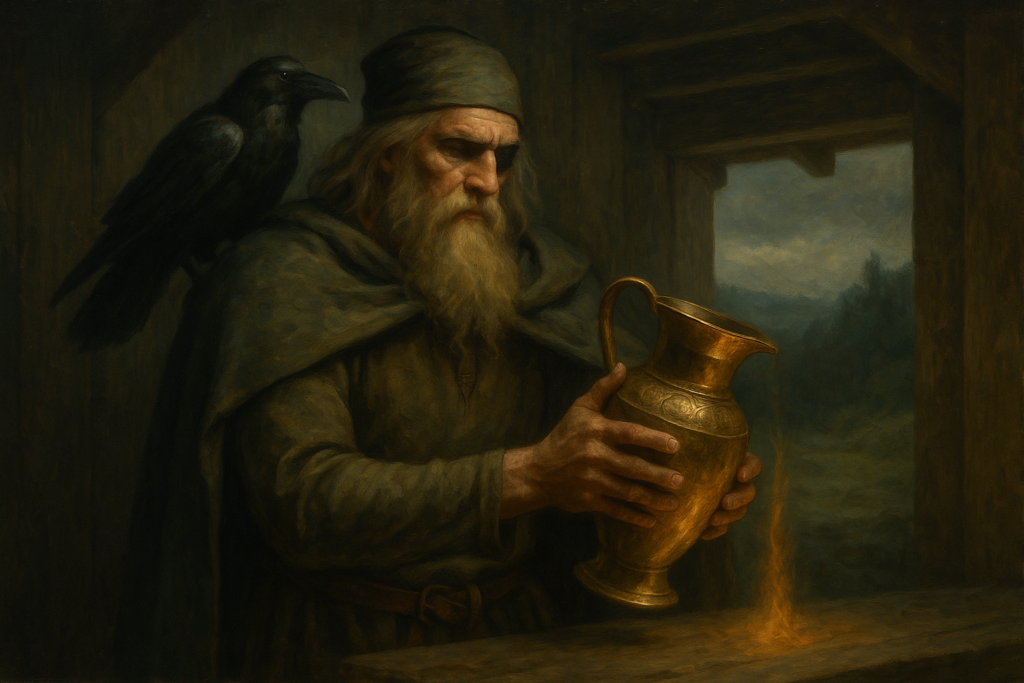
Odin’s theft of the Mead of Poetry is one of the best-known myths attached to the Norse god Óðinn, but the surviving evidence is not a single, uniform story. The fullest account is in Snorri Sturluson’s Prose Edda, written in thirteenth-century Iceland, while the poem Hávamál in the Poetic Edda alludes to a different version of Odin’s winning of the mead. Together these texts show Odin as a god of wisdom, cunning, and poetic inspiration, though they were written down in Christian times and preserve older traditions in mediated form rather than giving us a direct snapshot of pre-Christian belief.
The mead and why it mattered
The Mead of Poetry is not ordinary drink. In the myth, it is a source of poetic skill and deep knowledge: whoever drinks it becomes a skald and a wise person. That idea fits the social world of early medieval Scandinavia, where poets were valued at courts for their ability to praise rulers, preserve memory, and shape reputation. The mead therefore stands for more than intoxication. It explains why poetry is powerful, why it can be treated as inspired, and why skalds could claim a special relationship to Odin. Later skaldic poetry repeatedly refers to poetry as “Kvasir’s blood” or by other names derived from the myth, showing that the story mattered within the poetic tradition itself.
Kvasir, the dwarves, and the making of the mead
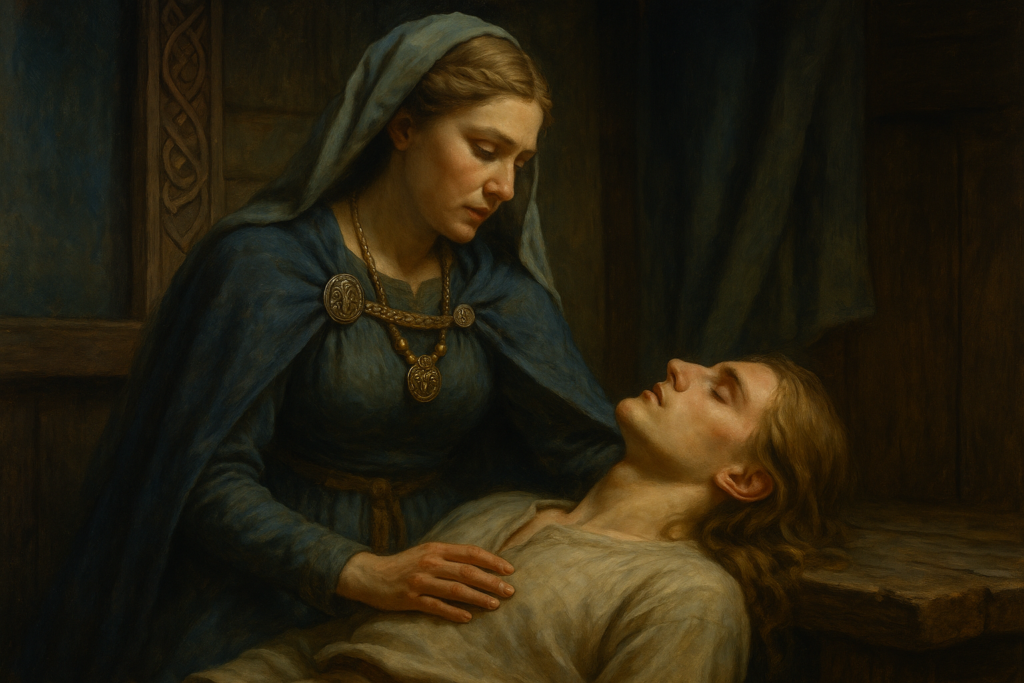
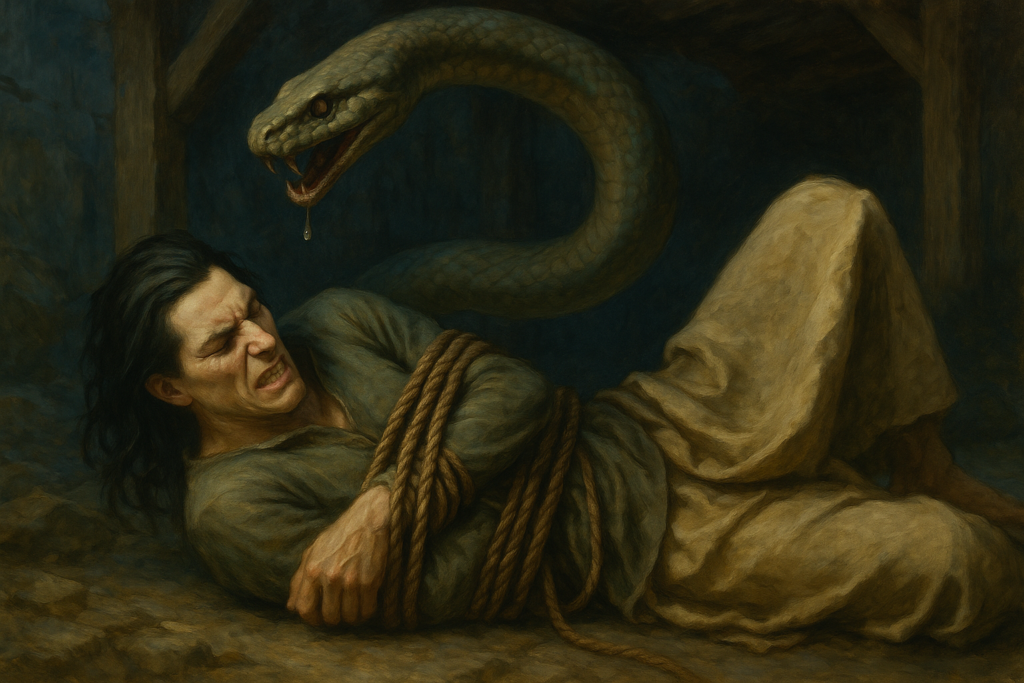
Snorri’s account begins after the war between the Æsir and the Vanir. To seal peace, the gods spit into a vessel, and from that mixture they create Kvasir, a being so wise that he can answer any question. Kvasir travels widely teaching wisdom until the dwarves Fjalar and Galar invite him aside and kill him. They collect his blood in two vessels and a kettle, then mix it with honey. The result is the Mead of Poetry. This is the first stage of the story and it is essential: the mead is born from violence, knowledge, and transformation. The myth links inspiration to sacrifice and to the dangerous transfer of power from one being to another.
Snorri also explains the mead’s names. It can be called the Mead of Suttungr, because the giant Suttungr later acquires it, and it is associated with the containers in which it is kept. These details matter because they show that the tradition was already complex when Snorri wrote it down. He is not simply telling a folktale; he is organising inherited material for readers who needed to understand poetic language.
Odin’s bargain with Baugi
Once the mead has fallen into Suttungr’s hands, Odin sets out to obtain it. In Snorri’s telling, he takes the name Bölverkr, “worker of evil”, and goes to the giant Baugi, Suttungr’s brother. He works for Baugi’s nine labourers over the summer, then asks for a drink of the mead as payment. Baugi says he cannot decide, but agrees to help him if he can. Odin then uses trickery: he has Baugi drill a hole into the mountain Hnitbjörg where the mead is stored. This part of the story makes Odin a figure of patience and deception rather than open force. He does not seize the treasure in battle; he engineers access to it.
Snorri’s narrative is careful about sequence. Odin first secures an entry into the mountain, then transforms himself. The mead is protected not merely by a giant but by a closed, hidden space, which underscores its rarity and value. Odin’s success depends on shape-shifting, oath-breaking, and verbal cunning as much as on strength.
The eagle flight and the stolen draught
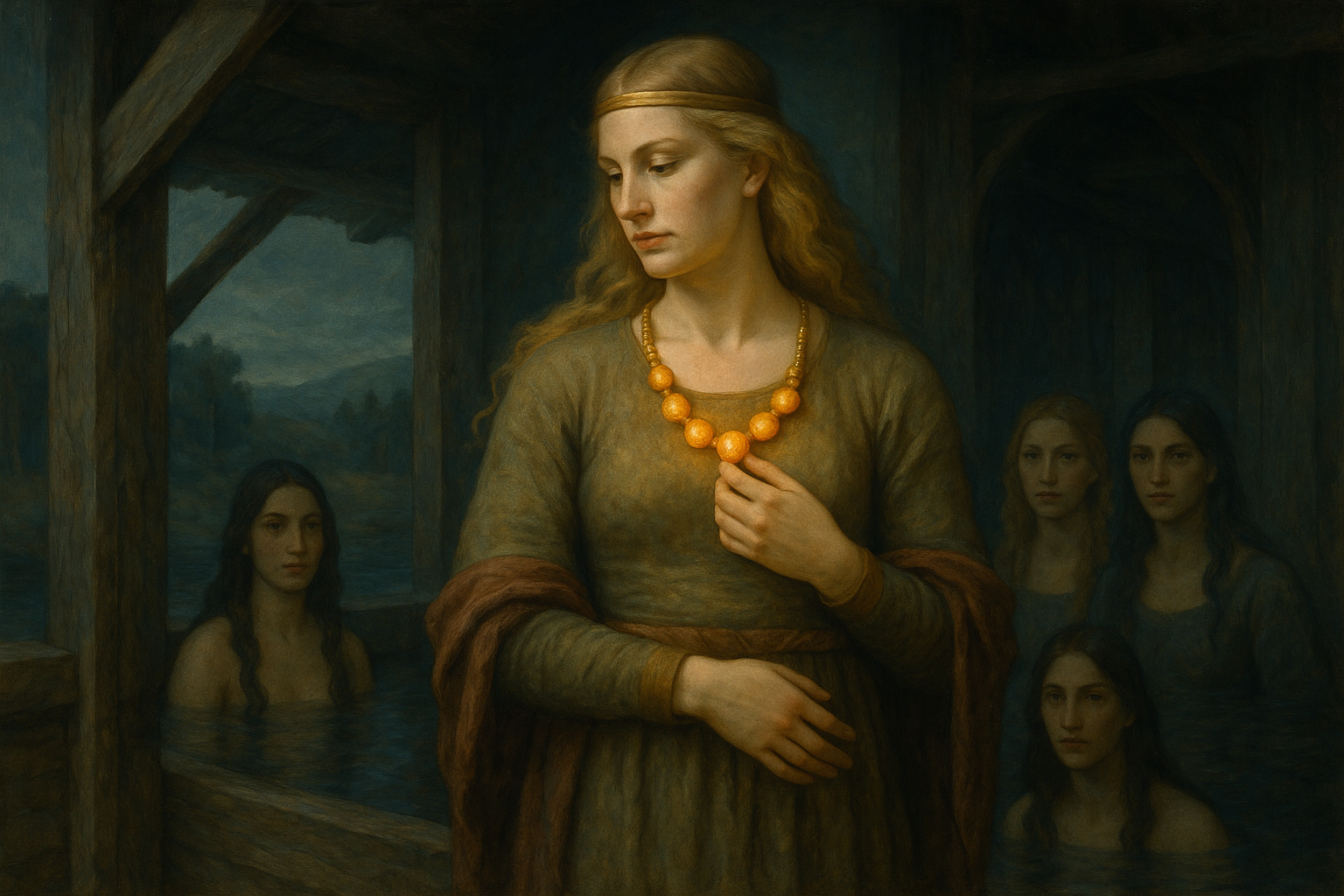
After entering the mountain, Odin seduces Gunnlǫð, Suttungr’s daughter, who is guarding the mead. He spends three nights with her and is allowed three drinks. In Snorri’s version, he drinks the whole supply in three draughts, taking down all the mead at once. Then he turns into an eagle and flies away. Suttungr also assumes eagle form and chases him, but Odin reaches the gods’ enclosure first. The gods set out containers; Odin spits the mead into them. According to Snorri, some of it is lost and falls behind the pursuer, which becomes the share of bad poets. That detail is characteristic of the myth’s humour: not all poetry is equally good, and not everyone who claims inspiration receives the full gift.
This is the version most readers know, but it is not the only one. Snorri’s Prose Edda presents the story in a prose narrative shaped by his own literary and explanatory purposes. It helps account for poetry in general, and skaldic diction in particular, by tracing it back to a divine theft.
What Hávamál says differently
The poem Hávamál offers a related but distinct account in its sections on Odin’s dealings with Gunnlǫð. There, Odin speaks in the first person about gaining the precious mead and about the woman who let him drink it. The tone is more lyrical and compressed than Snorri’s prose. The poem does not retell every step of the mountain episode in the same detail, and readers should not flatten the two sources into one composite myth. They overlap strongly, but they are not interchangeable. Hávamál is an eddic poem; Snorri’s version is a later prose retelling, written with a poetics handbook in mind.
That distinction matters because medieval Icelandic literature preserves myths in different genres for different purposes. Eddic poems are old anonymous verse, though surviving in medieval manuscripts. The Prose Edda is Snorri’s thirteenth-century manual for poets and mythic reference. Skaldic poetry, by contrast, is highly crafted court verse that often alludes to myths in compressed form. A single reference in a skaldic stanza may presuppose the entire mead story without narrating it.
Odin, poetry, and Christian-era transmission
Why was this myth so enduring? Part of the answer lies in Odin’s role as a patron of poetry and wisdom. The mead story makes poetic skill something that can be received, stolen, and unevenly distributed. It also suits a culture in which poets performed at courts and where mastery of language carried prestige. At the same time, the evidence we possess comes from medieval Christian scribes and compilers, especially in Iceland. They did not invent the myths from nothing, but neither did they simply transcribe a pre-Christian oral record. Their texts preserve older material through the filters of later literary culture.
That is why scholars treat the sources critically. The tale of the Mead of Poetry is not a transparent report of what every pre-Christian Scandinavian community believed. It is a literary myth, preserved in several forms, each with its own voice and agenda. Yet across those forms, Odin remains recognisable: a god who pursues wisdom relentlessly, wins it through risk and deception, and makes poetry itself part of the divine order.
Sources and Further Reading
- Edward Pettit, The Poetic Edda: A Dual-Language Edition (Open Book Publishers) (opens in a new tab)
- Snorri Sturluson, The Prose Edda, translated by Arthur Gilchrist Brodeur (opens in a new tab)
- Lee M. Hollander, The Poetic Edda (University of Texas Press) (opens in a new tab)
- Cambridge University Press, A History of Old Norse Poetry and Poetics, chapter on Old Norse poetic aesthetics (opens in a new tab)