Ame-no-Uzume and the Cave Dance: Performance, Laughter and Sacred Renewal
Ame-no-Uzume is one of the most vivid figures in early Japanese mythology: a deity associated with performance, laughter and the restoration of light. Her best-known role appears in the “cave dance” episode, where her spirited performance helps draw Amaterasu, the sun kami, back into the world after the latter has hidden herself in the heavenly rock cave. In the literary and religious imagination of Japan, it is a story about more than entertainment. It is also about ritual, social order and the renewal of a cosmos threatened by darkness.
Amaterasu’s retreat into the heavenly rock cave
The principal version of the story is found in the Kojiki, compiled in 712 in the political context of an expanding court culture that was gathering and organising sacred narratives linked to imperial authority. In that telling, Susanoo’s disruptive behaviour in the Plain of High Heaven leads to a crisis. The text then moves to the episode in which the weaving maiden is injured while working on the divine garments. In the Kojiki, this injury is part of what drives Amaterasu to withdraw into the heavenly rock cave, shutting the world away from her light.
Once Amaterasu has hidden herself, the world falls into darkness. The other kami gather, and the narrative presents their response not as brute force, but as a careful sequence of ritual actions designed to restore balance. Divination is performed, sacred objects are prepared, and the gods assemble outside the cave. The story is dramatic, but it is also ceremonial in tone: a disorder caused by violence and distress must be answered by collective ritual action.
Ame-no-Uzume steps forward
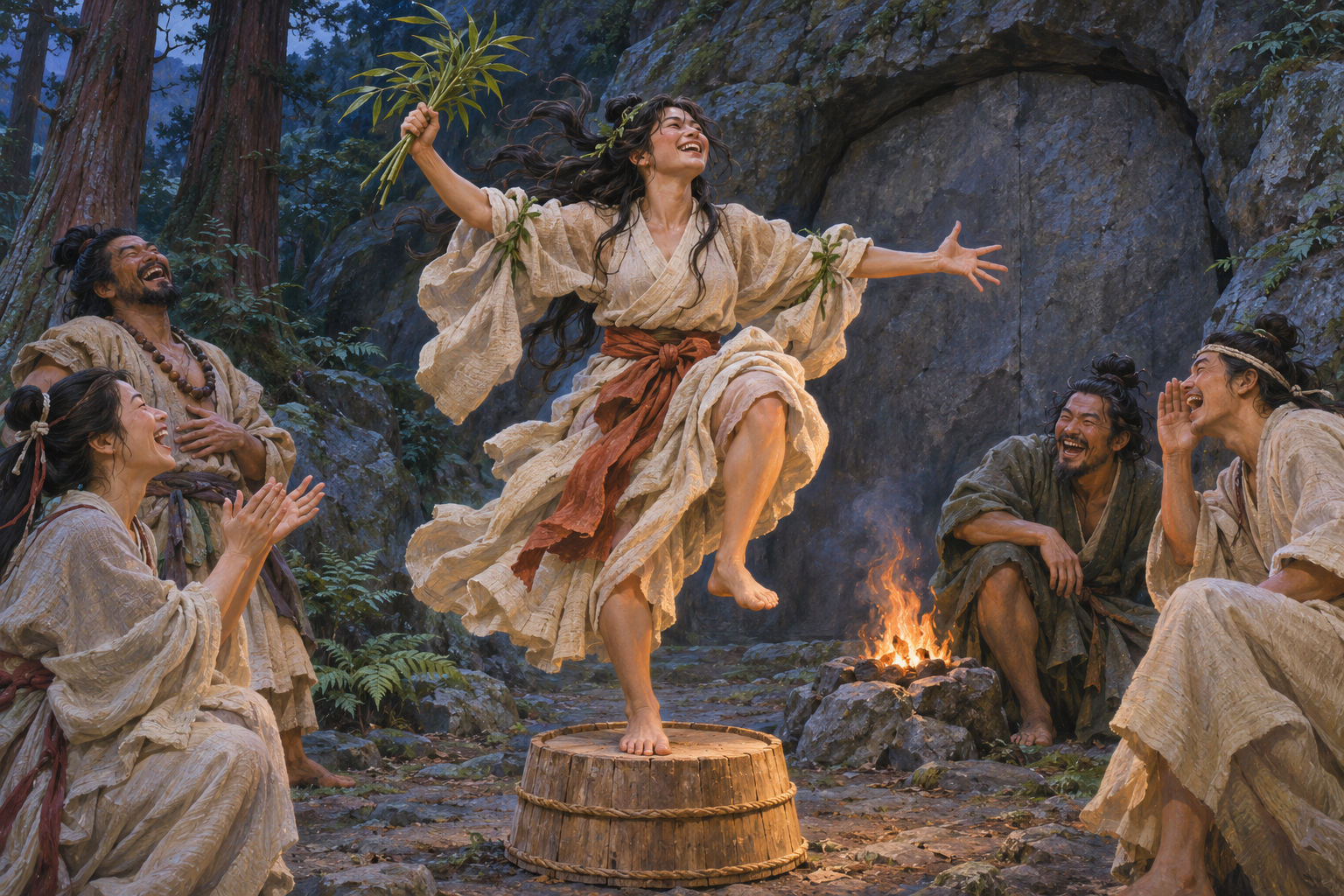
It is at this point that Ame-no-Uzume takes centre stage. In the Kojiki, she adorns herself with plants, places an overturned tub before the cave and begins to dance. The text emphasises bodily movement, rhythm and boldness. Her performance is not simply spontaneous amusement. It is a purposeful act in a sacred setting, one that transforms sound, gesture and laughter into a means of summoning Amaterasu’s attention.
The Kojiki version is striking for the way it combines ritual detail with comic energy. Ame-no-Uzume’s dancing becomes increasingly exuberant, and the assembled gods laugh. That laughter matters. It marks a shift from tension and absence towards shared response and renewed connection. In the story’s logic, laughter is not trivial; it is part of the sacred mechanism by which life can begin again.
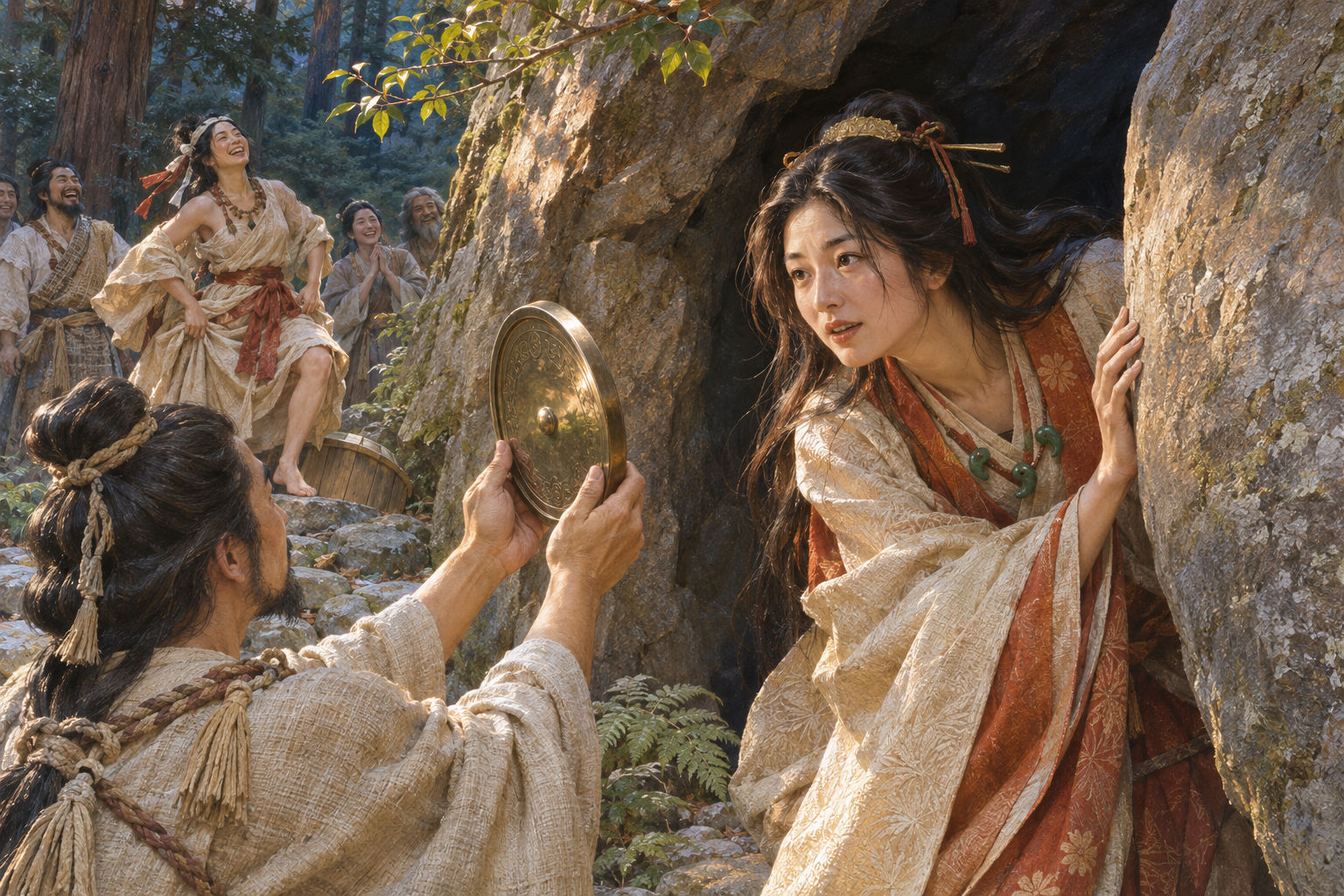
One of the episode’s most famous details appears here in the Kojiki: the gods’ amusement draws Amaterasu’s curiosity. Hearing the noise outside, she opens the cave slightly to ask what is happening. This small movement is enough. The gods seize the moment, and Amaterasu is brought back into the open, restoring light to the world.
The role of performance, laughter and sacred objects
The cave episode is often remembered as a “dance”, but that word can make it sound too simple. What Ame-no-Uzume performs is closer to ritualised performance: dance, display, rhythm and procession combined. The scene includes objects and actions that point to ceremonial practice rather than to entertainment in a modern sense. A tub serves as a platform. Plant materials, costume-like adornments and the gods’ laughter all contribute to the atmosphere of a rite whose purpose is effective presence, not merely spectacle.
This is one reason the story has been so influential in later Japanese thought about performance. Scholars and ritual specialists have often seen in Ame-no-Uzume a model for sacred dance and for the idea that performance can alter a spiritual situation. She is frequently linked, in later interpretation, with kagura, the ritual performing arts associated with shrine contexts. That connection is important, but it should be treated as an interpretation and later development, not as a claim that the Kojiki itself describes kagura in fully formed terms.
How the Nihon Shoki tells the story differently
The Nihon Shoki, another early court chronicle, preserves the cave narrative too, but it does not tell exactly the same story. It was compiled in a different court context and is often more restrained in its treatment of the material. In the Nihon Shoki, alternative accounts are preserved alongside one another, which means the text does not offer a single fixed version of events.
For the cave episode, the Nihon Shoki moderates some of the more explicit elements found in the Kojiki. The injury that precedes Amaterasu’s withdrawal is treated differently, and Ame-no-Uzume’s performance is presented without the same emphasis on genital exposure that appears in some Kojiki recensions and later retellings. The broader structure remains recognisable: the gods gather, a performance is staged, and Amaterasu is enticed back. But the tone and details are not identical. For a general reader, it is best to say that the Kojiki preserves the most vivid and influential version of the dance scene, while the Nihon Shoki offers a more restrained telling and alternative forms of the myth.
What the story meant in shrine and ritual traditions
Ame-no-Uzume’s place in Japanese religious life extends beyond the written chronicles. She is associated in shrine traditions with dance, possession and the enlivening force of ritual action. The term kami is often translated as “gods” or “deities”, but it does not map neatly onto any single English word. In these narratives, kami are not all the same kind of being, and they are not reducible to human-shaped gods. They can be forces, presences, ancestors or revered powers, depending on context.
Later traditions connected Ame-no-Uzume with shrine performance and with the ancestry of the Sarume line, a ritual and performing lineage. That association helped give the cave dance lasting importance in the history of Japanese ceremonial arts. At the same time, it is worth keeping the distinction clear between the early court chronicles and later shrine, medieval and folkloric interpretations. The story survives not as a single flat legend, but as a set of related tellings that different communities have shaped in different ways.
Renewal after darkness
The enduring power of the cave dance lies in its emotional and ritual shape. Disorder drives a sun kami into hiding; the world becomes dark; then a collective performance of wit, sound and bodily movement helps bring light back. The story is not a simple morality tale, and it is not really about punishment or defeat. It is about restoration: how a broken relation can be repaired, and how life can return through ceremony, laughter and the skilful action of a deity who knows how to move a crowd.
That is why Ame-no-Uzume remains so compelling. She is not merely a comic figure, nor simply a goddess of dance. In the oldest narratives, she stands at the point where performance becomes power, and where sacred renewal begins with the courage to step forward and make the world listen.
Sources and further reading
- Kokugakuin University, “Kojiki English Translation” (opens in a new tab)
- Basil Hall Chamberlain, “The Kojiki: English Translation” at Sacred Texts (opens in a new tab)
- Basil Hall Chamberlain, “Kogoshui” at Sacred Texts (opens in a new tab)
- Kokugakuin University Digital Museum, “Amenouzume” (opens in a new tab)