Kali and the Slaying of Raktabija in the Devi Mahatmya
Kali and the problem of Raktabija
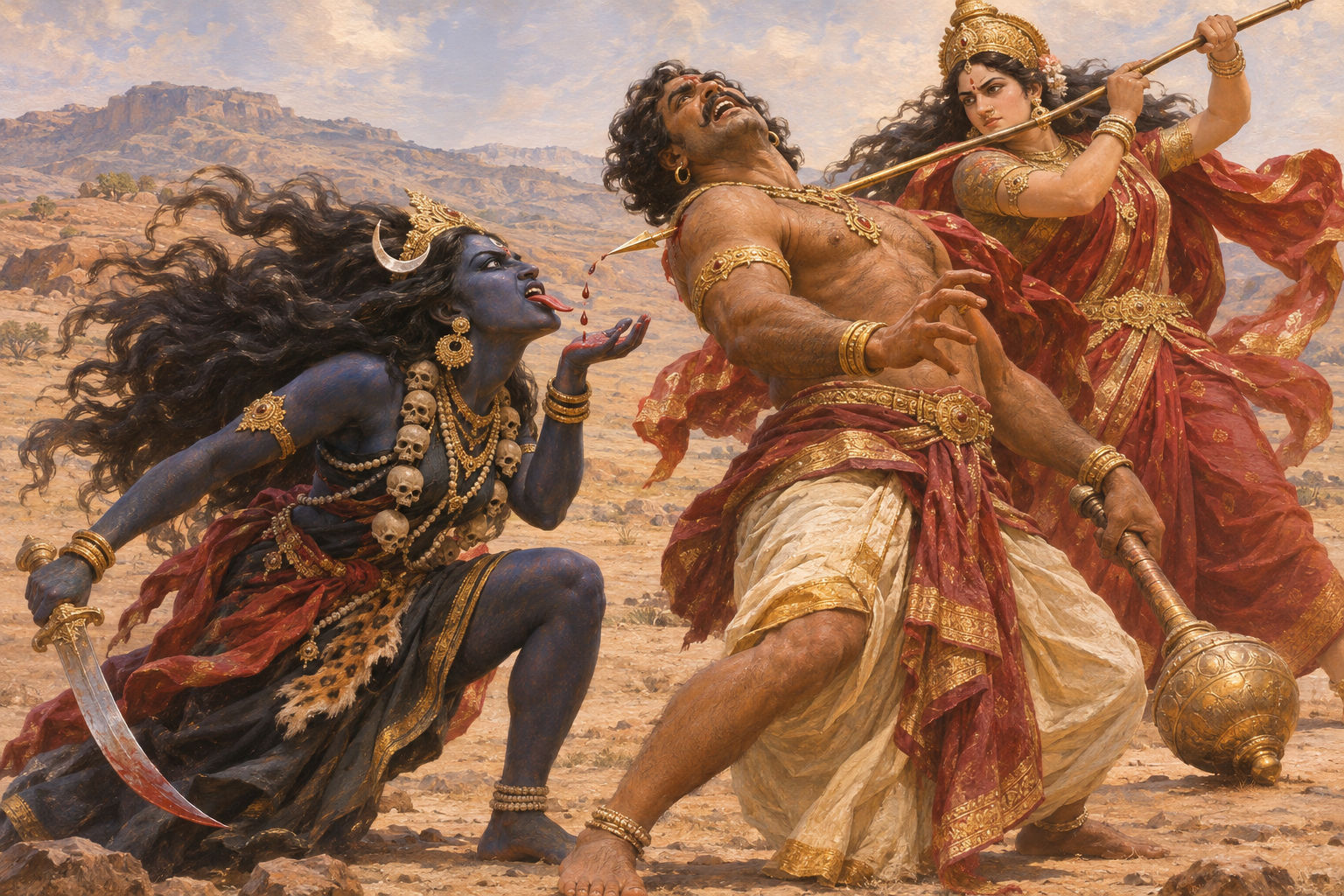
Among the most arresting episodes in the Devi Mahatmya is the story of Kali’s battle with Raktabija, the “blood-seed” demon whose every drop of blood could generate a fresh enemy. The scene is dramatic, but it is also carefully constructed: force alone cannot solve the crisis. Instead, the goddess answers an impossible multiplication of violence with a form of power that is just as fierce, but more exact. In the text’s own devotional universe, this is not merely a fight; it is a revelation of the goddess’s supreme efficacy.
The Devi Mahatmya and its place in Hindu tradition
The Devi Mahatmya, sometimes called the Durga Saptashati, is a foundational Sanskrit hymn and narrative section embedded in the Mārkandeya Purana. Modern scholarship generally places its composition in the early centuries CE, though precise dating remains debated. It is especially important in Shakta traditions, where the Goddess, Devi, is treated as the ultimate divine reality or source of power. That theological emphasis belongs to the text and its religious reception; it should not be flattened into a claim that all Hindu traditions read the divine in exactly the same way.
The Raktabija episode belongs to the work’s central war narrative, in which the Goddess—here called Chandika or Ambika in several verses—acts through a series of fierce forms and attendants. Kali appears within that sequence, not as a separate, independent heroine detached from the Goddess, but as an expression of Devi’s own power. That relationship matters, because later tellings can give Kali a more autonomous role than the Devi Mahatmya itself does.
How Raktabija becomes nearly impossible to defeat
The story is part of the wider conflict between the Goddess and the demon brothers Shumbha and Nishumbha. After their forces are checked, the demons send out one of their most dangerous commanders, Raktabija. His boon makes him uniquely hard to kill: whenever a drop of his blood touches the ground, another demon arises, matching him in strength and form. In practical terms, every wound he receives creates more enemies than it removes.
Earlier in the same battle, the Goddess’s energy is said to manifest as a set of warlike powers and attendant goddesses. The text then intensifies the struggle by bringing in Kali. The divine forces are not portrayed as passive symbols; they are active battlefield presences, each responding to a different aspect of the threat. This is one reason the episode has remained so vivid in later devotion and art.
Kali enters the battlefield
When Raktabija’s multiplication makes ordinary combat useless, Kali appears as the decisive answer. In the Devi Mahatmya, she is fierce, dark, and formidable, a manifestation of the Goddess’s wrath and energy. She does not simply strike the demon and hope for the best. Instead, she drinks the blood before it can fall to the earth, preventing the copies from being born. In other words, she attacks the source of the problem rather than only its visible effects.
The text presents this as a complete tactical reversal. Raktabija’s own power is turned against him: he depends on spilled blood for survival and reproduction, but Kali removes that advantage. This is one of the most memorable ideas in the entire goddess cycle, because it makes theological and poetic sense at once. The violent energy of the battle is not denied; it is redirected and mastered.
What the text says about Kali’s identity
In the Devi Mahatmya, Kali is closely associated with Chandika’s fury, and in some passages she is linked with the mother-goddess army of mātrikās, the “mothers” who assist the Goddess in war. Later Hindu texts and regional traditions often develop Kali in more varied ways: sometimes as a distinct goddess in her own right, sometimes as an especially terrifying form of Devi, and sometimes as a major focus of independent devotion. Those later developments are important, but they should not be silently folded back into the older text as though nothing changed over time.
This is also where popular retellings can become misleading. In some modern summaries, Kali is described as though she alone defeats Raktabija in a standalone exploit. The Devi Mahatmya is subtler: it places her in a larger divine campaign in which the Goddess’s many forms work together. Kali’s role is crucial, but it is part of a broader sacred battle rather than an isolated legend.
Why the image of blood-drinking matters
Readers sometimes encounter the episode as a shocking image, but its religious significance is not reducible to shock value. The blood-drinking motif solves a narrative problem with almost mathematical elegance: if spilled blood creates more enemies, then the only sure victory is to prevent the blood from reaching the ground. The story therefore gives form to a very old religious insight: a problem can persist even when it is apparently being attacked, unless its generative source is addressed.
There is also a devotional dimension. In Shakta traditions, the Goddess is not a distant figure who merely authorises others to fight; she is the force that can enter the battlefield directly, in whatever form the crisis demands. Kali’s ferocity is not presented as moral failure. Rather, it is a mode of divine protection, terrifying because the danger itself is terrifying. That is one reason the episode remains powerful in worship, sculpture and painting.
How later art and devotion keep the scene alive
The Raktabija episode has been widely represented in South Asian art, especially in images showing Durga or Chandika surrounded by warriors, with Kali advancing to intercept the demon’s blood. Museum collections preserve several such works, which demonstrate how central the scene became to visual culture as well as liturgy. These images usually emphasise the same dramatic logic found in the text: the Goddess’s power is not diminished by the demon’s multiplication; it is made more unmistakable.
At the same time, later devotional literature often expands Kali’s character beyond this one episode. Some traditions praise her as a liberator, a motherly protector, or the supreme form of the divine feminine. Those interpretations are meaningful within their own contexts, but they are developments, not simple restatements, of the Devi Mahatmya narrative. A respectful reading should keep those layers distinct while recognising the lasting force of the original story.
Kali’s victory over Raktabija endures because it is both vivid and precise: a dark goddess meets an enemy who multiplies through blood, and answers with a fierceness that contains the threat at its source. In the Devi Mahatmya, that is not just a battle scene, but a statement about divine power meeting chaos without hesitation.
Sources and further reading
- “Chapter 8: The Slaying of Raktabīja” in The Devi Mahatmya, Digital Temple of the Divine Mother (opens in a new tab)
- “The Devi Mahatmya” in Sacred Texts, translated by Swami Jagadiswarananda (opens in a new tab)
- “Durga, Kali, and the Matrikas Battle the Demon Raktabija” in The Metropolitan Museum of Art collection (opens in a new tab)
- “Devi Mahatmya” in Encyclopaedia Britannica (opens in a new tab)
Recommended reading
These are affiliate links. If you buy through them, we may earn a commission at no extra cost to you.
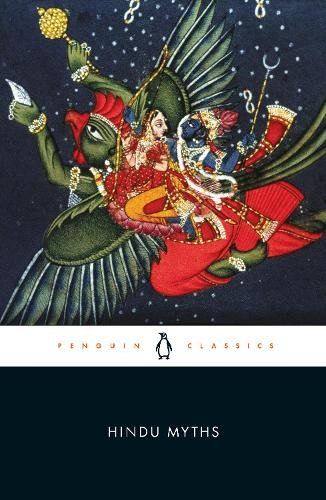
Hindu Myths: A Sourcebook Translated from the Sanskrit
Preserved in ancient Sanskrit texts like the Rig Veda and Mahabharata, Hindu myths date as far back as 1000 BCE. These seventy-five core stories feature Vishnu’s heroic avatars and youthful Krishna, along with tales of minor gods, demons, and sacred animals. Vibrant and expansive, they reflect a worldview encompassing cosmic creation, infinite earthly possibilities, and the universal touch of Death.
The Bhagavad Gita (Deluxe Hardbound Edition)
Compiled from the nine-volume Complete Works, this book brings together Swami Vivekananda's commentary on the Bhagavad Gita, systematically ordered by chapter and verse. Readers can study the original Devanagari verses and their English translations right alongside Vivekananda's illuminated perspective.
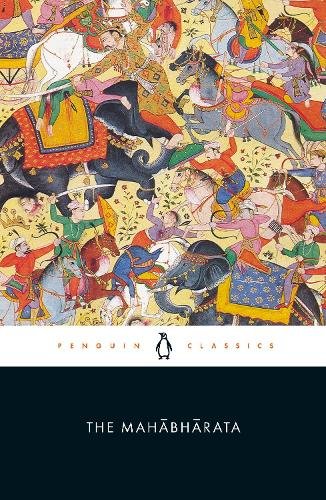
The Mahabharata
Rooted in ancient Indian literature, the Mahabharata is a cornerstone Sanskrit epic and a vital text of Hinduism. Beyond its sweeping narrative, it delves into the four key human pursuits—artha (purpose), kama (pleasure), dharma (duty), and moksha (liberation)—exploring how karma and self-identity shape an individual's connection to society and the universe.