Atum and the First Mound at Heliopolis
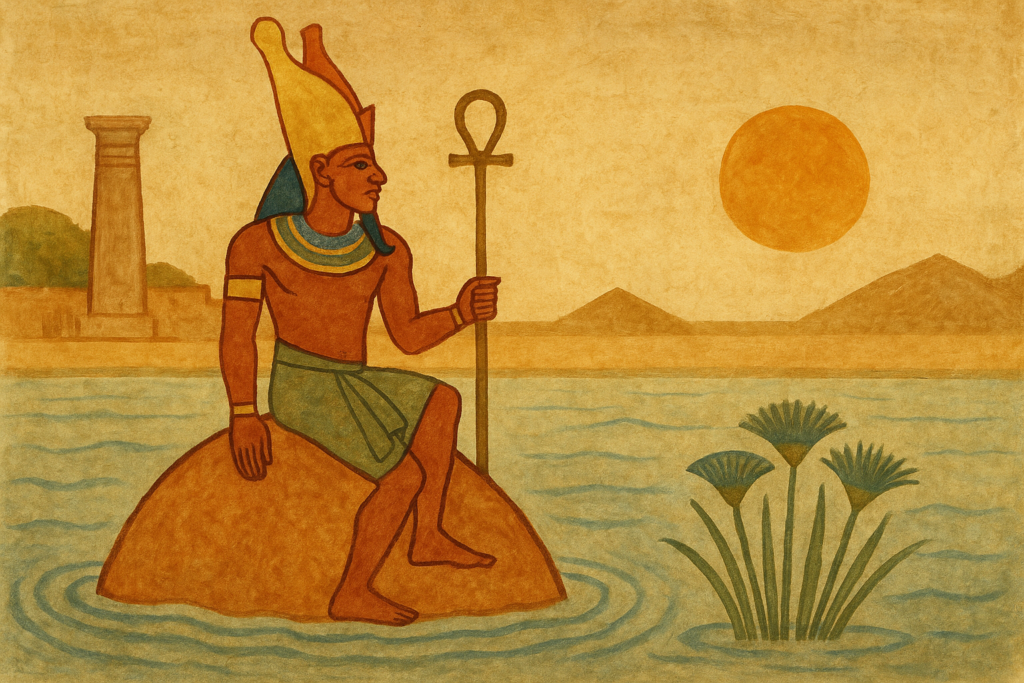
Atum and the First Mound belong to the Heliopolitan creation tradition, one of ancient Egypt’s most influential accounts of how the world began. In this myth, the creator god Atum emerges from the primeval waters and stands upon the first patch of land to rise from them — the mound often called the benben. From that moment, the ordered world begins to take shape. The story was not the only Egyptian creation account, but it became central to the theology of Heliopolis, a major religious centre in Lower Egypt.
Atum in the Heliopolitan tradition
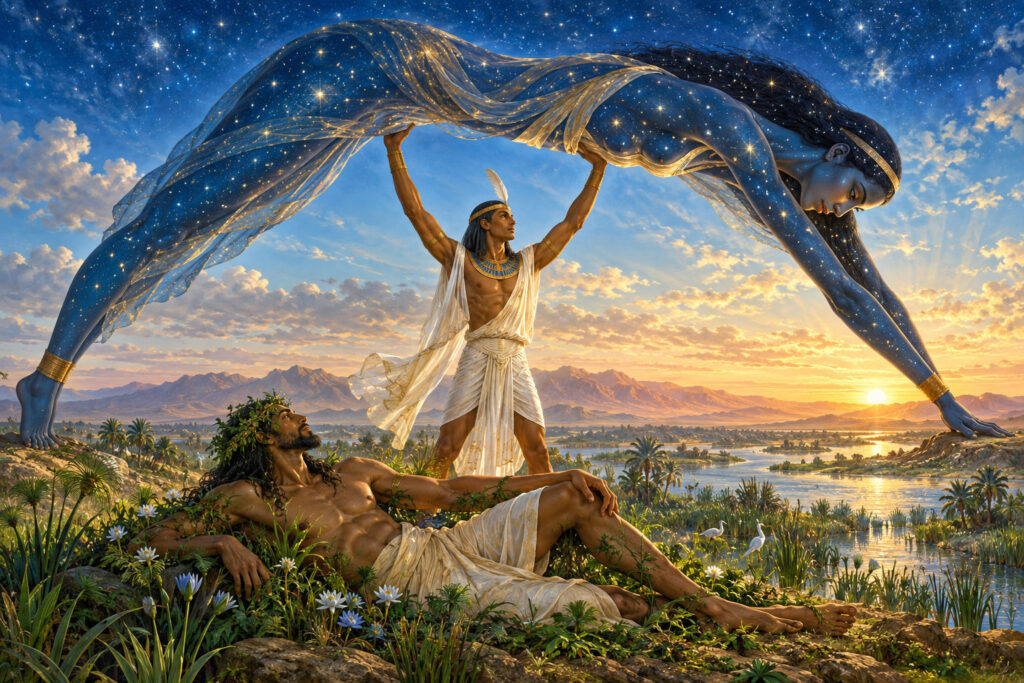
Atum was understood as a self-created god, complete in himself before anything else existed. His name is often explained by Egyptologists as meaning “the complete one” or “the finished one”, which suits his role as the source from which all later beings emerge. In Heliopolitan theology, he stands at the head of the divine family known as the Ennead, the “Nine”, which begins with Atum and extends through Shu, Tefnut, Geb, Nut, Osiris, Isis, Set and Nephthys. This was a specifically Heliopolitan genealogy and should not be treated as a universal Egyptian formula.
The Heliopolitan account is already visible in the Old Kingdom Pyramid Texts, the earliest substantial body of Egyptian religious writing. Those texts preserve a creation story in which Atum is the first god to emerge and the progenitor of the Ennead. Later Egyptian sources repeat and develop the same theology, showing that Atum’s role remained important across a long period of religious history.
The waters of Nun and the first act of creation
The myth begins with Nun, the inert primeval waters before creation. Egypt imagined the beginning not as an empty void but as a limitless expanse of watery potential. From these waters Atum rises by his own power. The precise phrasing varies, but the essential idea is constant: Atum comes into being before any other god and before any ordered land, and his appearance marks the first step away from chaos.
The first land to appear is the mound, the earliest dry ground. This was a powerful image in a country shaped by the annual flooding of the Nile, when land seemed to vanish beneath water and then reappear. The mound was not just a useful symbol: it was the place on which creation itself could be imagined to have begun. In Heliopolitan thought, the first mound and Atum belong together. Some traditions identify the god as standing on the mound; others speak as though he arises with it or as it. The myth is flexible, but always points to the same sacred beginning.
The benben and the sacred landscape of Heliopolis
The first mound was associated with the benben, a name applied to the primeval hill and also, in later religious language, to a sacred stone or stone form connected with Heliopolis. This is why Heliopolis became so closely linked with solar creation. The site’s theology treated the first emergence from the waters as local and cosmic at the same time: the dawn of the universe had happened there.
Ancient evidence suggests that Heliopolitan religion gave special importance to this idea of the first rising land. The city’s temple precinct embodied the sacred geography of creation, even though very little of the ancient site survives above ground today. The mound was not merely a mythic memory; it was a way of imagining the temple space as a place where beginnings remained present.
Shu and Tefnut: the first divine pair
Once established on the first mound, Atum brings forth the first divine pair, Shu and Tefnut. The Pyramid Texts preserve several images for this act. In some versions, Atum produces them through bodily emission; in others, later Egyptian commentary gives the detail in a different form. What matters in the myth is not the exact physiology, but the idea that the creator generates the first distinction and relationship from himself alone.
Shu and Tefnut represent the emergence of ordered conditions from undifferentiated existence. Shu is commonly associated with air, and Tefnut with moisture. Their appearance allows the next stages of creation to unfold, leading to Geb and Nut and, in turn, to the remainder of the Ennead. This genealogy is one of the best-known features of Heliopolitan religion, because it explains the cosmos as a family descended from a single divine source.
Atum, the sun, and daily renewal
Atum was closely linked with the sun, though Egyptian religion also distinguished him from other solar forms such as Ra and Khepri. The association helped Heliopolitan theology connect the first act of creation with the daily rising of the sun. Each dawn could be understood as a repetition of the original emergence from darkness and water. In this way, the first mound was not only an origin story but also a model for continual renewal.
Later Egyptian thought often brought Atum and Ra together in compound forms such as Ra-Atum, especially in solar hymns and temple contexts. This does not mean that all Egyptians always treated them as identical. Rather, it reflects a common Egyptian habit of combining divine figures when their roles overlapped. Atum remained the creator who completed the first act; Ra was especially prominent as the travelling sun.
Different creation stories in ancient Egypt
It is important not to treat the Heliopolitan myth as the single Egyptian explanation of creation. Ancient Egypt preserved several creation traditions, and they did not all say the same thing. Heliopolis emphasised Atum and the Ennead; Memphis developed a theology centred on Ptah, who created through thought and speech; Hermopolis described a different primordial ordering, associated with the Ogdoad. These traditions coexisted, sometimes competitively, within Egyptian religion.
The Heliopolitan story is therefore best understood as one powerful religious model among others, not as a final or exclusive doctrine. Its prominence came partly from the prestige of Heliopolis itself and partly from the durability of the Pyramid Texts, which preserved its myth in writing. That textual survival has made Atum and the First Mound especially visible to modern readers.
Ancient evidence and later interpretations
The main ancient evidence for Atum’s role comes from religious texts, temple traditions and later theological summaries. The Pyramid Texts are especially important because they preserve early references to the Heliopolitan cosmogony. Later sources continue the same basic pattern, though details shift over time. Modern scholars use these texts to reconstruct the theology, but the surviving material does not give a single, fixed version.
Later Greek and Roman writers also encountered Egyptian religion, but their explanations do not always match Egyptian ways of thinking. It is better to stay with the Egyptian evidence itself and avoid forcing Greek philosophical categories onto it. Atum is not simply a generic “creator god” in an abstract sense; he is a distinct figure within a specific mythic and ritual landscape shaped by Heliopolis and by Egyptian ideas of emergence, completeness and renewal.
Atum and the First Mound remain compelling because they join cosmic scale to a remarkably concrete image: the first dry land rising from water. In Heliopolitan mythology, that moment is the beginning of everything that follows — gods, earth, sky and the ordered world itself.