The First Battle of Mag Tuired in Irish Mythic Tradition
The First Battle of Mag Tuired belongs to the Irish mythic tradition, specifically to the medieval narrative cycle that later scholars often call the Mythological Cycle. In the surviving tale, the Túatha Dé Danann — a supernatural people of Ireland’s mythic past — fight the Fir Bolg for sovereignty over the island. The story is best known from Cath Maige Tuired Conga (“The Battle of Mag Tuired at Cong”), a medieval Irish text preserved in later manuscript transmission and closely related to the broader pseudo-historical tradition found in works such as Lebor Gabála Érenn (“The Book of Invasions”).
That context matters. The story is not a straightforward record of ancient religion, nor is it simply Christian invention. It is a medieval narrative shaped by learned Irish writers who wove myth, genealogy, place-lore and pseudo-history together. Read on its own terms, it offers one of the richest surviving stories about how medieval Ireland imagined divine or semi-divine power, kingship and rightful rule.
The claim to Ireland
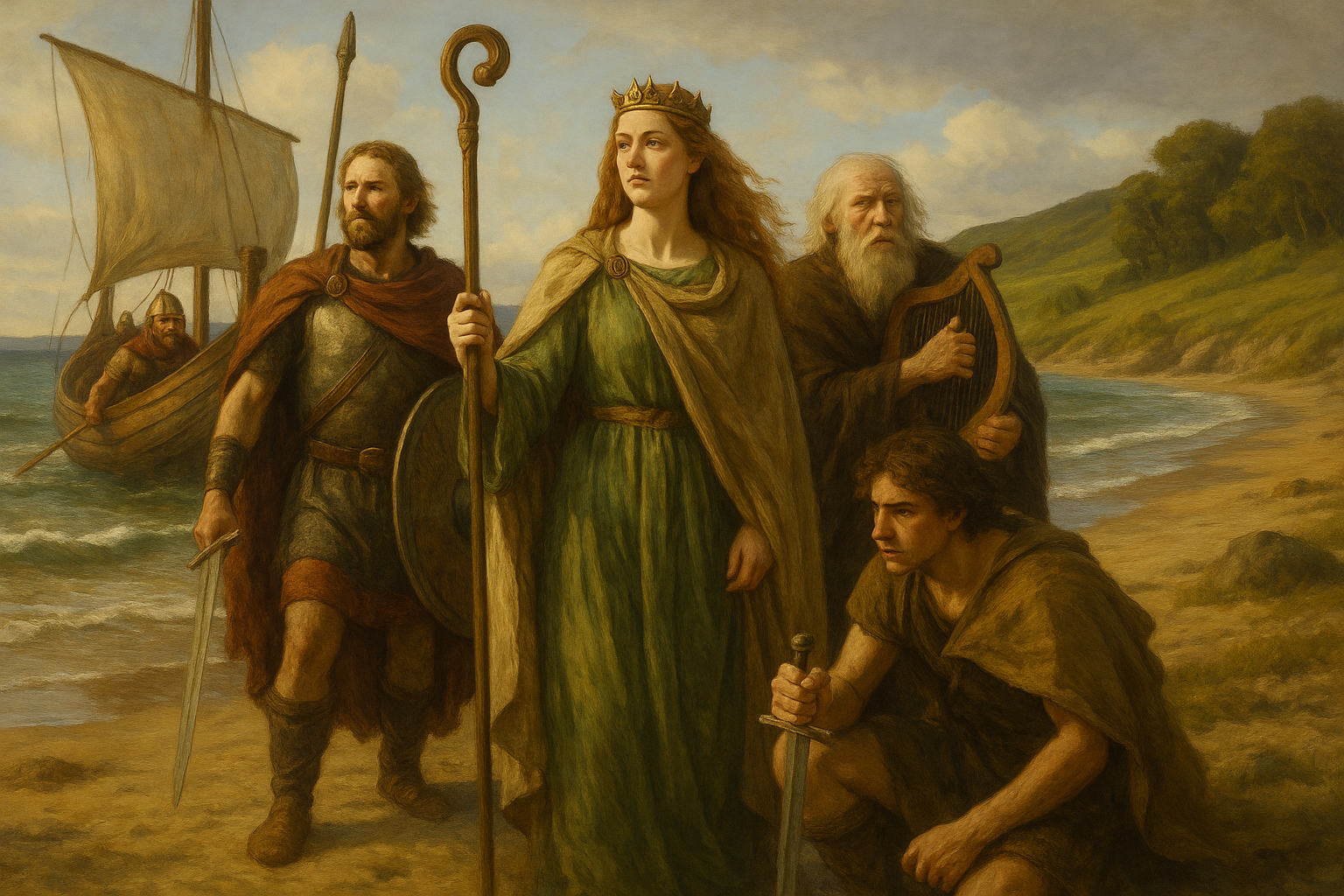
The tale opens with the Túatha Dé Danann seeking a share of Ireland. In the narrative tradition, they are not ordinary mortals but an otherworldly people associated with wisdom, craft and supernatural power. Their king is Nuadu, later known by the epithet Airgetlám, “Silver Hand”, after the injury he suffers in the battle. The Fir Bolg, meanwhile, are already in possession of Ireland and are ruled by Eochaid mac Eirc.
Rather than plunging immediately into combat, the story begins with negotiation. Nuadu sends an envoy to request that the island be divided between the two peoples. The Fir Bolg reject the proposal. The issue at stake is not merely territory in a modern sense, but kingship, precedence and the right to occupy the land. In this tradition, battle is the final answer when settlement fails.
The location is important too. The title names Mag Tuired in the south-west of Ireland, and later tradition associates the battlefield with the Cong area in County Mayo. Medieval and later writers often tried to anchor legendary events in real landscapes, but those identifications should be treated as literary and localising traditions rather than secure historical proof.
Five days of war at Mag Tuired
Once the armies meet, the battle is described as lasting five days. The text is interested not only in scale, but in structure: there is advance, challenge, heroic exchange and sustained slaughter. The Fir Bolg are led by strong champions, and the Túatha Dé Danann by their own elite fighters, including Nuadu and his retainers.
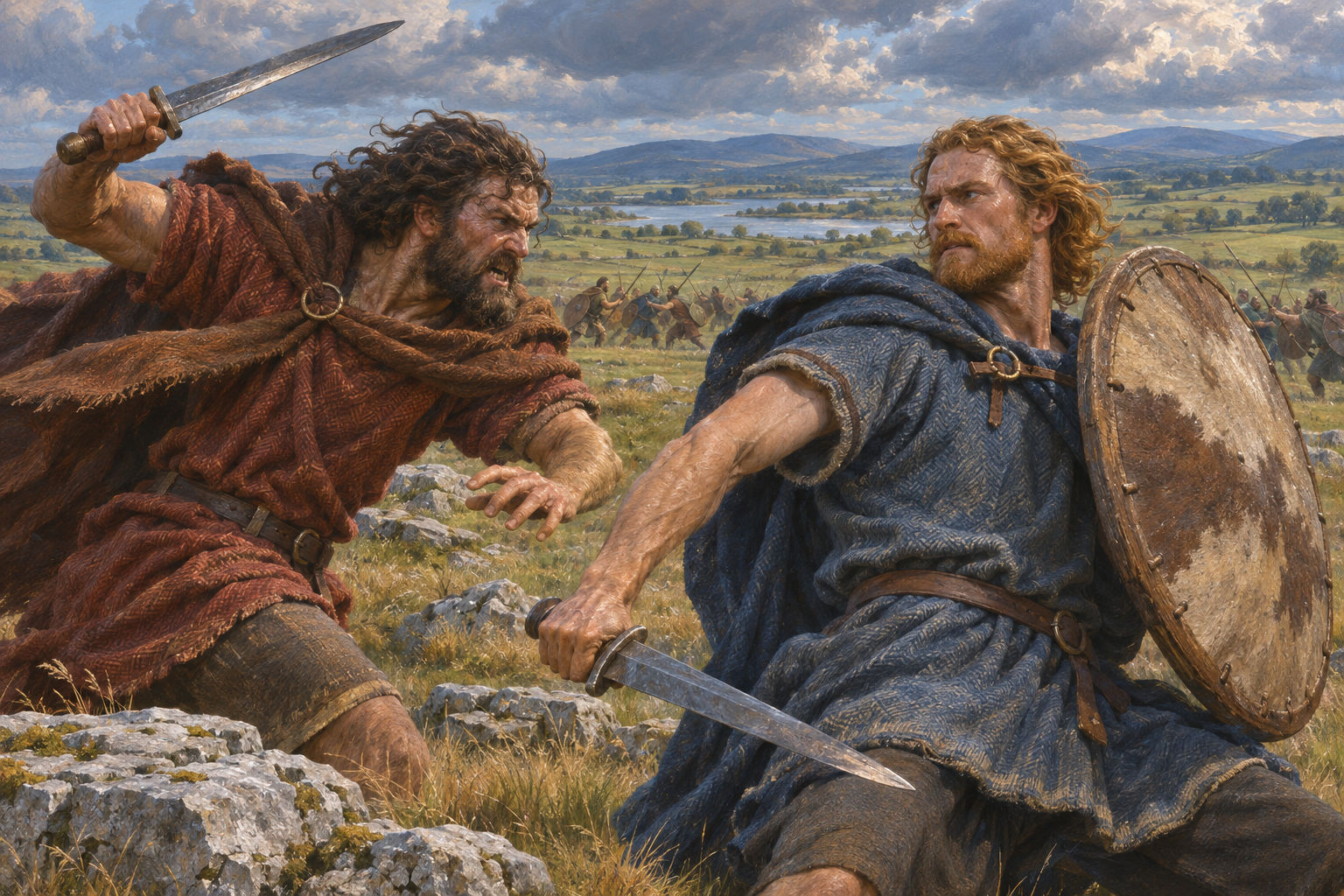
One of the best-known episodes is the single combat between Nuadu and Sreng, the Fir Bolg champion. The duel is central because it dramatises the struggle between the two peoples through representative fighters rather than anonymous masses. Nuadu proves brave, but Sreng severs his arm at the shoulder. This wound is crucial to the wider mythic tradition: a king who has been physically diminished can no longer remain in full sovereignty. In later tradition, the loss of the arm leads to his replacement as king.
The battle does not resolve in a neat heroic triumph on either side. Instead, the Túatha Dé Danann win the field, but only after suffering losses of their own. The Fir Bolg are driven back, yet the tale remembers them as formidable opponents rather than mere foils. That balance gives the story much of its force: this is not a simple fantasy of effortless conquest.
Nuadu’s wound and the problem of kingship
Nuadu’s severed arm is one of the most memorable details in the whole tradition because it turns a battlefield injury into a question of legitimacy. In medieval Irish kingship ideology, a king should be whole, physically and ceremonially fit to rule. After the battle, Nuadu’s mutilation disqualifies him from kingship, and Bres is chosen in his place.
This transition belongs partly to the wider mythological tradition surrounding the Túatha Dé Danann and partly to the later literary elaboration preserved in related texts. It matters because it links the battle to a deeper concern: who may rule, and on what grounds? Military victory alone is not enough. Kingship is tied to bodily integrity, social harmony and the distribution of prosperity.
Nuadu’s restoration, achieved elsewhere in the tradition by the physician Dian Cécht and the craftsman Credne, belongs more fully to the second battle cycle and related narrative material. It is worth mentioning here only because the wound inflicted at Mag Tuired becomes the hinge for later events.
The Fir Bolg after defeat
After their defeat, the Fir Bolg are not annihilated. In the version reflected in the broader tradition, they survive in exile, settling in other parts of Ireland or on offshore islands. That detail is significant because it allows the narrative to preserve them as part of Ireland’s legendary population history rather than erasing them entirely. Medieval Irish pseudo-history often explains the island’s past as a sequence of settlements, displacements and inheritances.
Some later retellings and local traditions add colour to the aftermath, including explanations for cairns, stones and place-names around the Cong district. Those are interesting as reception history, but they should be kept distinct from the principal tale. The core story is the contest for Ireland, the duel of champions and the establishment of Túatha Dé Danann supremacy.
How the battle fits into Irish mythic tradition
The First Battle of Mag Tuired is often read alongside the second battle of the same name, where the Túatha Dé Danann fight the Fomorians. The pair works almost like a diptych. In the first, the Túatha Dé Danann secure Ireland against the Fir Bolg; in the second, they defend or reorganise divine sovereignty against a more chaotic enemy. Together, the two tales give a mythic shape to rule, order and conflict.
The first battle also shows how medieval Irish literature loved to connect story, genealogy and landscape. Lebor Gabála Érenn incorporates the Túatha Dé Danann into a pseudo-historical sequence of invasions, making them one chapter in a grand narrative of Ireland’s past. The battle is therefore both a mythic event and a literary device: it explains how one group came to dominate the island in the story-world, while also linking heroic legend to a patterned account of history.
Reading the story today
Modern readers often ask whether the Túatha Dé Danann were “really” gods. The safest answer is that the surviving sources preserve them as literary and mythic figures whose earlier religious associations are possible, but not always easy to reconstruct in detail. Some may reflect pre-Christian divine or otherworldly beings; others are fully shaped by medieval narrative art. The First Battle of Mag Tuired should be approached in that spirit: not as a transparent survival from antiquity, but as a powerful medieval Irish story about sovereignty, bodily wholeness and the costs of taking land by force.
Its appeal lies in that combination of grandeur and specificity. The tale is full of gods, kings and champions, but it is also anchored in contested territory, broken bodies and the hard logic of succession. That is why it still reads as more than a battle story: it is a myth about what it takes to rule, and what is lost when rule is won.
Sources and further reading
- Elizabeth A. Gray, translator, “Cath Maige Tuired: The Second Battle of Mag Tuired”, CELT, University College Cork (opens in a new tab)
- John Carey, “Irish Historical Thinking in the Saga Cath Maige Tuired Conga”, Ulster University (opens in a new tab)
- R. A. S. Macalister, “Lebor Gabála Érenn”, CELT, University College Cork (opens in a new tab)
- National Library of Wales Archives and Manuscripts, “Cath Maige Tuired” manuscript record (opens in a new tab)
Recommended reading
These are affiliate links. If you buy through them, we may earn a commission at no extra cost to you.
Celtic Druidry: Rituals, Techniques, and Magical Practices
Ellen Evert Hopman’s practical guide blends ancient Celtic wisdom with modern Reconstructionism, covering Druidic tools, cosmology, tree lore, and rituals. Packed with seasonal rites, Ogham divination, and protective charms, it offers everything needed to begin the Druid path.
Celtic Tales: Fairy Tales and Stories of Enchantment from Ireland, Scotland, Brittany, and Wales
Gathering tales from Ireland, Scotland, Brittany, and Wales, this illustrated collection features sixteen folklorist-transcribed stories brimming with magical creatures and timeless wit. Enhanced by Kate Forrester’s elegant silhouette artwork, it vividly transports readers to the enchanted realms of Celtic myth.
The Historical Atlas of the Celtic World
Featuring 54 vibrant full-color maps, this atlas comprehensively charts 3,000 years of Celtic history from Bronze Age origins to the modern global diaspora. Incorporating the latest research, it explores Continental, Atlantic, and contemporary Celtic cultures to trace their enduring legacy across Europe and beyond.