Týr and the Loss of His Hand to Fenrir
Týr is one of the most striking figures in Norse mythology: a god associated with law, courage and battle, remembered above all for the loss of his right hand to the wolf Fenrir. The story survives most fully in Snorri Sturluson’s Prose Edda, a thirteenth-century Icelandic work written in a Christian milieu but preserving older mythological material. The same episode is also alluded to in the Poetic Edda, though not told there in full. What follows uses Snorri’s account as the principal retelling, while noting where other medieval sources differ or add details.
Týr in the surviving sources
Týr is not one of the gods about whom the medieval sources give the most stories, but he is consistently presented as a figure of great bravery and judgement. Snorri says he is the boldest of the gods and especially suited to victorious battle. The Poetic Edda and later skaldic poetry preserve his name in formulas and references, which suggests that he mattered more widely in earlier tradition than the small number of surviving narratives might imply. Scholars also note that the name survives in the weekday “Tuesday”, just as Óðinn, Þórr and Frigg live on in other Germanic weekday names. That linguistic evidence is useful, but it does not on its own tell us exactly how Týr was worshipped in pre-Christian Scandinavia.
It is important not to treat every medieval source as if it offered the same version of Norse mythology. Snorri Sturluson wrote the Prose Edda in Iceland in the thirteenth century as a handbook for poets, while the Poetic Edda is a collection of older mythological and heroic poems surviving in manuscript copies from medieval Iceland. Both preserve earlier material, but neither is a transparent record of pagan belief as such.
The wolf grows up among the gods
In Snorri’s retelling, the gods bring up Fenrir among themselves when he is still a young wolf. At first he seems manageable, and only Týr dares feed him. But as Fenrir grows larger day by day, the gods become uneasy. Prophecies tell them that he will one day bring them great harm. That future danger is crucial to the story: the gods do not bind the wolf out of cruelty or whim, but because they believe his strength will become catastrophic.
They first test him with two chains. The wolf breaks the first, called Lædingr, without effort. He then snaps the second, Dromi, even more easily. These failures convince the gods that a stronger bond must be made, one that cannot be broken by brute force. The story’s tension lies in the fact that Fenrir has already shown himself strong enough to make ordinary restraints useless, so the gods must resort to cunning.
Gleipnir and the bargain
The gods send for the dwarfs, who forge a third bond called Gleipnir. Snorri describes it as made from impossibly strange ingredients: the sound of a cat’s footfall, a woman’s beard, the roots of a mountain, a bear’s sinews, a fish’s breath and a bird’s spittle. Whether one reads these as poetic marvels, riddling imagery or evidence of ancient mythic craftsmanship, the point is clear: Gleipnir is not a chain like the others. It is subtle, deceptive and stronger than metal.
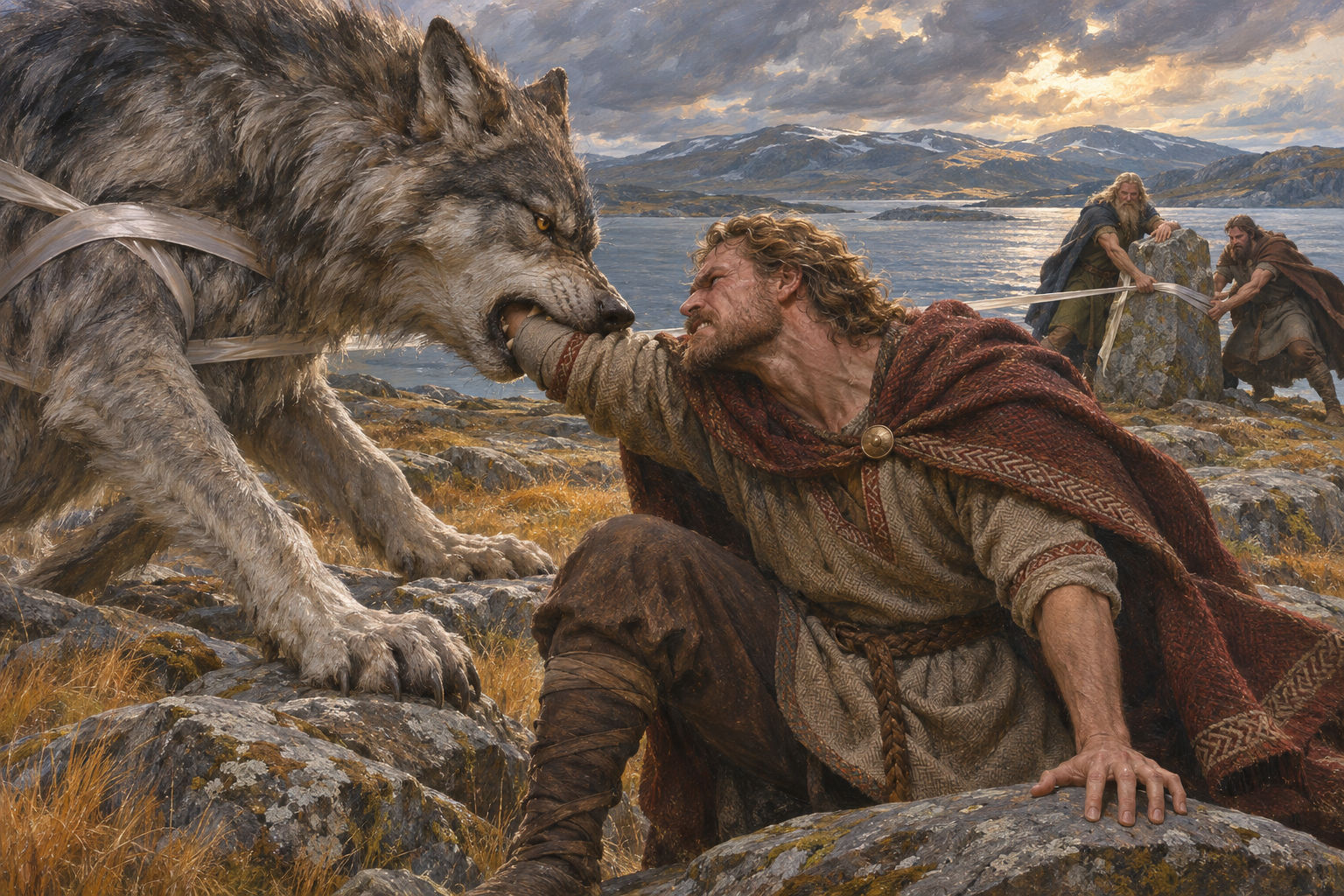
Fenrir does not trust the gods. He suspects a trick, and his refusal is perfectly reasonable, since he has already broken two bonds. He agrees to be tested only if one of the gods will place a hand in his mouth as a pledge that they will release him again after he proves unable to escape. This is the moment that determines Týr’s fate. The other gods hesitate; no one wishes to sacrifice a hand. Týr alone places his right hand in Fenrir’s jaws.
Once the wolf is bound with Gleipnir and cannot break free, the gods refuse to release him. Fenrir realises that he has been deceived and bites off Týr’s hand. Snorri says the place is then called the wolf’s joint, and Týr is thereafter one-handed. The loss is not presented as accidental. It is the visible price of the god’s integrity, or at least of his willingness to stand behind a pledge when the others will not.
Why Týr’s hand matters
The episode gives Týr a distinct place among the gods. He is not the most powerful, nor the most frequently featured, but he becomes a god marked by courage, sacrifice and the danger of binding oaths. The hand loss is central because it turns an abstract quality into a bodily sign. Týr’s bravery is not merely asserted; it is embodied in an injury that cannot be reversed.
The story also makes the gods morally complicated. They need to restrain Fenrir for the sake of the divine order, yet they do so by deceit. Týr’s sacrifice therefore stands in uneasy contrast to the gods’ collective decision. In Snorri’s telling, the one god who keeps faith with the terms of the bargain is the one who suffers for it.
What the Poetic Edda adds and what it does not
The most direct poetic witness is the Poetic Edda, especially the poem Hymiskviða, where Týr appears in a different myth, accompanying Þórr on a fishing expedition. That poem does not narrate the Fenrir episode in detail, but it treats Týr as a known figure and helps confirm that he was not merely Snorri’s invention. Other Eddic poems allude to his one-handedness and his association with battle and wisdom. The full binding story, however, is Snorri’s most elaborate version and is the basis for most modern retellings.
There are also differences of emphasis in later and related material. Some medieval sources, especially those not focused on myth in the same way, preserve only the bare fact that Týr lost a hand to Fenrir. Others expand the scene with more dramatic description. None should be conflated as if they were identical. The safest course is to keep Snorri’s sequence of events in view and treat additional details as separate attestations unless they are explicitly present in that text.
Fenrir, Ragnarök and the wider mythic pattern
The binding of Fenrir belongs to a larger mythic pattern in which the gods try, unsuccessfully, to forestall fate. Even after being chained, Fenrir remains part of the future: at Ragnarök he will break free and kill Óðinn. That later development is not part of the hand-loss episode itself, but it explains why the gods fear him so greatly in the first place. The story therefore works in both directions: it explains Týr’s loss and foreshadows the end of divine authority.
For readers approaching Norse myth for the first time, this is one reason the tale stands out. It is a story of courage, but also of deception, prophecy and tragic foresight. The gods act to protect themselves, yet their protection depends on a betrayal that costs one of their own a hand and fails to solve the deeper problem. Týr’s injury remains the enduring sign of that failure — and of the rare god who was willing to pay the price.
Sources and Further Reading
- Snorri Sturluson, Gylfaginning, in Heimskringla.no (opens in a new tab)
- Carolyne Larrington, The Poetic Edda (Oxford World’s Classics) (opens in a new tab)
- John Lindow, “Eddic Poetry and Mythology”, in A Handbook to Eddic Poetry (opens in a new tab)
- Gro Steinsland, “Coda: Playing Gods”, in The Lives and Deaths of the Norse Gods (opens in a new tab)