Jupiter, Oaths and the Sanctity of Roman Rule
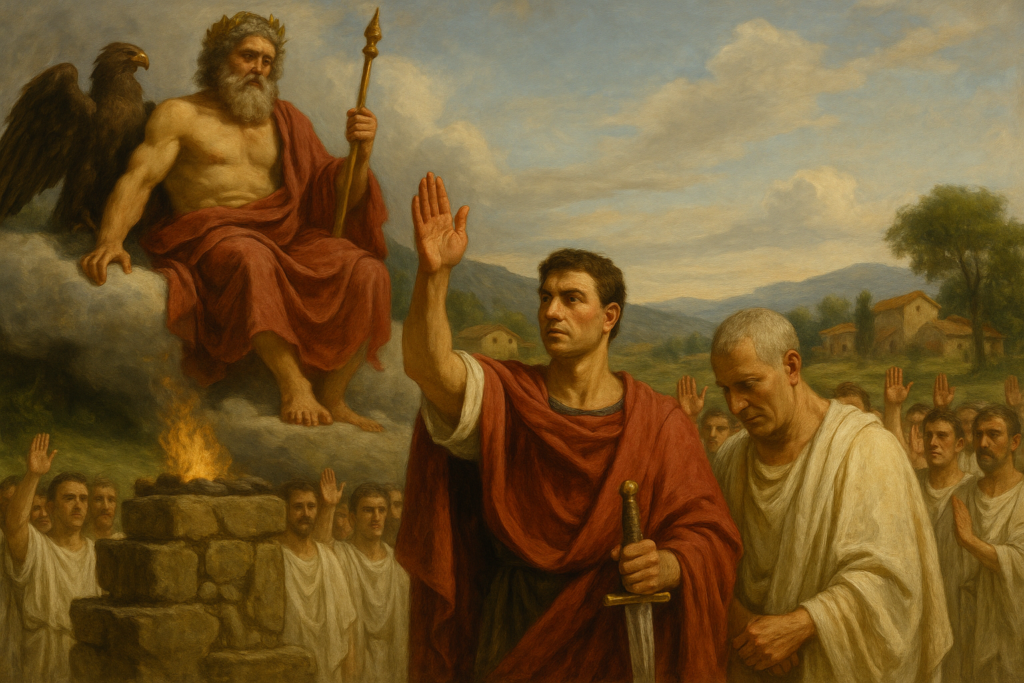
Jupiter was not just Rome’s sky-god. In Roman life he stood at the centre of public truth: oaths, treaties, commands and the legitimacy of rule. That made him especially important in stories about kings, foundations and the moral order of the city. When Roman authors linked Jupiter to the making of promises or the founding of institutions, they were showing that power in Rome was meant to rest on something higher than force alone.
Jupiter as Rome’s guardian of sworn words
In Roman religion, Jupiter was the god most closely associated with solemn speech and binding obligation. Swearing by Jupiter was not a casual flourish. It placed a promise under divine witness, and a broken oath was a religious offence as well as a social one. Roman writers present this idea as part of the city’s deepest identity: promises mattered because Jupiter stood behind them.
This is why Jupiter appears so often in accounts of treaties and declarations of war. Livy’s description of the fetial ritual, preserved in Book 1, shows Roman diplomacy clothed in religion. Before war could be declared, a priestly envoy approached the frontier, recited formal claims, and called on Jupiter to witness the justice of Rome’s case. When a treaty was struck, the same sacred logic applied: the agreement was not merely political but made under divine sanction. In Roman thinking, peace and war alike needed Jupiter’s oversight if they were to be legitimate.
The fetiales and the religious language of Roman power
The fetiales were priests concerned with international ritual: treaties, reparations and the ceremonial opening of war. Their role is easiest to grasp through Livy, because he gives us the fullest surviving literary account of their procedures. In his version, the envoy first asks permission to speak on behalf of the Roman people, then recites the grievance, and finally invokes Jupiter before casting the symbolic spear or, in treaty-making, striking the sacrificial victim. The point is clear. Rome did not present expansion as raw aggression; it wrapped it in a ritual claim of right.
It is worth separating the literature from the history here. Livy wrote centuries after the early monarchy, and his account is a Roman reconstruction of ancestral practice, not a record we can verify line by line. Even so, the ritual he describes is deeply revealing. It shows that Romans imagined legitimate force as something that had to pass through religious form. Jupiter was not an ornament to politics; he was the god who made political action answerable.
Romulus, Jupiter Feretrius and the first triumph of rule
One of the most important foundation traditions involving Jupiter is Romulus’ dedication to Jupiter Feretrius after defeating Acron, king of Caenina, and taking the spolia opima, the spoils won by a Roman commander in single combat. Livy tells this story in Book 1. Romulus defeats the enemy leader, carries the captured armour to a small shrine on the Capitoline, and dedicates the prize to Jupiter Feretrius. The episode is a charter myth for Roman victory: military success is completed not by possession of the spoils, but by their surrender to the god who receives them.
The shrine of Jupiter Feretrius also mattered because later antiquarians connected it with especially solemn forms of oath and treaty. Some sources associate the sanctuary with a sacred stone used in ritual striking, and later scholarship has often linked this with the language of “striking” a treaty in Latin. The details are not entirely secure, but the underlying idea is consistent: Jupiter Feretrius belonged to the most serious acts by which Romans bound themselves to one another and to the gods.
Numa and Jupiter: law, worship and the making of Rome
If Romulus represents war and conquest, Numa Pompilius represents ordered religion. Livy’s Numa tradition presents the second king as the man who organised Roman worship and made it more regular. In one famous scene, Jupiter is asked to confirm Numa’s kingship through signs in the sky. In another tradition, best known from Ovid’s Fasti and later authors, Numa even enters into negotiation with Jupiter over how to protect Rome from divine anger. The versions differ in details, but both make the same larger point: Roman order begins when a king accepts limits, signs and rituals laid down in relation to Jupiter.
Ovid’s version is especially memorable because it turns a serious religious issue into a story of bargaining. Jupiter’s demand, as the tradition has it, concerns sacrifices and the proper handling of divine power; Numa seeks to secure Rome while reducing bloodshed. This is a literary myth, not a historical report, but it reflects a Roman ideal. Good rule was the rule that knew how to talk to the gods. Under Numa, authority is not merely imposed; it is ritually mediated.
The Capitoline Jupiter and the public face of Roman sovereignty
The most important civic cult of Jupiter was that of Jupiter Optimus Maximus on the Capitoline Hill. His great temple became the most visible religious monument of Roman sovereignty, and Roman magistrates swore and sacrificed there as part of public life. The title “Best and Greatest” belongs to this political and religious Jupiter of the Roman state, not simply to the Greek Zeus of literary comparison. The Romans did identify their chief god with Zeus in broad interpretative terms, but Jupiter had his own civic role, ritual setting and public identity.
That distinction matters. Greek myth often presents Zeus as a ruler among gods in a family drama of divine succession. Roman Jupiter is more tightly tied to law, oath, auspices and state authority. He is the god before whom magistrates act, armies swear and treaties are made. In Rome, the sanctity of rule depended on the sanctity of speech; Jupiter guaranteed both.
Why Jupiter mattered so much to Roman identity
Jupiter’s importance in Roman religion came from more than thunder and sky. He was the deity who stood at the meeting point of kingship, law and public trust. A Roman ruler could claim power, but that power was supposed to be visible to the gods and disciplined by ritual. In the founding legends, Romulus, Numa and the fetial priests all show different sides of that same principle: Rome belonged to Jupiter because Rome’s rule was supposed to be answerable.
That is why Jupiter remains such a striking figure in Roman mythology. He is not only a god of weather or celestial force. He is the divine guardian of Rome’s most serious promises, and the silent witness to the city’s claim that power should be bound by oath.