Janus and the Roman Meaning of Beginnings and Boundaries
Janus at the threshold of Roman religion
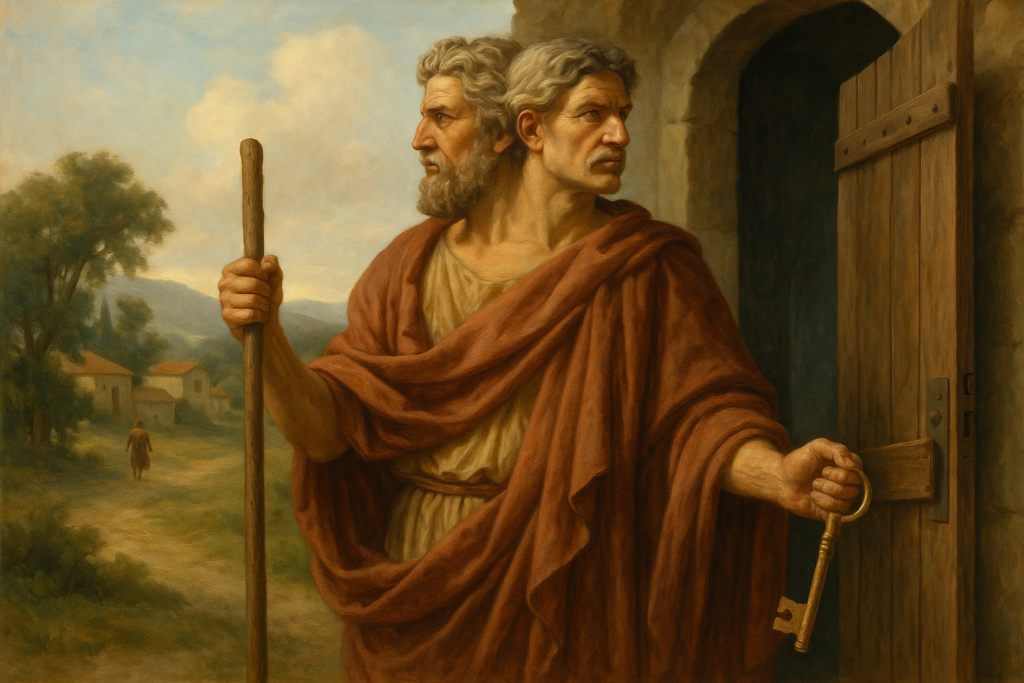
Janus is one of the most distinctive gods in Roman religion: a deity of beginnings, passages, doors, and the moment of crossing from one state to another. He is usually shown with two faces, looking in opposite directions, because his power is bound up with what lies behind and what lies ahead. That image has made him famous, but the Romans valued him for more than symbolism. Janus stood at the opening of prayer, at the start of the calendar year, and at the uneasy border between war and peace. He is a god of thresholds in the broadest Roman sense.
Not a Greek import, but a Roman presence
Unlike many Roman gods, Janus was not simply borrowed from Greece and renamed. Ancient and modern writers alike treat him as an old Italian, even native Roman, figure, though the exact origin of the name is uncertain. That matters because Janus is best understood through Roman religion itself, not through a Greek equivalent. He does not fit neatly beside Zeus, Hermes, or any other Greek deity. He is less a “sky god” or messenger than a guardian of openings, transitions, and ordered change. The British Museum describes him as the Roman god of beginnings and doorways, while classical scholarship often emphasises his role as the god invoked first in ritual.
Why Janus has two faces
The familiar double face is not just a striking artistic convention. Roman authors used it to explain Janus’ authority over transition: one face sees where something comes from, the other where it is going. Ovid develops this idea in Fasti, where Janus speaks at the opening of the poem’s first book and identifies himself as the god of the threshold, the first to be addressed in prayer. Ovid’s Janus is not merely decorative. He is the power that makes a beginning possible, whether that beginning is a journey, a sacrifice, or the first day of a new year. In that sense, he belongs to movement itself: the instant when a door is opened, a season changes, or a rite begins.
Roman writers also linked Janus with Janus-like images in the built environment: gates, arches, and the symbolic act of entering or leaving. Modern scholarship sometimes stresses that the god’s image and his functions overlap so closely that the architectural threshold is almost a physical expression of the deity. That is an interpretation, but it suits the Roman imagination well. Janus is what happens at the crossing point, when the old is not entirely gone and the new has not yet fully begun.
The month of January and the first moment of the year
Janus’ name gave rise to January, and his connection with beginnings made him especially important at the turn of the year. Ovid notes that January was the opening month of the Roman year in the older calendar, and although the calendar changed over time, the association with starting afresh remained powerful. This was a fitting place for Janus, because Roman life paid close attention to auspicious beginnings. To begin badly was to risk the whole enterprise; to begin under divine favour was to set the right tone.
That is why Janus appears at the start of prayers and offerings. Romans often addressed him first before any other deity, because an opening must itself be opened properly. The logic is simple and very Roman: if beginnings matter, then the god of beginnings matters most at the beginning.
The Janus Geminus and the language of war and peace
Janus is also tied to one of the best-known religious symbols in Rome: the doors of the Janus shrine, often called the Janus Geminus. Livy gives the classic literary account. In his version, King Numa Pompilius built the shrine at the bottom of the Argiletum so that its open doors would mark war and its shut doors peace. Livy presents this as part of Numa’s broader effort to civilise an early Roman people still shaped by war. The shrine therefore becomes a public sign, a visible state symbol as much as a religious one.
It is worth distinguishing Livy’s narrative from firmer evidence. The literary tradition certainly says the doors were opened in wartime and closed when peace was secured, but the precise history of the shrine is harder to recover. Ancient authors disagree over details, and some later explanations may reflect how Romans understood the rite rather than when it first began. Even so, the image was powerful enough to endure for centuries. Closing the doors of Janus became a public claim that Rome had achieved peace, or at least a temporary respite from war.
Several ancient accounts connect the shrine with especially famous moments. Livy says it was shut in Numa’s reign; later writers associate closures with the end of the First Punic War and with Augustus after Actium. Augustus in particular liked to advertise the closing of Janus as a sign of restored peace, and that political use should be understood clearly: the ritual signalled peace, but it did not by itself prove an end to all conflict across the Roman world. It was a proclamation, not a modern peace treaty.
Janus in myth, ritual, and Roman self-image
Janus appears in Roman literature not only as a cult figure but as a way of thinking about Roman order. Ovid gives him a voice because Janus can explain the logic of openings better than any other god. Livy uses him to show Numa shaping a warlike city into a more disciplined state. Later Roman writers and antiquarians continued to treat him as a key to Roman religious practice: first in prayer, first in time, first at the threshold of action. Even when the evidence is fragmentary, the pattern is consistent. Janus marks beginnings because the Romans believed beginnings needed marking.
There is also an important contrast with Greek myth. Greek gods can have boundary functions, but Janus is not a simple equivalent to any one of them. His importance lies in a specifically Roman concern with ritual sequence, civic order, and the meaning of public signs. He belongs to the Roman habit of turning abstract ideas into practice. A door can be opened or shut; a month can be named; a prayer can start correctly; a city can announce peace. Janus presides over all of that with a double gaze.
Why Janus still feels modern
Janus endures because his domain is recognisable: every beginning is also a crossing, and every crossing involves uncertainty. The Romans gave that moment a god. They made beginnings visible in ritual, in the calendar, and in the city’s most symbolic doors. Janus therefore remains more than a two-faced figure from antique art. He is a Roman way of saying that passage itself deserves reverence.