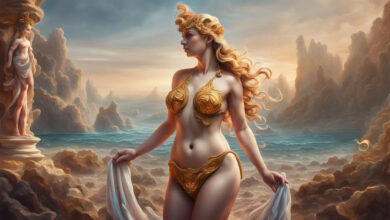

The Roman Interpretation of the Four Elements
The ancient Roman worldview, much influenced by earlier Greek philosophy, encompassed a rich interpretation of the physical universe. A central aspect of this worldview was the concept of the four elements: Earth, Water, Air, and Fire. These elements were not merely physical substances; they acted as philosophical constructs that shaped Roman thought, mythology, and science. This article explores the Roman interpretation of these four fundamental elements and their significance in Roman culture and society.
Historical Context
The Roman interpretation of the four elements can be traced back to the Greeks, particularly to philosophers like Empedocles and Plato, who first introduced the elemental theory around the 5th century BCE. However, it was with philosophers like Aristotle that the elements gained a more structured definition. Aristotle’s work greatly influenced Roman thinkers, integrating the four elements into a broader cosmological framework that encompassed the nature of life, the universe, and philosophical discourse.
Upon engaging with these philosophies, Roman scholars and writers adopted and adapted these ideas to fit their own cultural context, thus formulating an interpretation that resonated with their beliefs and practices.
Earth
In Roman thought, Earth (Terra) represented stability, nourishment, and fertility. It was revered as the source of all agricultural abundance and domestic stability. Deities like Ceres, the goddess of agriculture, were central to Roman religion, emphasizing the reverence for the Earth. Cultivating land was intrinsically linked to Roman identity, illustrating the value placed on agriculture and the idea of ‘pax agraria’—the peace that comes from cultivation.
The Romans also attributed specific qualities to Earth, such as solidity and permanence. This was reflected in their architecture, characterized by grand structures, fortifications, and aqueducts, all designed to withstand the tests of time. Thus, Earth was not only a physical entity but also a metaphor for resilience and cultural longevity.
Water
Water (Aqua) represented life and purity in Roman culture, embodying cleansing and sanctity. The Romans revered various water bodies, viewing rivers and springs as sacred. For example, the Tiber River was integral to Rome’s identity. Deity figures like Neptune, the god of the sea, and Venus, often associated with rivers, emphasized the life-giving and sometimes destructive power of water.
The Roman approach to water also manifested in their awe-inspiring engineering, seen in aqueducts that transported fresh water to urban centers, ensuring the growth of cities. Water was not merely a resource but a fundamental element that made civilization possible. Rituals involving water, such as lustration (purification rites), underscored its significance in maintaining public and spiritual health.
Air
Air (Aer), while perhaps less physically tangible than the other elements, was no less significant. The Romans associated air with the intellect, thought, and the divine. It was often linked with the gods themselves; for instance, Jupiter, the king of the gods, ruled from above the clouds, embodying the power of the heavens.
The Romans believed that air was vital for life and had both nourishing and destructive qualities. The concept of ‘spiritus’ or breath, representing life force, was derived from this element. The blending of air with intellect and creativity brought a poetic dimension to Roman philosophy and literature. Poetry, rhetoric, and oratory flourished in this context, establishing a culture that valued expression and communication.
Fire
Fire (Ignis) held a dual aspect in Roman culture, symbolizing both destruction and transformation. On one hand, fire was revered for its life-giving properties, essential for cooking, warmth, and light. On the other hand, it was also a source of chaos and devastation, as seen in mythological tales where uncontrolled flames led to ruin and loss.
The worship of Vesta, the goddess of the hearth, illustrates the centrality of fire in Roman domestic life. The flame in her temple was seen as the sacred heart of Rome, representing the health and wealth of the city. Fire also came to symbolize passion, ambition, and creativity, making it a favored element in artistic expression. Literature and drama frequently invoked fire as a metaphor for intense emotions, often highlighting its paradoxical nature.
Interconnectivity of the Elements
In Roman philosophy, the four elements were not seen as isolated entities; rather, they existed in a dynamic, interconnected web. This interdependence was reflected in various aspects of Roman thought and culture. For example, the blend of fire and water could symbolize both destruction (a raging fire consuming water) and creation (steam as a transformative energy).
Moreover, the Romans believed that human beings are composed of these elements, influencing their temperament and character. This led to the concept of the four humors—blood, phlegm, yellow bile, and black bile—derived from the four elements, which Roman physicians believed affected one’s physical health and personality.
Conclusion
The Roman interpretation of the four elements—Earth, Water, Air, and Fire—was integral to their understanding of the cosmos and their cultural identity. These elements were imbued with philosophical meanings that encompassed stability, purity, intellect, and passion. They were reflected in religious practices, literature, and societal values, shaping a worldview that acknowledged both the physical and metaphysical realms.
As we explore contemporary thought and culture, it becomes evident that the legacy of these ancient interpretations still resonates today. The interplay of these elements continues to inspire us, reminding us that understanding the world often involves looking beyond the surface. By appreciating the depth of the Roman interpretation of the four elements, we grasp not only their historical significance but also their enduring influence in the quest for knowledge and meaning in our lives.