Saraswati in Hindu Worship, Learning and Speech
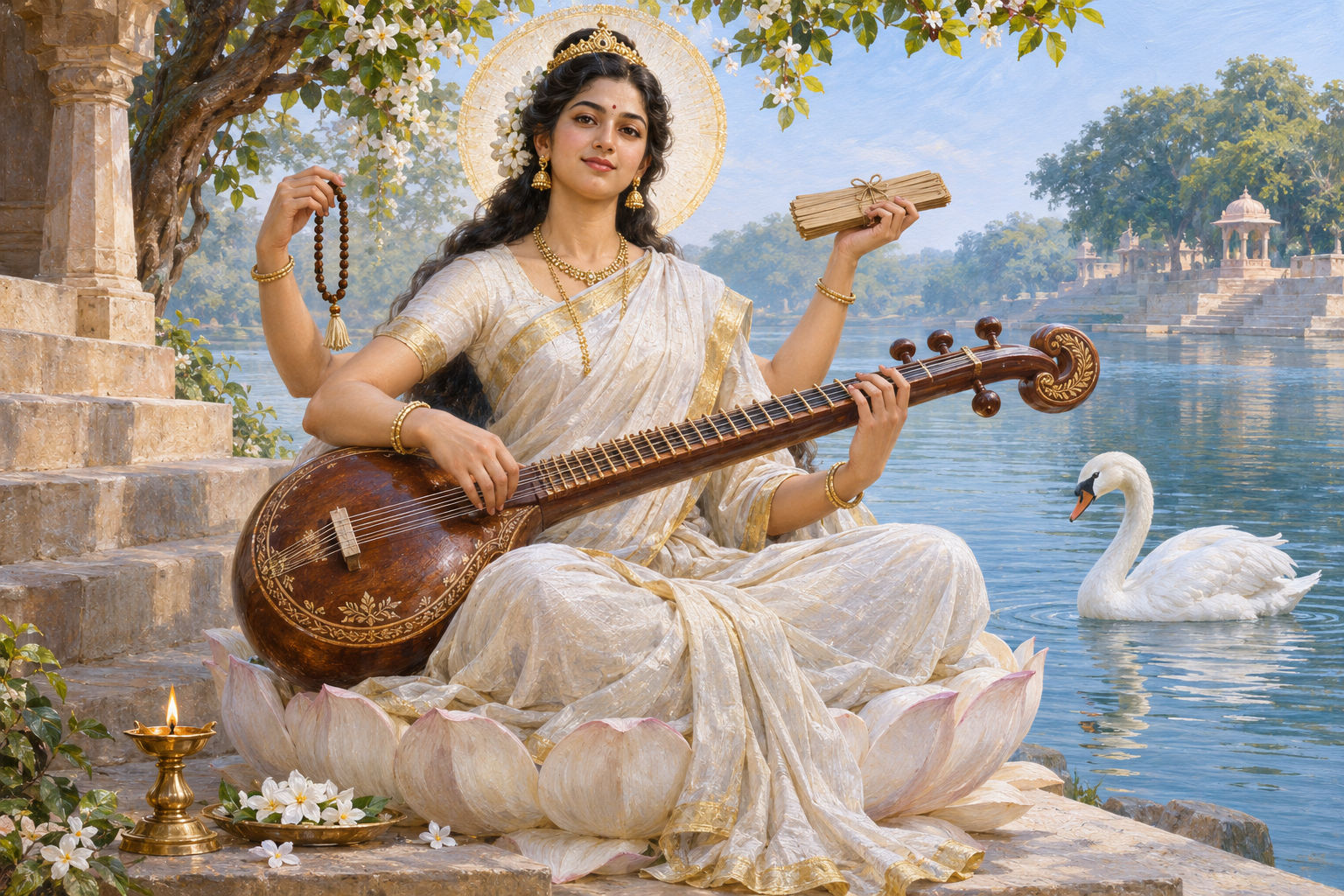
Saraswati is one of the most recognisable goddesses in Hindu tradition: graceful, white-clad, associated with music, learning and eloquent speech. Yet she is more than a simple “goddess of education”. Her history stretches from the earliest Sanskrit hymns, where she appears as a river, to later devotional traditions in which she becomes the power that makes speech meaningful, scholarship possible and the arts flourish. That layered identity is part of what makes Saraswati so fascinating. She belongs at once to landscape, language and devotion.
From river to goddess
In the Rigveda, the oldest of the Vedas, Saraswati is praised primarily as a river. The hymns describe her as powerful, life-giving and worthy of sacrifice, and one celebrated verse addresses her directly as a mighty stream. Scholars have long noted that this early imagery already carries a sense of abundance and inspiration, even before the fully developed goddess of later Hindu devotion emerges. In other words, Saraswati does not begin as an abstract patron of learning; she grows out of a sacred river presence that is gradually enriched by further associations.
Over time, Saraswati becomes linked with Vāc, the Vedic goddess of speech. That connection is central: speech is not merely communication, but the medium through which ritual is performed, knowledge is transmitted and sacred sound is preserved. In later Hindu tradition, Saraswati is often understood as the divine force behind articulation, memory, poetry and disciplined study. Some texts and traditions also identify her as the consort of Brahma, the creator god, but this relationship is not the same in every community or text, and it should not be treated as universal.
The goddess of speech and sacred learning
Saraswati’s best-known role today is as the patroness of learning, literature and the fine arts. This is not a modern reinvention, but a long development in which the goddess of river and speech comes to represent the cultivated use of mind and voice. Her very name is often understood in relation to flowing water, and that image remains apt: speech should move clearly, knowledge should travel from teacher to student, and inspiration should not stagnate.
In Hindu thought, learning is not only an academic activity. It is tied to dharma, the proper ordering of life, and to the disciplined pursuit of wisdom. Saraswati therefore stands close to the Vedas, the Sanskrit language and the authority of recited text. In manuscript culture, her presence in opening verses and invocations is especially important. Scribes and scholars traditionally ask for her blessing before beginning a work, because accurate writing is itself a sacred task. The page becomes a place of reverence as much as of instruction.
Why she matters to speech, music and memory
One reason Saraswati remains so enduringly beloved is that she governs the tools of thought. Speech is not treated as an afterthought in Hindu worship; it is a spiritual power. A prayer recited badly, a mantra mispronounced or a teaching forgotten at the crucial moment can all disrupt religious practice. Saraswati embodies the grace that allows words to be chosen well, spoken well and remembered well.
She is also strongly associated with music and the performing arts. The veena, a stringed instrument often shown in her hands, symbolises harmony and cultivated expression. Her iconography is usually calm and luminous: white garments, a swan or lotus, a book, beads and sometimes the veena. White signifies clarity rather than emptiness, suggesting purity of thought and concentration. The swan is often read as an emblem of discernment, the ability to separate truth from confusion. Together these symbols present knowledge not as dry accumulation, but as a refined way of seeing and speaking.
How she is worshipped in living practice
Saraswati is worshipped in diverse ways across India and the wider Hindu world, and practice varies by region, family and institution. One of the most visible occasions is Saraswati Puja, often associated with Vasant Panchami, a spring festival. In many homes, schools and cultural organisations, books, pens, musical instruments and writing materials are placed before the goddess and blessed. For students, the ritual is especially meaningful: it frames education as something entrusted to divine care, not simply personal effort.
Among musicians, artists and writers, Saraswati may be honoured before a performance or new project begins. In many temples and households, the goddess is invoked alongside or before other deities, depending on local custom. This is one reason she has such wide appeal: she is not confined to a single sectarian setting, but belongs naturally to the practical rhythm of daily devotion. At the same time, it is worth remembering that different Hindu traditions understand her differently. Some emphasise her as an independent goddess; others place her in relation to Brahma; still others connect her with broader goddess theology in which shakti, or divine power, is supreme.
Saraswati in texts beyond the Vedas
Later Sanskrit literature expands Saraswati’s profile in new directions. Epic and Puranic texts preserve river imagery, but they also deepen her status as a divine presence connected with sacrifice, wisdom and blessing. In the Mahabharata, for example, the Saraswati is still a sacred river with a living religious geography. The text also preserves the idea that the river can be hard to see in the landscape yet remain present in a subtler way, which reflects the continuing sanctity of the river beyond simple physical observation.
In some later Puranic and devotional traditions, Saraswati acquires more elaborate mythic biographies. These stories may describe her emerging from Brahma, becoming his consort, or taking other divine forms. Such accounts are important within the traditions that tell them, but they are not the only way Saraswati is understood across Hinduism. A careful retelling should therefore distinguish between early Vedic praise of the river, the later identification with speech, and the more developed devotional stories of the goddess. The development is cumulative rather than neatly linear.
A goddess shared across traditions, but not interpreted in only one way
Saraswati is not exclusively a Hindu figure. She also appears in Buddhist and Jain traditions, where she is similarly connected with knowledge, learning and eloquence, though often within distinct theological frameworks. That shared presence shows how influential the goddess became in South Asian religious culture more broadly. It also reminds us that divine figures can travel across traditions without losing their local meanings.
In Hindu contexts, the goddess continues to speak powerfully to the practical life of study. She is invoked by schoolchildren, poets, classical musicians, scholars and devotees who seek clarity of mind. Her worship acknowledges that language is not neutral: words can teach, bless, distort or liberate. Saraswati represents the hope that speech may be truthful, memory strong and learning fruitful.
That is why Saraswati still feels so immediate. She is not only the goddess of books on a shelf, but of the living intelligence that turns knowledge into understanding, and understanding into eloquence. In her, Hindu devotion honours the quiet but transformative power of speech well used.
Sources and further reading
- Elizabeth Mary Rohlman, “The Elusive Sarasvatī: A Goddess, a River, and the Search for the Universal in the Particular” (Oxford University Press) (opens in a new tab)
- Ralph T. H. Griffith, translation of Rigveda 7.95, “Sarasvatī” (Internet Sacred Text Archive) (opens in a new tab)
- Arthur Avalon (ed. and trans.), “Sarasvatī (Sarasvatīstotra) from the Tantrasāra” (opens in a new tab)
- Smithsonian’s National Museum of Asian Art, “Devi: The Great Goddess” (opens in a new tab)
Recommended reading
These are affiliate links. If you buy through them, we may earn a commission at no extra cost to you.
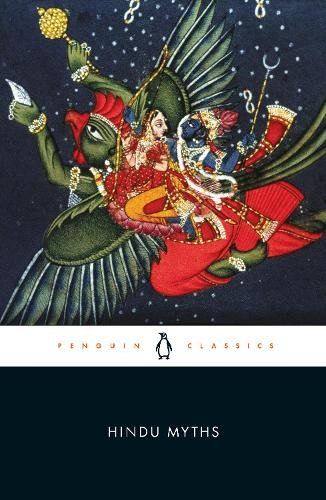
Hindu Myths: A Sourcebook Translated from the Sanskrit
Preserved in ancient Sanskrit texts like the Rig Veda and Mahabharata, Hindu myths date as far back as 1000 BCE. These seventy-five core stories feature Vishnu’s heroic avatars and youthful Krishna, along with tales of minor gods, demons, and sacred animals. Vibrant and expansive, they reflect a worldview encompassing cosmic creation, infinite earthly possibilities, and the universal touch of Death.
The Bhagavad Gita (Deluxe Hardbound Edition)
Compiled from the nine-volume Complete Works, this book brings together Swami Vivekananda's commentary on the Bhagavad Gita, systematically ordered by chapter and verse. Readers can study the original Devanagari verses and their English translations right alongside Vivekananda's illuminated perspective.
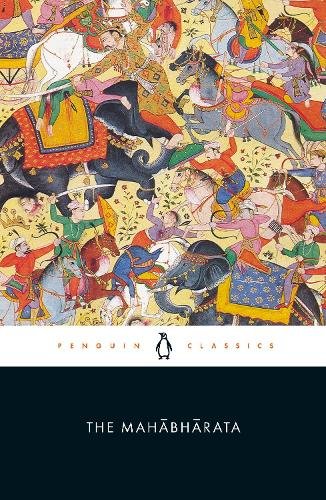
The Mahabharata
Rooted in ancient Indian literature, the Mahabharata is a cornerstone Sanskrit epic and a vital text of Hinduism. Beyond its sweeping narrative, it delves into the four key human pursuits—artha (purpose), kama (pleasure), dharma (duty), and moksha (liberation)—exploring how karma and self-identity shape an individual's connection to society and the universe.