The Second Battle of Mag Tuired and the Rise of the Tuatha Dé Danann
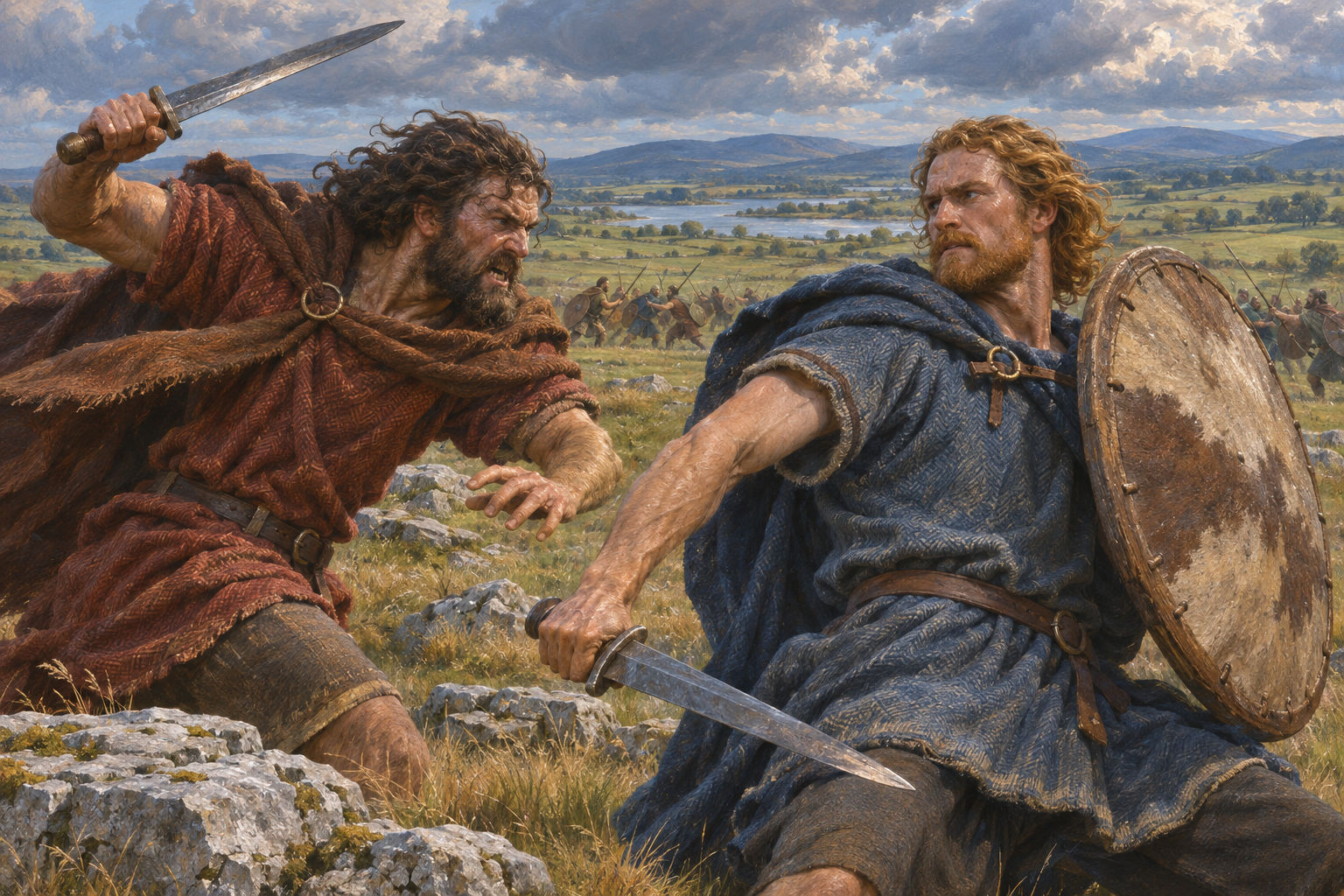
In Irish myth, the Second Battle of Mag Tuired is the story that seals the rise of the Tuatha Dé Danann: the divine and semi-divine people who, in medieval Irish literary tradition, become the central supernatural race of early Ireland. The tale survives in an Old/Middle Irish narrative usually called Cath Maige Tuired, preserved by Christian scribes but drawing on older learned material. It is not a transparent window onto prehistoric religion, yet it is one of the richest surviving Irish myths, full of kinship, sovereignty, tribute, hospitality and the uneasy boundary between order and the Otherworld.
The Irish tradition behind the tale
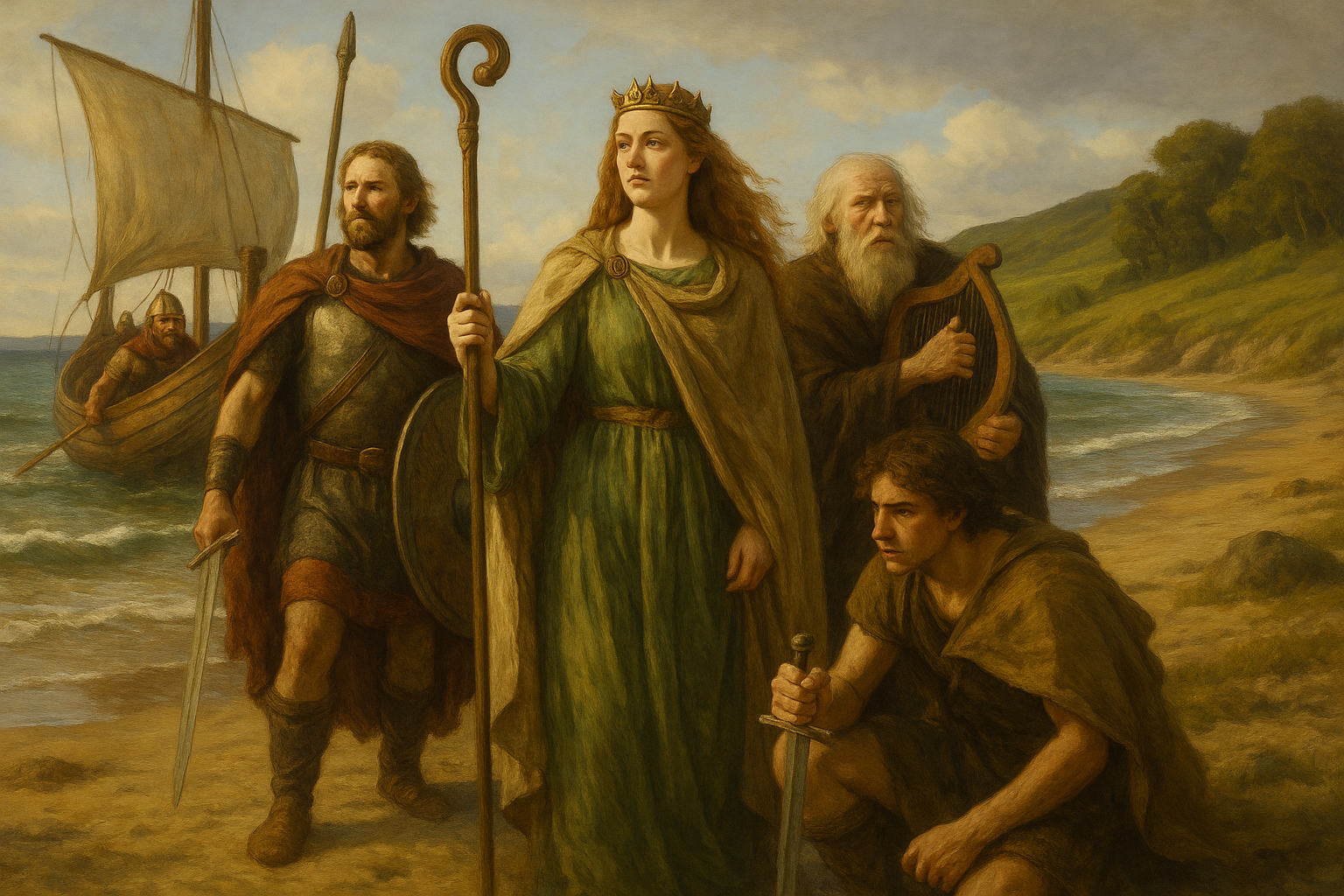
Cath Maige Tuired belongs to the Irish mythological tradition, not to a single pan-Celtic story shared by all Celtic-speaking peoples. Its principal text is the “Second Battle of Mag Tuired”, distinct from the earlier “First Battle of Mag Tuired” between the Túatha Dé Danann and the Fir Bolg. The best-known modern English translation is Elizabeth A. Gray’s edition, available through CELT at University College Cork. Medieval Irish compilers often linked such stories to pseudo-history in works like Lebor Gabála Érenn (“The Book of the Taking of Ireland”), which tries to fit legendary peoples into a historical sequence of arrivals in Ireland. That framework is part of the literature’s medieval setting, not a straightforward record of ancient belief.
Within this tradition, the Túatha Dé Danann are presented as a wondrous people associated with skill, kingship and the síd, the Otherworldly dwelling-hills later connected with fairies in modern folklore. In the older literary setting, though, they are not simply “fairies” in the modern sense. They are powerful supernatural figures, sometimes treated euhemeristically as mortal ancestors, sometimes as gods or god-like beings, depending on the text and the compiler’s purposes.
Nuada, Bres and the troubled kingship
The story opens in the aftermath of the Túatha Dé Danann’s earlier victory over the Fir Bolg. Their king, Nuada, has lost an arm in that battle, and although the physician Dian Cécht later fashions him a silver replacement, Irish royal ideology requires a ruler to be physically whole. Because of that blemish, Nuada must surrender the kingship. The choice falls on Bres, a handsome but deeply flawed king whose parentage itself points to the tale’s tensions: his father is Fomorian, while his mother belongs to the Túatha Dé Danann.
Bres’s reign turns bitter. He is beautiful, but he is a bad king: he does not practise the generosity and reciprocity expected of a ruler. The text shows him imposing hard labour and tribute on the Túatha Dé Danann, who are humiliated by service and by the loss of proper hospitality. In a society where a king’s honour is tied to feeding, protecting and rewarding his people, Bres’s failure is not merely personal rudeness; it is political disaster. The world of the story begins to tilt because kingship itself has gone wrong.
The Fomorian threat and the loss of the Dagda’s harp
Bres’s rule also opens the door to open oppression by the Fomoire, a hostile supernatural people who in this tale function as the chief enemies of the Túatha Dé Danann. The Fomoire are not a tidy equivalent of “evil”; the saga treats them as dangerous rivals, raiders and tributary lords, with Balor and Indech among their leading figures. Under Bres, Ireland is burdened by heavy tribute. The famous image is of a land so oppressed that there is not a smoke-plume from a roof that is not taxed.
One of the tale’s most memorable episodes concerns the Dagda, who goes to Bres’s court and is mocked with miserly hospitality. In a story that values social order, this insult matters. The Dagda later regains a stolen harp, and its music can compel laughter, tears and sleep. The episode is both vivid and symbolic: the rightful supernatural order has been diminished, but not destroyed. The Túatha Dé Danann remain, waiting for a leader who can restore balance.
Lug arrives: the champion of every art
That leader is Lug, later famous in Irish tradition as Lugh Lámhfhada, “Lug of the Long Arm”. He is introduced with ceremonial care because the court at Tara initially bars him from entry. When asked what craft he can offer, he names skill after skill: he is not a one-function specialist, but a figure of total competence. The king’s house needs a smith, a harper, a warrior, a physician, a poet, a champion; Lug can fill all those roles and more. The point is not simply that he is talented, but that he embodies mastery across the very arts Bres has failed to honour.
Nuada recognises him as the one person who can save the Túatha Dé Danann. Lug is admitted, and the saga gathers its powers around him. This is one of the clearest examples in Irish narrative of a hero whose authority rests not on brute force alone, but on knowledge, eloquence and right action. He becomes the organiser of the coming battle and the counterweight to Fomorian domination.
How the battle is won
The battle itself is not a simple clash of armies; it is a contest of leaders, weapons and supernatural force. The Túatha Dé Danann prepare under Lug’s direction. Goibniu, the smith, forges weapons that do not fail. Dian Cécht and his son Miach, in related traditions, are associated with healing and restoration, though the main battle narrative emphasises support rather than medical miracle. The saga’s power lies in the way it stages the defence of a whole social order: craft, kingship, martial skill and magical knowledge all have to work together.
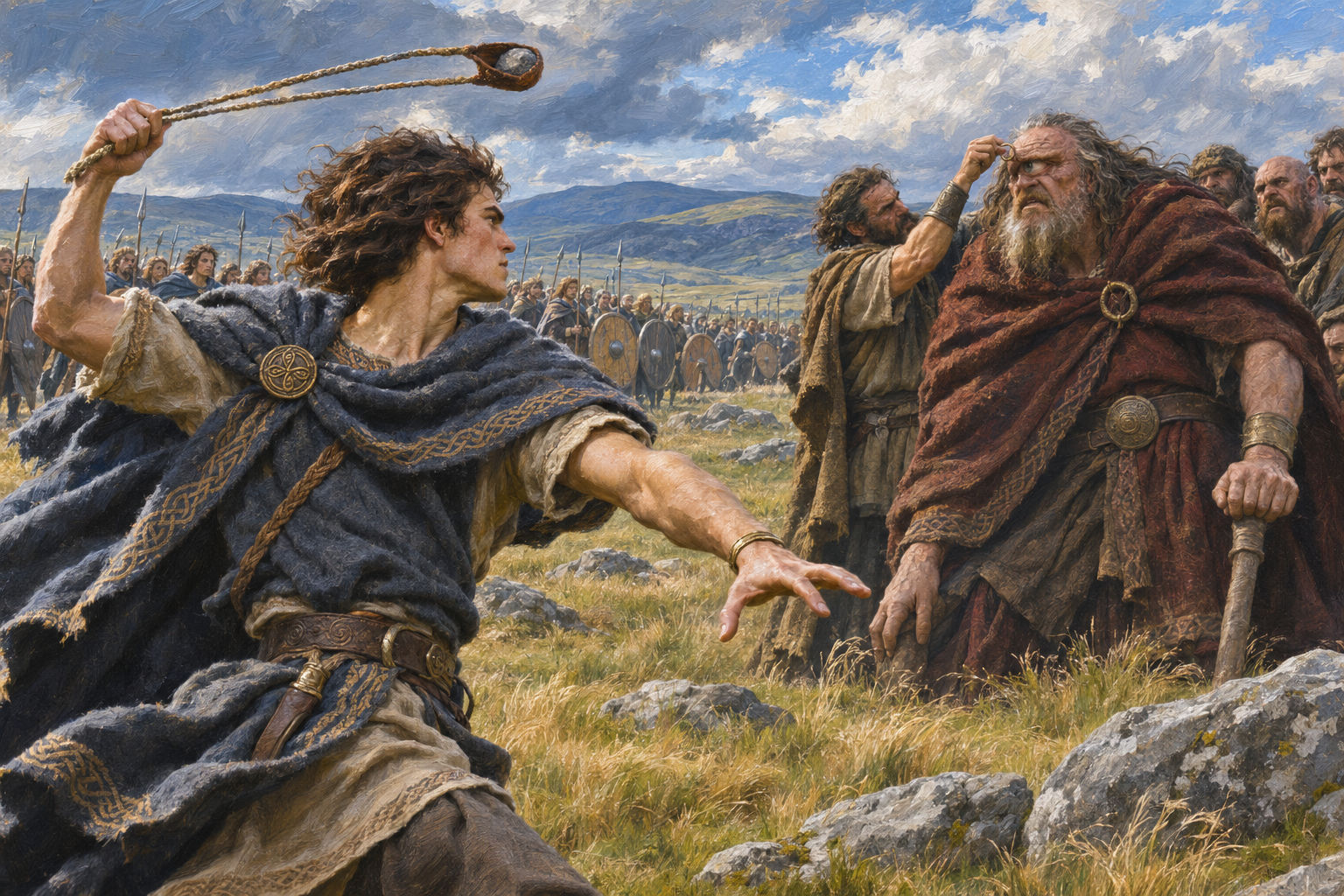
At the height of the fighting, Lug meets Balor, the fearsome Fomorian chief whose destructive eye is central to the story. Balor’s eye is so dangerous that attendants must lift its lid, and once it is opened it devastates whatever it faces. In the battle, Lug uses a sling-stone to strike that eye through Balor’s head. The force of the blow turns back on Balor’s own host, and the Fomorian leader is killed. This is the tale’s great decisive moment: not just the defeat of an enemy, but the destruction of the power that had held the land in tribute.
Balor’s death matters because it symbolically ends the Fomorian threat as the ruling force over Ireland. The battle then breaks in favour of the Túatha Dé Danann, and the old oppression is lifted. The story is not tidy in modern heroic terms: it is violent, costly and crowded with losses. But it does end with the restoration of order, and with Lug established as the indispensable figure of victory.
What the ending says about kingship and the Otherworld
After the battle, the Túatha Dé Danann are no longer simply invaders or newcomers. In later Irish tradition, they become associated with the hidden world beneath the hills, the síd, where they continue to dwell after the age of open conflict with humans. That development belongs to the wider mythological tradition, especially as shaped by Lebor Gabála Érenn and related texts. The Cath Maige Tuired itself is interested less in a neat “origin story” than in the right ordering of power: who may rule, who may demand tribute, and what happens when hospitality and justice fail.
Read this way, the battle is not merely a supernatural war. It is a tale about legitimacy. Bres loses because he is a king without generosity; Nuada can rule only once physical wholeness is restored; Lug triumphs because he embodies the many arts a healthy society needs. The supernatural language of the tale gives those concerns dramatic force, but the social imagination underneath is just as important.
Why the story still matters
The Second Battle of Mag Tuired survives because it is more than a list of divine names and martial feats. It is a carefully structured myth of conflict, injury and renewal, preserved in medieval Irish literary culture yet reaching back, perhaps imperfectly, to older ideas about sacred kingship and supernatural sovereignty. For modern readers, its appeal lies in that blend of grandeur and clarity: a wounded order, a false king, a champion who can do everything, and a battle in which the fate of a people turns on whether skill and justice can overcome appetite and tribute.
Sources and further reading
- Cath Maige Tuired: The Second Battle of Mag Tuired, translated by Elizabeth A. Gray (CELT, University College Cork) (opens in a new tab)
- Lebor Gabála Érenn, edited and translated by R. A. S. Macalister (CELT, University College Cork) (opens in a new tab)
- Ireland’s Immortals: A History of the Gods of Irish Myth, by Mark Williams (opens in a new tab)
- Attitudes towards Paganism in Medieval Irish and Old Norse Texts of the Trojan War, by [Cambridge repository article] (opens in a new tab)
Recommended reading
These are affiliate links. If you buy through them, we may earn a commission at no extra cost to you.
Celtic Druidry: Rituals, Techniques, and Magical Practices
Ellen Evert Hopman’s practical guide blends ancient Celtic wisdom with modern Reconstructionism, covering Druidic tools, cosmology, tree lore, and rituals. Packed with seasonal rites, Ogham divination, and protective charms, it offers everything needed to begin the Druid path.
Celtic Tales: Fairy Tales and Stories of Enchantment from Ireland, Scotland, Brittany, and Wales
Gathering tales from Ireland, Scotland, Brittany, and Wales, this illustrated collection features sixteen folklorist-transcribed stories brimming with magical creatures and timeless wit. Enhanced by Kate Forrester’s elegant silhouette artwork, it vividly transports readers to the enchanted realms of Celtic myth.
The Historical Atlas of the Celtic World
Featuring 54 vibrant full-color maps, this atlas comprehensively charts 3,000 years of Celtic history from Bronze Age origins to the modern global diaspora. Incorporating the latest research, it explores Continental, Atlantic, and contemporary Celtic cultures to trace their enduring legacy across Europe and beyond.