Durga’s Victory over Mahishasura and the Power of the Goddess
Durga and Mahishasura: a goddess who cannot be contained
The story of Durga’s victory over Mahishasura is one of the most vivid and influential episodes in Hindu religious literature. In the Devi Mahatmya, a celebrated section of the Markandeya Purana, the goddess is not a secondary figure beside male gods, but the central power who restores order when even the gods fail. The tale is both dramatic and restrained: a battle story, certainly, but also a meditation on divine energy, courage and protection. In many Hindu traditions, it has become a key way of understanding the Goddess as shakti — living power, capability and force.
The gods fail, and the Goddess is invoked
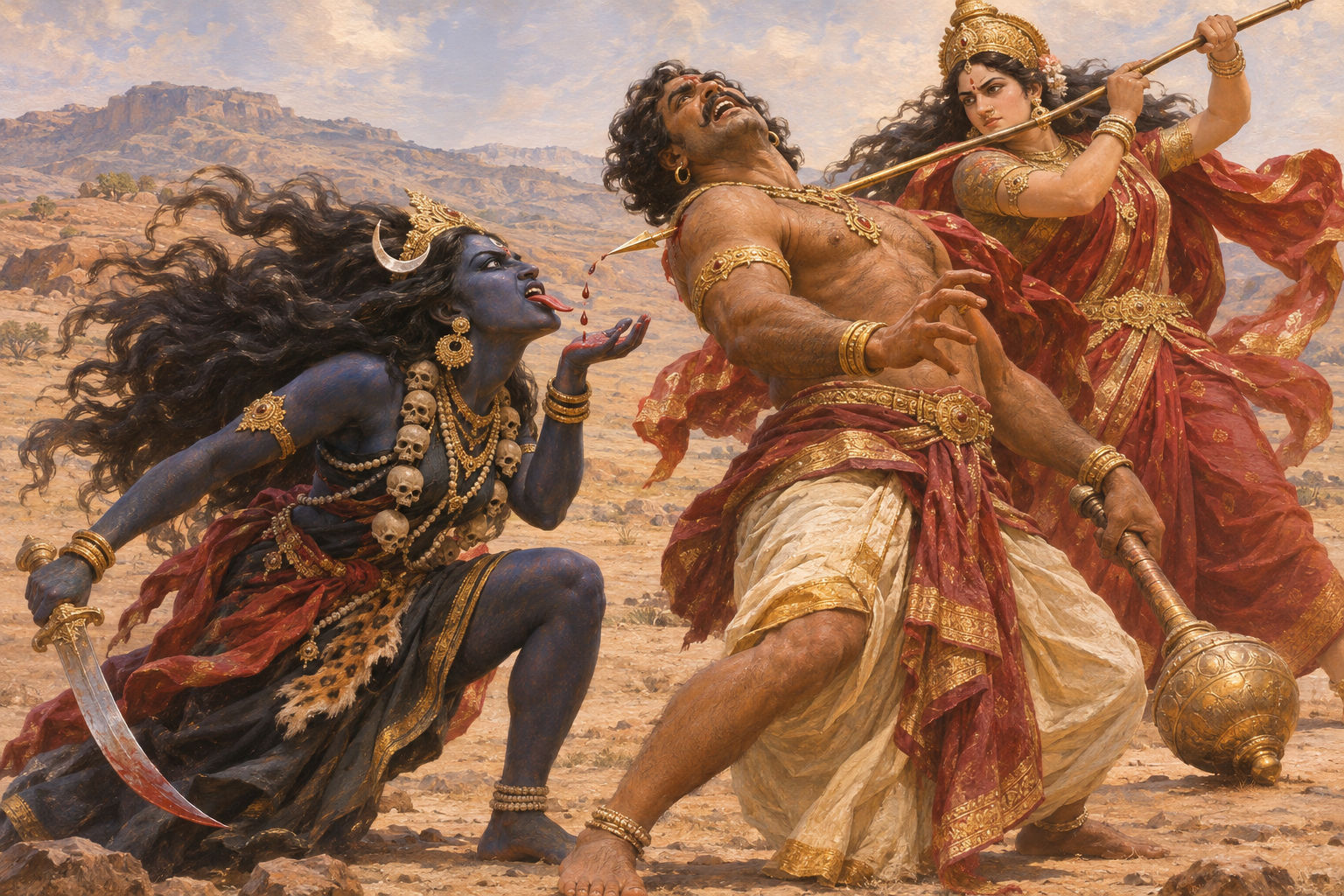
The principal retelling begins in the Devi Mahatmya with the gods in distress. The buffalo-demon Mahishasura has overthrown Indra and driven the gods from heaven. They turn together in anguish, and from their combined energies a radiant goddess appears. This is not a tale of one male deity simply sending a female champion; the text presents Durga as arising from the gathered power of the gods themselves, then surpassing them all. She receives weapons from different deities, each offering her the tools of war that they, separately, could not use to defeat the demon. The imagery is important: the goddess is armed by the gods, yet the victory belongs to her. The story is framed in the Devi Mahatmya as a revelation of the Goddess’s supremacy and as a source of protection for devotees.
Mahishasura’s shape-shifting challenge
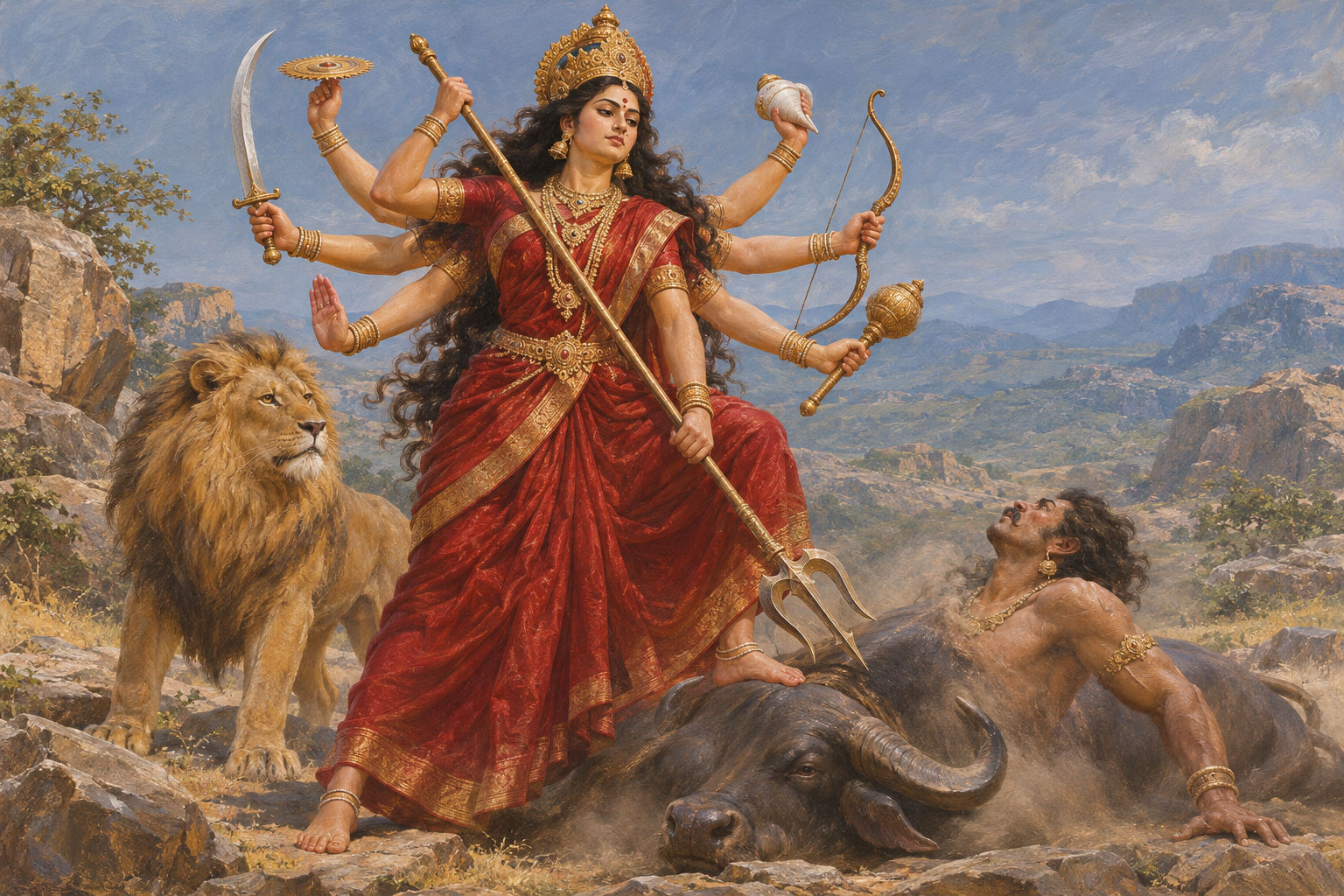
Mahishasura is a buffalo-demon, but he is not presented merely as a beast. In the story he can assume different forms, including that of a buffalo and a man, which makes him harder to pin down and more unsettling to defeat. The goddess confronts him in a series of escalating encounters. He sends armies against her; she destroys them. He changes form and tries different tactics; she meets each with calm force. The text does not linger on psychological explanation or moral sermonising. Instead, it builds tension through repeated demonstration: whatever Mahishasura throws at her, Durga remains composed, powerful and unshaken. This steady advance towards victory is one reason the story has remained so compelling in later art and worship.
Why the battle matters in the Devi Mahatmya
The final defeat of Mahishasura is not just an action scene. In the Devi Mahatmya, it confirms a theological claim: the Goddess is the ultimate source of power that sustains and rescues the world. After the battle, the gods praise her and ask her to remain favourable to them and to humanity. The text’s later chapters continue this emphasis by showing her granting boons, knowledge and protection. In other words, the battle against Mahishasura is the opening proof of a wider truth about the Goddess’s benevolence and might. Many Shakta traditions — traditions centred on the Goddess — have treated this as a foundational statement of faith, though not every Hindu community reads the text in the same way or gives it the same degree of liturgical importance.
Durga’s weapons, posture and calm face
Later artists made the story instantly recognisable. Sculptures and reliefs across South Asia show Durga with many arms, each holding a divine weapon: sword, discus, trident, bow, arrow, noose and shield. The Metropolitan Museum of Art’s description of a ninth-century image from Bihar notes that the goddess is shown in a multi-armed form, using the weapons lent by the gods, while the lion mount joins the attack. Such images are not mere illustration. They translate the poem into a visual theology of concentrated power. Even when Durga is shown at the height of violence, the face is often serene. That contrast — calm expression and unstoppable force — is one of the most striking features of the goddess’s iconography.
Different tellings, one enduring core
The story of Durga and Mahishasura appears in several forms in Indian religious culture, but the Devi Mahatmya is the principal source for the classic narrative of the goddess arising from the gods’ energies to slay the buffalo-demon. Later Puranic and regional traditions often expand her character, her associations and her worship. Some place greater emphasis on her relation to Shiva as his consort or as a manifestation of his shakti; others emphasise her independence much more strongly. What remains consistent is the central intuition that divine feminine power can be the decisive force in restoring balance. That is why the story has proved so adaptable: it is at once specific enough to be vivid and open enough to speak to different communities in different ways.
From sacred text to living devotion
The Devi Mahatmya is not only a literary source; it is also recited, memorised and worshipped. Thomas Coburn’s study of the text notes its deep embedding in Goddess devotion, especially in Shakta and Tantric contexts, where the recitation itself is treated as powerful and transformative. That helps explain why the story of Mahishasura’s defeat has travelled so widely: it is not simply a mythic episode preserved in books, but a narrative that lives through ritual, festival and image. During Navaratri and related observances, many devotees hear or recite the story as part of honouring Durga’s presence in the world. The tale endures because it offers more than triumph; it offers confidence that disorder is not the last word.
Durga’s victory over Mahishasura remains powerful because it joins beauty and ferocity, composure and combat, devotion and doctrine. The story does not flatten the world into a simple contest of good against evil; it presents a goddess whose strength is itself a form of protection, and whose greatness lies in meeting chaos without losing her poise. That combination has made Durga one of the most enduring figures in South Asian religious imagination.
Sources and further reading
- Frederick Eden Pargiter, translation of the Mārkaṇḍeya Purāṇa, including the Devi-Māhātmya (opens in a new tab)
- Thomas B. Coburn, Encountering the Goddess: A Translation of the Devī-Māhātmya and a Study of Its Interpretation (opens in a new tab)
- The Metropolitan Museum of Art, Goddess Durga Slaying the Demon Mahisha (opens in a new tab)
- The British Museum, Feminine power: the divine to the demonic (opens in a new tab)
Recommended reading
These are affiliate links. If you buy through them, we may earn a commission at no extra cost to you.
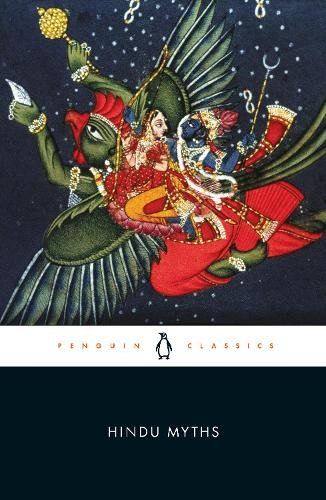
Hindu Myths: A Sourcebook Translated from the Sanskrit
Preserved in ancient Sanskrit texts like the Rig Veda and Mahabharata, Hindu myths date as far back as 1000 BCE. These seventy-five core stories feature Vishnu’s heroic avatars and youthful Krishna, along with tales of minor gods, demons, and sacred animals. Vibrant and expansive, they reflect a worldview encompassing cosmic creation, infinite earthly possibilities, and the universal touch of Death.
The Bhagavad Gita (Deluxe Hardbound Edition)
Compiled from the nine-volume Complete Works, this book brings together Swami Vivekananda's commentary on the Bhagavad Gita, systematically ordered by chapter and verse. Readers can study the original Devanagari verses and their English translations right alongside Vivekananda's illuminated perspective.
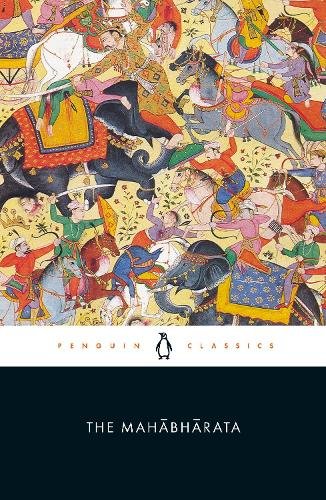
The Mahabharata
Rooted in ancient Indian literature, the Mahabharata is a cornerstone Sanskrit epic and a vital text of Hinduism. Beyond its sweeping narrative, it delves into the four key human pursuits—artha (purpose), kama (pleasure), dharma (duty), and moksha (liberation)—exploring how karma and self-identity shape an individual's connection to society and the universe.