The Creation of the Land in Awaji: Izanagi, Izanami and Regional Tradition
Awaji Island has a special place in Japanese mythology because it is linked to the opening movements of creation itself. In the central court chronicles, especially the Kojiki, the island is the first land to emerge from the union of Izanagi and Izanami, the divine pair whose story explains how the islands came to be, how important kami entered the world, and why purity matters so deeply in Shinto tradition. Awaji’s own shrine traditions have preserved that memory in a more local form, making the island a rare place where narrative, devotion and landscape are closely entwined.
The first task: shaping a floating world
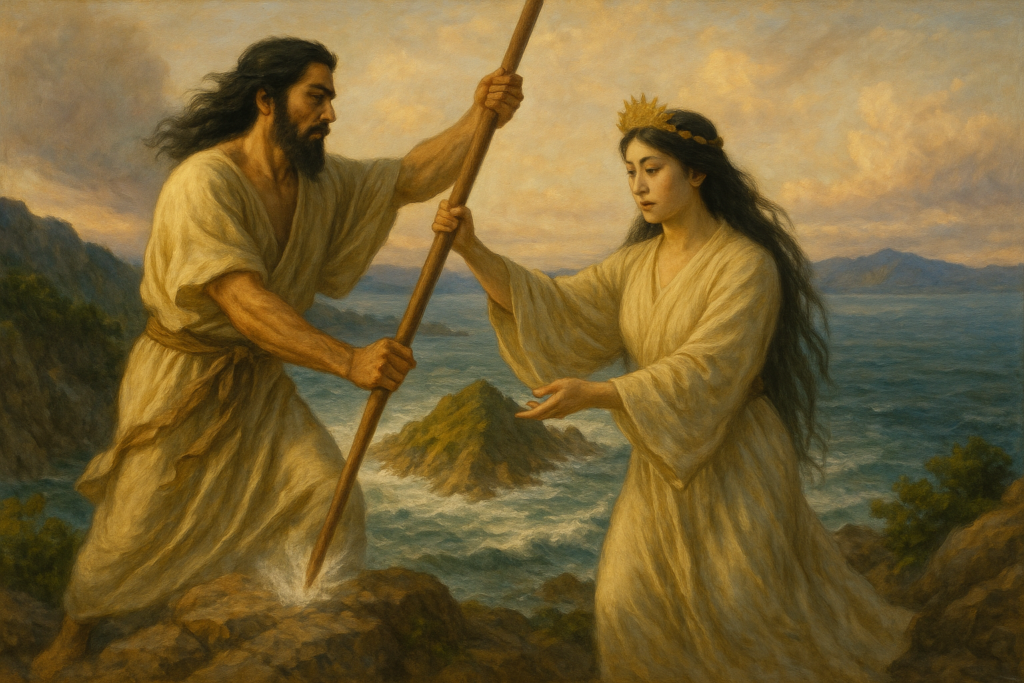
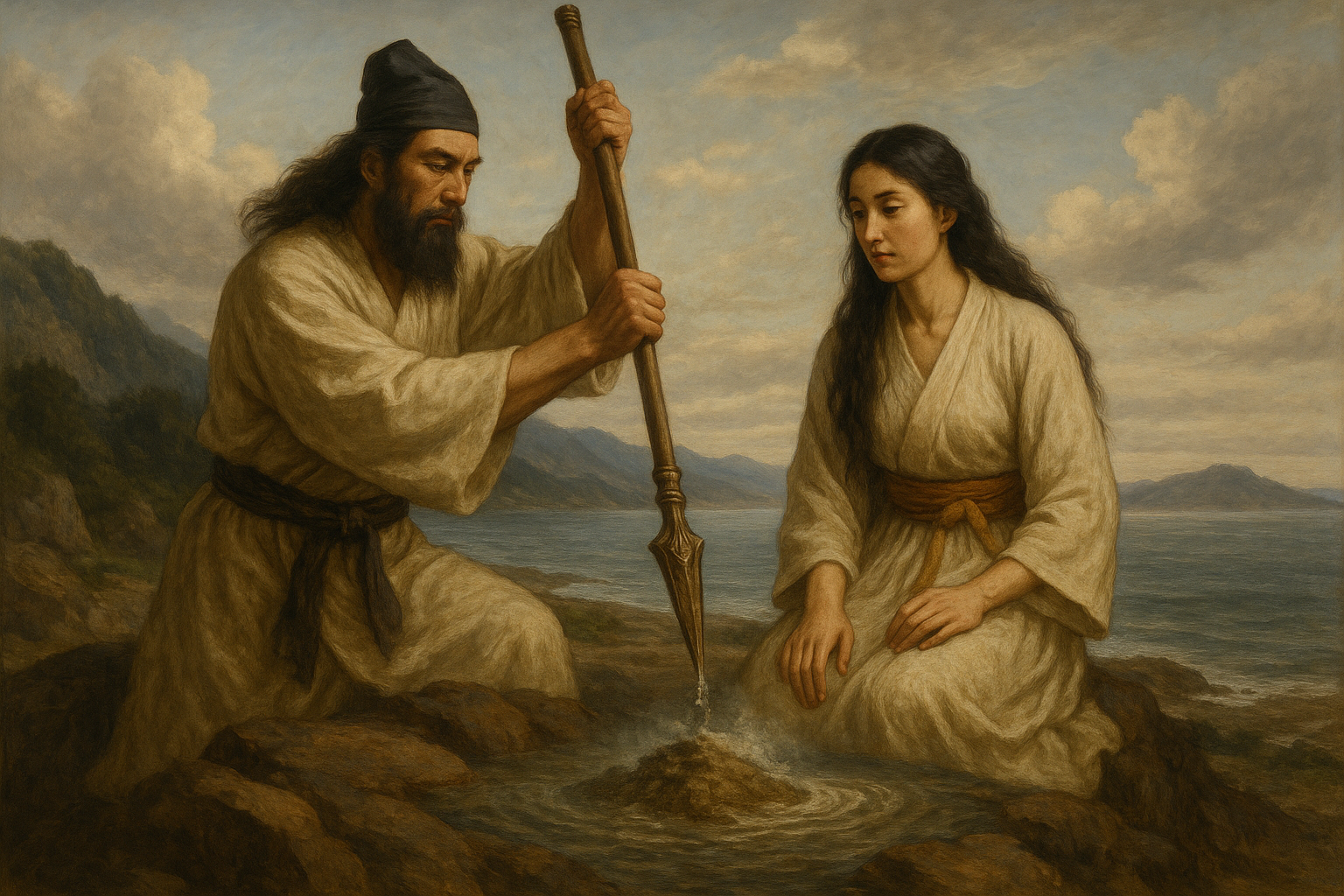
The best-known version of this story is told in the Kojiki, compiled in 712 at the Yamato court. That date matters: the text is not a neutral transcript of ancient belief, but a court-sponsored compilation that gathered myths, genealogies and political memory into a single narrative. In its creation account, the heavenly deities send Izanagi and Izanami down to the “floating bridge of heaven” with a jewelled spear. Standing above the shapeless, watery world below, they stir the brine with the spear. When they lift it up, the salty drops that fall from the tip harden into land. The first island to appear is Awaji.
From that beginning, the couple continue to give birth to the islands of the archipelago. The Kojiki presents this as a sequence of births, not as a modern map being filled in one piece at a time. Awaji is followed by other islands, and the story eventually leads to the formation of the “Great Eight Islands”, the mythic core of the Japanese landmass. The point is not just geography. The islands are born through a divine relationship, so land, kinship and sacral order are linked from the start.
Why Awaji comes first in the Kojiki
Awaji’s priority in the tale is one reason the island later acquired such strong religious significance. In the Kojiki, it is the first land produced by the pair after they perform the rite at the heavenly pillar. Some translations preserve older name forms for the island, but the place is clearly Awaji. The story is careful about sequence: first the island, then the wider chain of islands, then the gods who govern different parts of the world. Awaji is therefore not a random stop on the way to the Japanese main islands; it is the opening result of creation.
That first birth also helps explain why Awaji became a local focus of worship. Regional tradition around the island treats it as a primary sacred landscape, not simply a location mentioned in a distant national myth. The island is especially associated with Izanagi, and later shrine devotion developed around the idea that he spent his final days there after completing his work of creation.
The birth of the gods and the wound in the story
Once the islands are established, the Kojiki turns to the birth of numerous kami. Here it is worth pausing on the word kami: it does not map neatly onto “god” or “spirit”, but names a broad category of sacred presence, force or being. The story’s divine offspring include the deities associated with the land, sea, trees and other parts of the world. In other words, creation is not only about territory. It is also about a populated cosmos in which relationships between the human world and the sacred world have been organised.
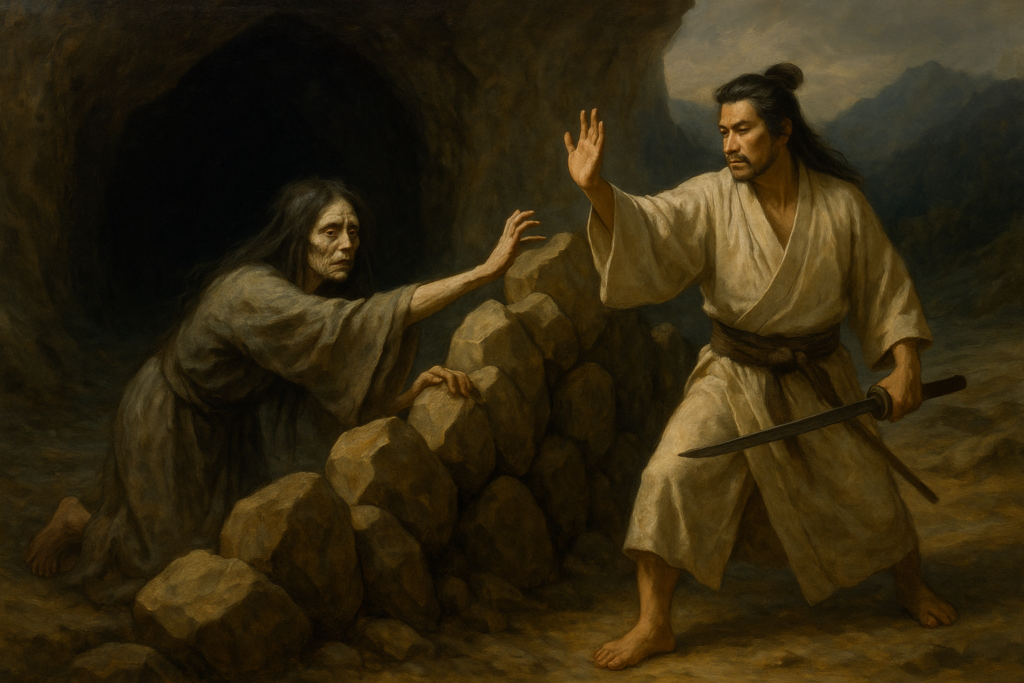
The narrative then shifts abruptly from creation to loss. Izanami dies after giving birth to the fire deity. This death is central to the story’s meaning. When Izanagi pursues her into Yomi, the land of the dead, he enters a realm that cannot simply be crossed and returned from unchanged. The episode is not a heroic rescue but a dangerous encounter with pollution, separation and the limits of mortal life.
In the Kojiki, Izanagi breaks his promise not to look at Izanami before she is released, and the encounter ends in horror and flight. The story is stark, but it is not simply a tale of punishment. It establishes a major religious pattern: contact with death creates defilement, and separation from the dead must be managed through ritual and purification. That concern will shape the next and most famous stage of the narrative.
Purification and the birth of major kami
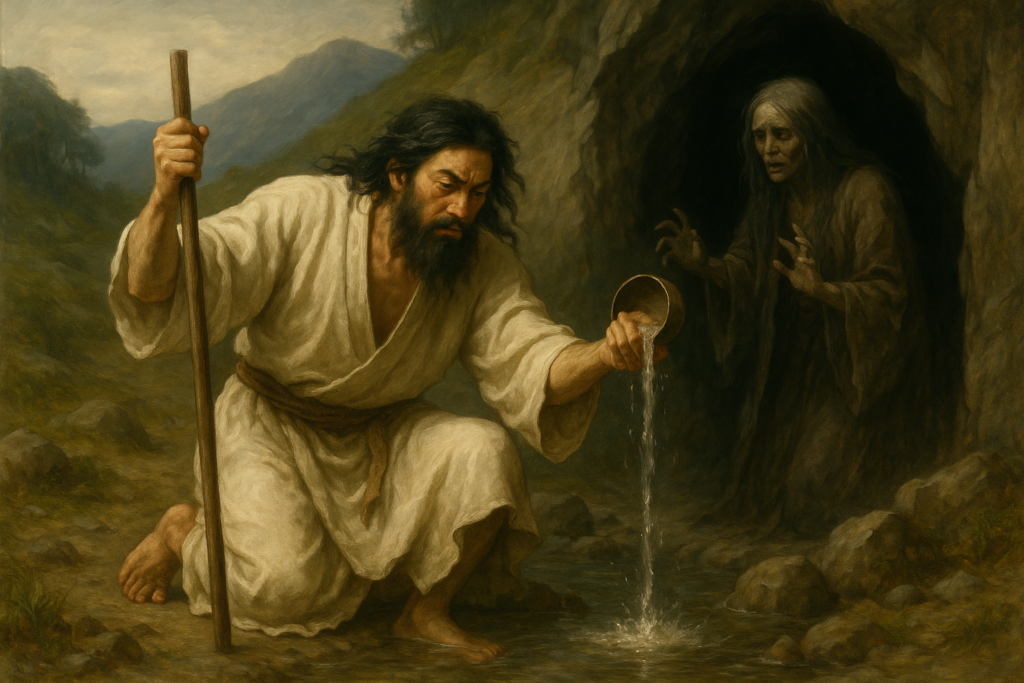
After escaping Yomi, Izanagi purifies himself. In the Kojiki, he washes away the pollution of the underworld in a river mouth in Himuka, in southern Kyushu. This act of purification is one of the most important scenes in the whole mythic cycle. As he removes his clothing and washes his body, kami emerge from the discarded items and from the water itself. The story then gives special prominence to three deities born from this cleansing: Amaterasu, the sun goddess; Tsukuyomi, associated with the moon; and Susanoo, linked to the sea and stormy disorder.
This is not a random list of divine children. The account gives the world a structured sacred order after the disorder of death. Izanagi’s purification is therefore both personal and cosmic. He is not only cleansing himself; he is re-establishing a workable relationship between purity, authority and divine presence. The story also explains why purification rituals matter in Shinto practice: they respond to pollution, restore clarity and open the way for renewed sacred life.
What the Nihon Shoki changes, and what it keeps
The Nihon Shoki, compiled in 720, tells the same broad mythic cycle but not in exactly the same way. It is another court chronicle, written in classical Chinese and shaped by different literary and political choices. The most important difference for Awaji is that the Nihon Shoki preserves alternative versions within its own text. In one account, Izanagi does not remain with Izanami in the underworld episode as in the Kojiki; instead, after completing his divine work, he withdraws to Awaji and lives there in concealment. Another tradition in the same chronicle likewise places his final abode on Awaji.
These differences matter because they show that there was never just one fixed ancient telling. The Kojiki is the principal source for the island-birth sequence, while the Nihon Shoki is especially important for the tradition that Izanagi retired to Awaji after his work was done. Rather than merging the two texts into a single smooth story, it is better to keep their roles distinct: the Kojiki gives the most influential creation narrative, and the Nihon Shoki preserves alternative court versions, including the Awaji retirement motif.
Awaji as a regional sacred landscape
Awaji’s local tradition did not arise in a vacuum. The island’s shrine culture reflects both the prestige of the court chronicles and the strength of regional devotion. Izanagi Shrine on Awaji is associated with the divine couple, and the shrine tradition treats the island as a place where the creator kami’s presence remains especially close. Such traditions should be understood as local religious inheritances, not as universal statements about every shrine in Japan.
That regional dimension is also visible in later reference works and local heritage materials, which connect the island’s landscape to the mythic creation cycle. These materials are useful because they show how the story has been lived and remembered on the ground. Still, they belong to later tradition. They help explain why Awaji is so prominent in memory, but they should not be mistaken for the oldest narrative source itself.
Awaji’s importance, then, lies in the meeting point of text and place. The island is not just named in a myth; it is remembered as the first land to emerge. That distinction gives it a quiet but lasting power. In Shinto terms, the island is not a relic of a finished past. It remains part of a living sacred geography, where the story of creation continues to shape how people understand the land beneath their feet.
Sources and further reading
- Kojiki Translation Project, Kokugakuin University (opens in a new tab)
- William George Aston, translator, Nihongi: Chronicles of Japan from the Earliest Times to A.D. 697 (opens in a new tab)
- Basil Hall Chamberlain, translator, The Kojiki (opens in a new tab)
- Hyogo Prefectural Museum of History, Ancient Japan through Harima no Kuni Fudoki (opens in a new tab)