Thor’s Fishing Trip and the Serpent Jörmungandr
Thor’s fishing trip is one of the best-known episodes in Norse mythology, but the story survives in more than one form and should not be treated as a single fixed tale. In the medieval sources, Thor’s encounter with the great serpent Jörmungandr belongs above all to two kinds of evidence: the Eddic poem Hymiskviða and Snorri Sturluson’s Prose Edda, both written down in Christian Iceland centuries after Scandinavia’s conversion. The poem and Snorri’s prose version share the same broad outline, yet they differ in emphasis, detail and tone.
The serpent and the god
Jörmungandr, usually called the Miðgarðsormr in Old Norse, is the world serpent that encircles the sea surrounding the human world. In Snorri’s Prose Edda, he is one of Loki’s monstrous children with the giantess Angrboða, alongside Fenrir and Hel. That genealogy is important: Jörmungandr is not simply a random sea monster, but part of a family of adversaries whose fate is tied to the gods and, ultimately, to Ragnarök.
Thor’s role is equally clear. He is the chief enemy of giants and monsters, a protector figure whose strength is repeatedly measured through contests. The fishing episode is one of the myth’s most dramatic tests: Thor comes close to catching the serpent before his companion intervenes. The result is not a triumphant victory, but an unfinished struggle that foreshadows the final battle at Ragnarök, where Thor and Jörmungandr kill one another.
Thor’s journey to Hymir’s hall
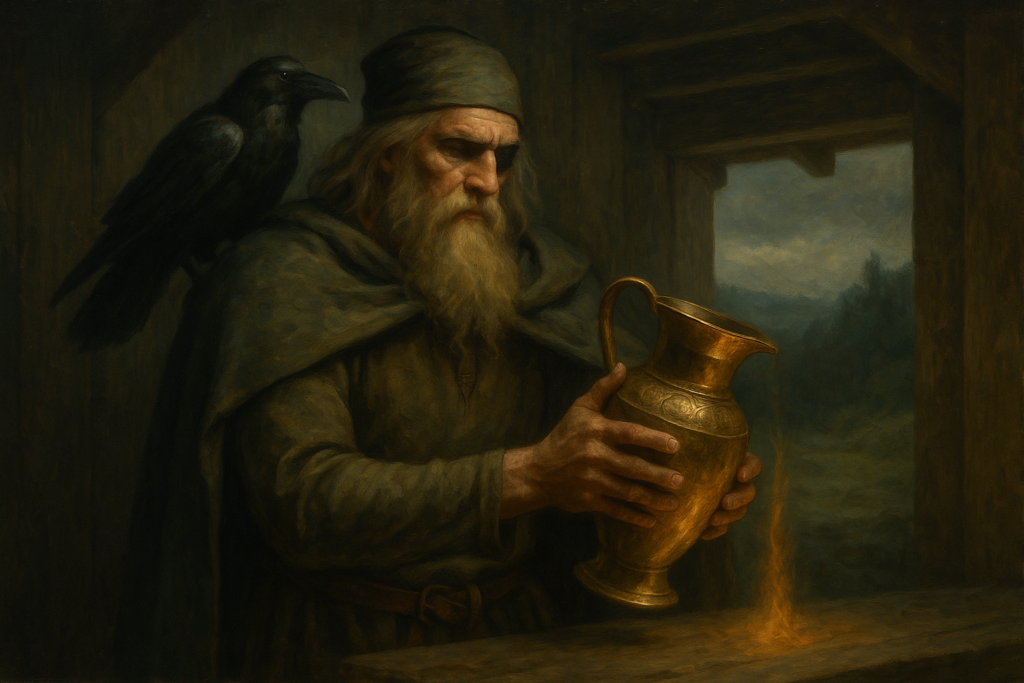
In Hymiskviða, the fishing trip is embedded in a larger story. The gods are holding a feast, but they lack a sufficiently large brewing cauldron. Thor and Tyr go to the giant Hymir to obtain one. Tyr has a complicated family connection here: in this poem Hymir is presented as Tyr’s father or grandfather figure, whereas other sources do not always preserve the same relationship in the same way. The poem’s sequence is straightforward. Thor travels in disguise, reaches Hymir’s dwelling at the edge of the world, and shares an uneasy meal with the giant before the two set out to sea the next day.
Hymir’s household matters because it sets up the fishing episode. Thor has to prove himself in a giant’s space, after a night in which he eats prodigiously and frightens his host. The poem gives the scene a rough, comic energy: Thor is not polished or restrained, but blunt, greedy and intimidating. That is not incidental. The poem uses Thor’s appetite and physical power to prepare the reader for what happens on the water.
The fishing expedition
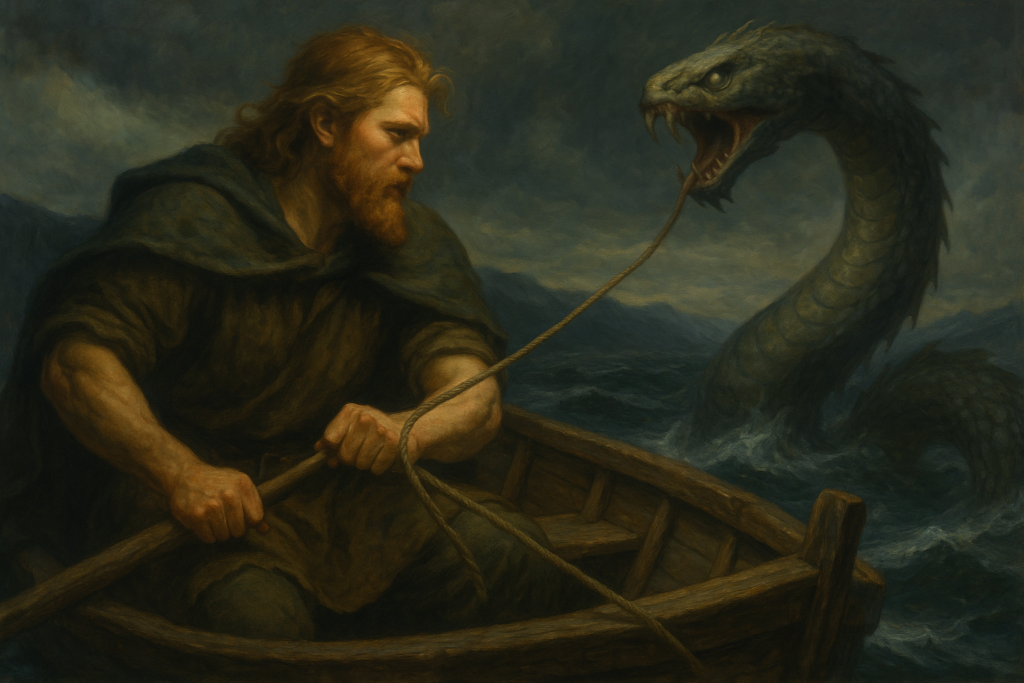
The sea journey is the heart of the myth. Thor insists on rowing far out, beyond the ordinary fishing grounds. Hymir grows uneasy, warning that they are nearing the place where they may encounter the Miðgarðsormr. Thor, however, wants to go further. The giant then provides bait in different ways depending on the version: in Hymiskviða Thor kills one of Hymir’s oxen and uses its head, while Snorri also makes the ox-head bait central to the scene. Thor’s fishing line and hook are prepared for a catch far beyond any ordinary fish.
Once the line is lowered, the serpent bites. Thor hauls so hard that his feet crash through the bottom of the boat and brace against the sea floor. The image is one of the most striking in Norse myth: the god of thunder, straining against a creature large enough to threaten the world, while the boat itself becomes almost a mere platform for cosmic violence. In the poem, the pair’s struggle is tense and precarious. Thor fixes his gaze on the monster and resists its power with grim determination.
The moment of failure
The decisive difference between the two best-known versions lies here. In Snorri’s account, Hymir is so terrified that the serpent will drag them under that he cuts the fishing line. In Hymiskviða, the ending is less neatly summarised, but the action likewise does not become a clean triumph for Thor. The serpent sinks back into the sea, and Thor punishes Hymir violently on the return journey. The story therefore remains one of almost-capture rather than conquest.
That matters for how the myth should be read. Thor does not kill Jörmungandr on this occasion; the serpent escapes. The myth preserves tension rather than closure. The sea remains the serpent’s domain, and the god’s victory is delayed until Ragnarök. This is one reason the fishing trip is so memorable: it stages a confrontation that is both decisive and incomplete, a brief struggle between divine order and monstrous chaos.
What the sources actually say
The medieval evidence is not interchangeable. Hymiskviða is an Eddic poem, preserved in the Poetic Edda, and it tells the story in compressed, poetic form with kennings and a playful, oral style. Snorri’s Prose Edda, by contrast, is a thirteenth-century prose handbook written to explain mythology and poetic language to later readers. Snorri often clarifies or rationalises material, and in this case his version supplies a more straightforward narrative of the boat, the bait and Hymir’s panic.
There are also traces outside the books. The Gosforth Cross in Cumbria, usually dated to the tenth century, is often discussed in connection with Thor and the serpent, though such identifications are interpretative rather than absolute. The monument shows how widely the story travelled in the Viking Age and how powerfully the image of Thor’s fishing trip could be expressed in stone. Still, archaeology does not replace the texts; it complements them.
Why the myth matters
For modern readers, the story is memorable because it compresses several important Norse ideas into one scene. Thor is strongest when facing impossible odds. Jörmungandr is the great enemy whose presence shapes the limits of the world. The sea is not a neutral setting but a perilous boundary. And the myth reminds us that what survives in writing is not the voice of a single pagan community, but a medieval literary record shaped by Christian scribes, poets and compilers who preserved older material in transformed form.
Thor’s fishing trip endures because it is vivid, abrupt and unfinished. It gives us one of the clearest encounters between god and monster in Norse mythology, but it leaves the wider conflict unresolved until the end of the world. That is exactly what makes it so powerful: even in apparent victory, the serpent slips away.
Sources and Further Reading
- “Hymiskviða” in an English translation of the Poetic Edda, Völuspá.org (opens in a new tab)
- Snorri Sturluson, “Extract from the Prose Edda”, Heimskringla.no (opens in a new tab)
- Skaldic Poetry of the Scandinavian Middle Ages: “The Old Norse World” (opens in a new tab)
- Ursula Dronke and related scholarly discussion in a University of Chicago Press preview on Norse monsters and Jörmungandr (opens in a new tab)