Shu and Tefnut in Early Egyptian Cosmogony
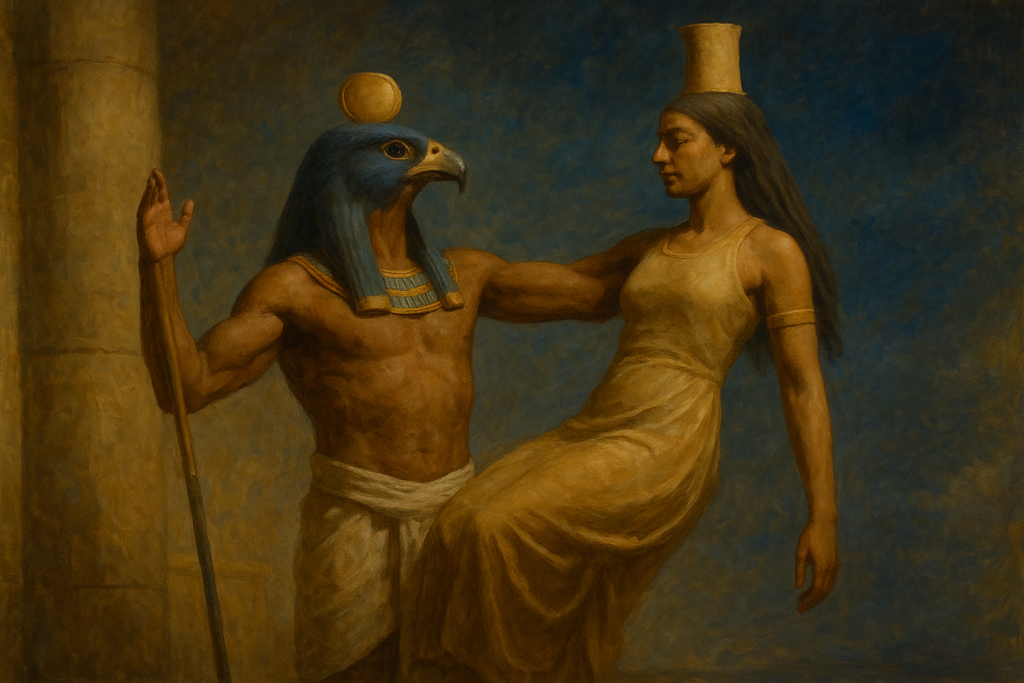
Shu and Tefnut stand at the beginning of one of ancient Egypt’s best-known creation traditions: the Heliopolitan cosmogony. In that theology, they are the first divine pair to emerge from the creator Atum and the ancestors of the gods who organise the world. Yet Egyptian mythology was never a single fixed story, and Shu and Tefnut appear in different forms and emphases across centuries, temples and texts. Their place in the cosmogony is therefore both central and variable.
Atum and the First Pair
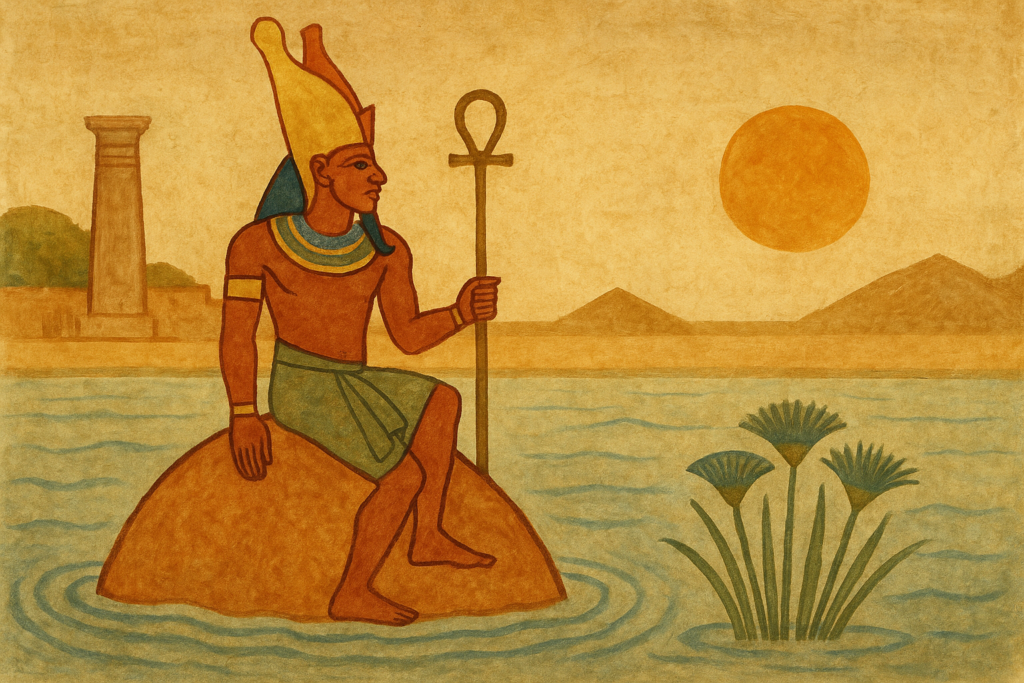
The Heliopolitan creation account is preserved above all in the Pyramid Texts, royal funerary spells first inscribed in the Old Kingdom. In that tradition, Atum-Khepri rises on the primordial mound and creates the first divine pair. A Pyramid Text describes him as spitting out Shu and spewing out Tefnut, then gathering them to himself so that his own power is within them. This is the key sequence for understanding their origin in Heliopolis: Atum comes first, then Shu and Tefnut, and only after them the wider divine family.
The language of creation by spitting is vivid, but it should not be misunderstood as crude humour. In Egyptian religious thought, bodily emission was a powerful image of self-generation and the movement of life from the creator into the world. Later texts continue to preserve this idea, even when they phrase it differently. Some traditions call Shu and Tefnut the product of Atum’s saliva; others treat them as formed by his desire or by an act of self-begotten generation. The underlying point remains the same: they are the first differentiated powers to come forth from the creator god.
Who Shu and Tefnut Were
Shu is usually the god of air, wind and the space that allows life to exist. Tefnut is generally identified with moisture, humidity and the life-giving dampness that balances dryness. That simple pairing becomes cosmic in the Heliopolitan system. Air and moisture are not merely weather conditions; they are primordial forces needed to separate, sustain and order the world.
Ancient images and later temple scenes show that the pair could also be linked with lion-headed or protective forms, especially in amulets and divine iconography from later periods. Egyptian gods were often multivalent rather than confined to one narrow role. Shu and Tefnut may be described in cosmological terms, but they also belong to a broader sacred language of protection, royal legitimacy and cosmic balance.
Geb, Nut and the Ordering of the Cosmos
In the Heliopolitan genealogy, Shu and Tefnut become the parents of Geb and Nut, earth and sky. This is where their cosmological importance becomes especially clear. Shu separates Nut from Geb by holding the sky aloft, creating the ordered space in which the world can function. In mythic terms, the sky is no longer pressed against the earth; instead, Shu’s sustaining role makes distance, movement and breathable space possible.
This separation is not simply a domestic family drama. It is a creation of structure. Egyptian temples and funerary texts often imagine the universe as held together by divine relationships, and Shu’s task is to maintain the division between sky and earth. Nut arches overhead, Geb lies beneath, and Shu stands between them. Tefnut, as his female counterpart, belongs to the same foundational order, though her role is often less dramatically narrated than Shu’s.
Heliopolis and the Great Ennead
The main setting for this cosmogony is Heliopolis, ancient Iunu, a major solar and theological centre in the Delta region. The city’s priestly tradition placed Atum at the head of the Great Ennead, the group of nine gods that includes Shu, Tefnut, Geb, Nut, Osiris, Isis, Seth and Nephthys. In this scheme, Shu and Tefnut are not marginal figures but the bridge between the creator and the later generations of gods.
It is important not to flatten all Egyptian creation traditions into one. Heliopolis is only one of several major theological centres. Memphite tradition gave pride of place to Ptah; Hermopolitan thought focused on the Ogdoad; later temple literature could blend or reframe older ideas. Still, Heliopolis is the classic setting for the genealogy of Atum, Shu and Tefnut, and it is here that their role as the first divine pair becomes most clearly defined.
Different Traditions, Different Emphases
Even within Heliopolitan material, the origins of Shu and Tefnut are not described in exactly one way. The Pyramid Texts favour the striking image of spitting or expectoration. Later Coffin Texts and temple literature may retain the same basic relationship while using broader or more theological language about self-creation. In one direction, this makes the myth more graphic; in another, more abstract. Both approaches belong to Egyptian religious thought.
Later Greek and Roman writers often tried to systematise Egyptian gods into familiar philosophical categories, but that can obscure the older evidence. The ancient Egyptian sources themselves do not offer a single tidy creed. They preserve a range of expressions for divine birth, and they also allow a god like Shu to be simultaneously a cosmic principle, a named person in a genealogy and a protective power invoked in ritual or iconography.
Shu and Tefnut in Egyptian Religion
Their importance did not end with creation mythology. Shu and Tefnut appear in funerary and protective contexts, where their presence signals ordered existence and divine support. The British Museum and the Metropolitan Museum of Art both preserve objects and images in which the pair appear alongside other gods, especially in solar and funerary settings. These artworks show that the pair retained religious force long after the earliest cosmogonic texts were composed.
In practice, Egyptian religion was additive. A deity could belong to creation myth, royal theology, temple ritual and funerary hope all at once. Shu and Tefnut are a good example of this flexibility. They are first-generation gods, but they are also living presences in later devotion, not just characters in an origin story.
Shu and Tefnut matter because they mark the passage from the undivided creator to an ordered cosmos. Through them, Atum’s self-generated beginning becomes a world with air, moisture, sky and earth. Their myth is one of Egypt’s foundational theological statements, but only when read in its proper Heliopolitan setting and alongside the many other ways Egyptians imagined creation.
Sources and Further Reading
- British Museum, “Ancient Egyptian gods and goddesses” (opens in a new tab)
- The Metropolitan Museum of Art, “Papyrus fragment with a painting of Khepri, Shu, Tefnut, Thoth, and Isis in a solar boat” (opens in a new tab)
- University of Chicago, Oriental Institute, “Kingship, Creation, and the Heliopolitan Tradition” (opens in a new tab)
- University of Chicago, Oriental Institute, scholarly discussion of Egyptian creation language and the Pyramid Texts (opens in a new tab)