
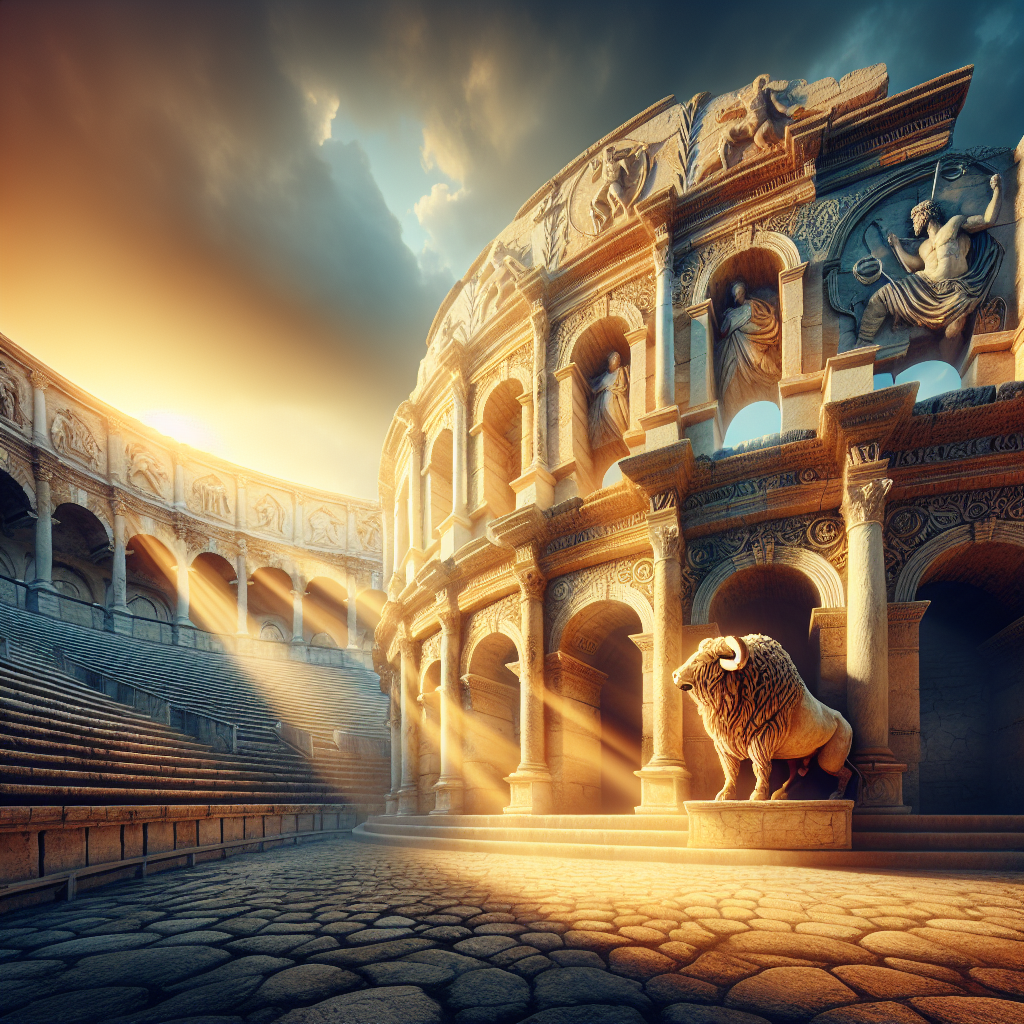
Roman architecture holds a prominent place in the annals of history, not only for its monumental structures and engineering prowess but also for its rich interplay of cultural and mythological symbolism. The integration of mythic imagery in Roman architecture reflects the society’s values, beliefs, and aspirations, serving as both a narrative and a medium through which the Romans articulated their identity. This article delves into the various facets of mythic imagery in Roman architecture, exploring its origins, manifestations, and cultural significance.
Origins of Mythic Imagery in Roman Culture
The Romans inherited much of their artistic and architectural lexicon from the Greeks, who famously imbued their temples and structures with mythological significance. However, Romans did not merely mimic these traditions; instead, they adapted and expanded upon them. Roman mythology, while heavily influenced by Greek mythology, was distinctively characterized by local deities and heroes that resonated with the Italian populace.
Central to understanding mythic imagery in Roman architecture is the concept of virtus (virtue), pietas (piety), and fides (faithfulness), which formed the bedrock of Roman identity and state ideology. The architecture became a means for the Romans to publicly celebrate their myths and historical narratives, solidifying their status and legitimacy.
Temples as Vessels of Myth
One of the most notable manifestations of mythic imagery in Roman architecture is found in temples. These sanctuaries were not only places of worship but also grand statements of political power and cultural heritage. The Pantheon, for instance, stands as a marvel of engineering and an embodiment of Roman religious practice. Originally built as a temple to the gods of Ancient Rome, its name translates to “all gods,” indicative of the inclusive nature of Roman religion.
The oculus and the coffered dome of the Pantheon suggest not only a connection to the divine but also symbolize the heavens. Similarly, the Temple of Jupiter Optimus Maximus on the Capitoline Hill, considered the most important temple in ancient Rome, featured representations of Jupiter alongside mythic scenes depicting his victories over chaos and insurrection, which were crucial in reinforcing Roman dominion and the belief in divine favor.
The Arch of Triumph
Triumphal arches serve as another critical example of mythic imagery interwoven with architecture. These monumental structures commemorated military victories and were often decorated with reliefs illustrating mythological scenes, thus linking the emperor’s achievements with the divine. The Arch of Titus, built to honor Emperor Titus’ conquest of Jerusalem, features reliefs depicting the spoils of war being brought to Rome, alongside scenes that echo Roman narratives of divine approval.
The archway itself is a triumphal passage, a symbolic entry into a new era marked by victory. This architectural form not only celebrated individual achievements but also served to promote collective memory and reinforce social cohesion.
Baths as Spaces of Mythical Interaction
Roman baths, such as the Baths of Caracalla and the Baths of Diocletian, were not merely venues for relaxation and socialization; they were also spaces imbued with myth. The lavish decorations often included mosaics and statues depicting mythic figures and deities that celebrated health, renewal, and beauty.
Incorporating mythic imagery into public baths marked these spaces as more than functional; they became sanctuaries. The statues of gods like Asclepius, the god of medicine, emphasized the connection between wellness and divine favor. Such representations invoked a sense of purity and mythic cleansing, mirroring the physical cleansing that took place within the baths.
The Use of Frescoes and Mosaics
Frescoes and mosaics provided another layer to the mythic imagery inherent in Roman architecture. These artistic elements adorned various public and private structures, narrating stories from mythology and epitomizing the virtues associated with these tales. The House of the Vettii in Pompeii, for instance, is famous for its lavish frescoes that depict scenes from the life of Dionysus, the god of wine and revelry.
These images not only celebrated the myths themselves but also illustrated societal values surrounding leisure, excess, and the idea of living in accordance with the divine. The careful placement of these myths within domestic environments reaffirms the notion that the divine influenced daily life and aspirations.
The Impact of Myth on Urban Planning
The integration of mythic imagery also extended to urban planning and the orientation of entire cities. Temples dedicated to deities often dictated the layout of Roman towns. For instance, the city of Pompeii featured a central forum surrounded by temples that projected mythic narratives central to Rome’s identity.
Such urban arrangements engaged citizens directly with their myths and fostered a collective memory that transcended generations. The design encouraged participation in rituals that reinforced civic pride and a sense of belonging, allowing the intertwining of public space with mythic tales that continued to resonate across time.
Conclusion: The Legacy of Mythic Imagery in Roman Architecture
Roman architecture’s enduring legacy lies not only in its technical achievements but also in its rich tapestry of mythic imagery. Through temples, arches, baths, mosaics, and the very fabric of urban design, the Romans articulated their cultural identity, celebrating their myths and reinforcing the ideals that shaped their society.
Understanding this mythic imagery enriches our perception of Roman architecture; it is a dialogue between the material and the spiritual, the public and the private, the past and the present. As we engage with these structures today, we are not merely observing the remnants of a bygone civilization but participating in an ongoing narrative that continues to influence contemporary thought about mythology, art, and identity.
The intersection of myth and architecture in Rome thus serves as a powerful reminder of how built environments can shape cultural narratives and collective identities, a lesson that remains relevant throughout history.