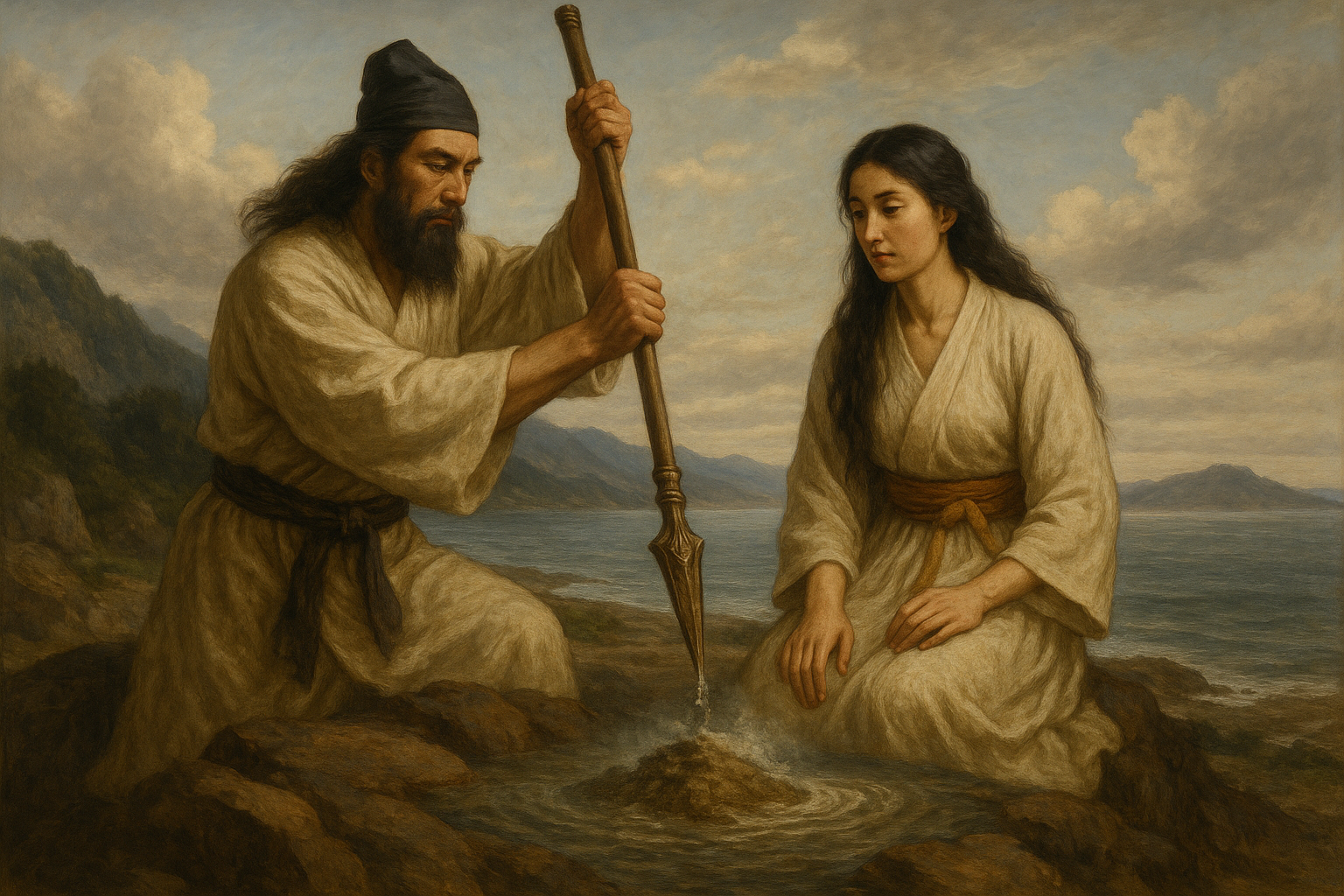
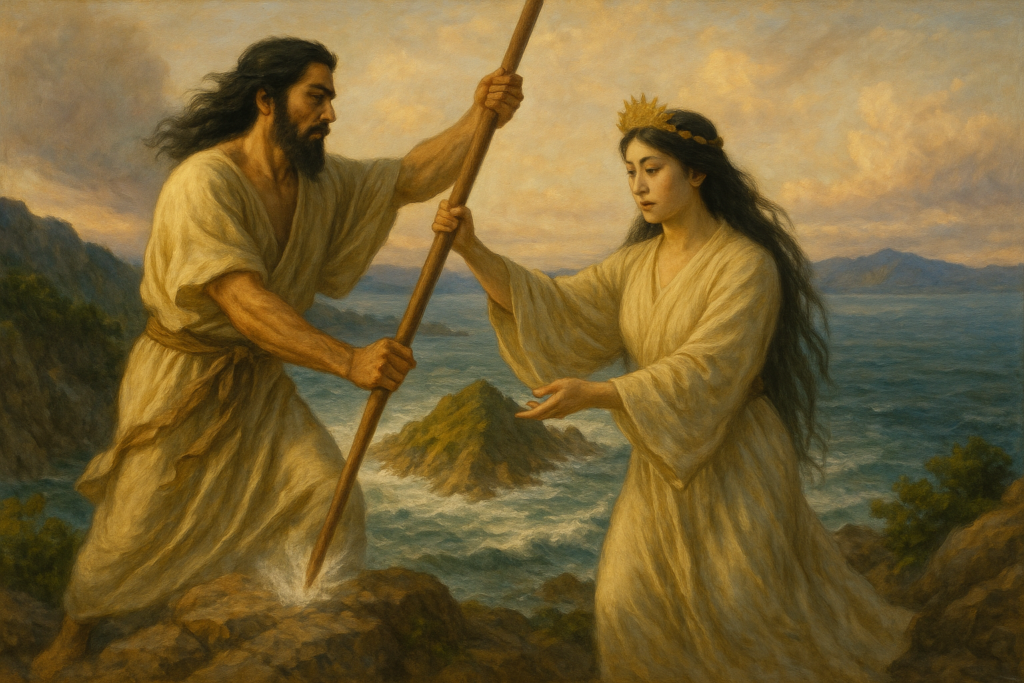
The Three Precious Children of Izanagi: Amaterasu, Tsukuyomi and Susanoo
Among the many figures in early Japanese myth, few are as important — or as dramatically different from one another — as Amaterasu, Tsukuyomi and Susanoo. Known together as the three precious children of Izanagi, they stand at the centre of the creation narratives recorded in the Kojiki and the Nihon Shoki, court compilations of the early eighth century that gathered older sacred traditions into texts suited to a newly centralised state. Read carefully, these stories are not a single smooth tale but a set of related versions in which family, ritual purity, order and disorder all matter at once.
Birth from purification: how the three children appear
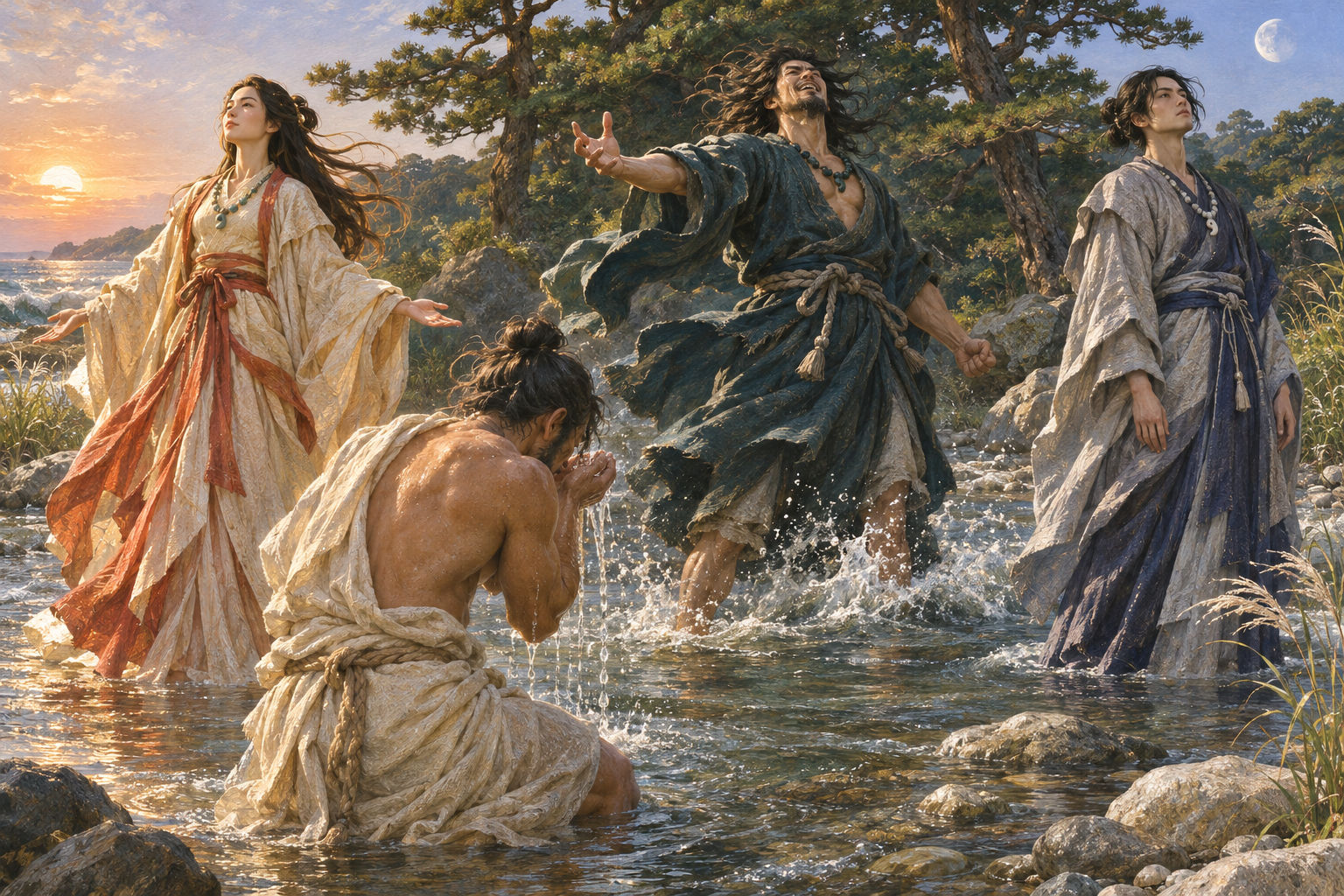
In the Kojiki, the three kami come into being after Izanagi returns from the land of the dead and purifies himself. As he washes, Amaterasu is born from his left eye, Tsukuyomi from his right eye, and Susanoo from his nose. This is one of the most famous creation sequences in Japanese myth, and it matters that the births arise from purification, not from ordinary parenthood. In Shinto usage, kami is not a simple one-to-one equivalent for “god”; it can suggest a presence, force or sacred being, and these three are among the most prominent such presences in the early texts.
The Nihon Shoki preserves a closely related but not identical account. It also presents alternative tellings within the text, which is one reason it is best read as a compilation rather than a single fixed narrative. In one version, the three children are again produced from Izanagi’s body during his purification, though the ordering and emphasis differ. The chronicles agree on the basic point: these siblings emerge from a rite of cleansing after contact with death, and that origin shapes the way the myth understands them.
Amaterasu takes the sky, Tsukuyomi the night, Susanoo the seas
After their birth, Izanagi assigns them their realms. In the main Kojiki version, Amaterasu is entrusted with the Plain of High Heaven, Tsukuyomi with the night, and Susanoo with the seas. The distribution is neat and symbolic: the sun, moon and stormy ocean are placed in relation to one another, but not in a way that guarantees harmony. These are not interchangeable divine figures. Amaterasu stands apart as the radiant presence who will become central to imperial genealogy and shrine devotion; Tsukuyomi is less developed in the Kojiki; and Susanoo is the most turbulent of the three, associated in later interpretation with wind and rain as well as the sea.
Even here, the sources are not entirely uniform. The Nihon Shoki offers different descriptions of the siblings’ duties in some of its versions, and later readers sometimes tried to harmonise them. For a clear retelling, though, the Kojiki’s allocation is the most coherent starting point: sky, moon and sea are placed under the care of three siblings whose relationship is destined to become strained.
Susanoo’s violence and the sealing of the heavenly cave
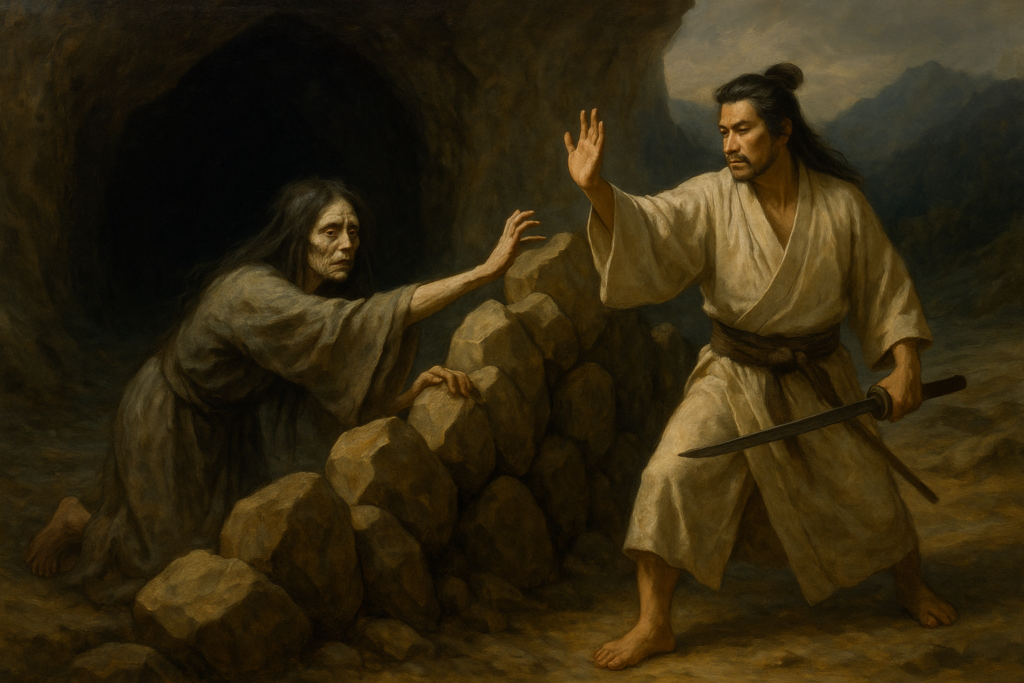
The story that gives the three children its greatest tension belongs chiefly to the Kojiki, though similar material appears in the Nihon Shoki. Susanoo does not behave as a dutiful guardian of the sea. Instead, he becomes disruptive and destructive. He weeps and rages, upsetting the order of heaven. In the most famous episode, his behaviour grows so extreme that Amaterasu retreats into the Rock Cave of Heaven, plunging the world into darkness. The episode is not merely a family quarrel; it is a myth about the fragility of order and the danger of uncontrolled violence.
The other kami respond with ritual ingenuity. They gather before the cave, make noise, perform dance and display treasures in an attempt to draw Amaterasu out. The moment she peeks out, she is drawn into daylight again, and the cave is sealed behind her. The narrative is vivid, but it is also carefully structured: darkness is overcome not by force but by collective ritual. This is one of the central ideas running through the early chronicles — that proper action can restore the world when disorder has driven it into crisis.
Susanoo is then judged and expelled from Heaven. In the Kojiki, he must make amends after his rampage and is subjected to punishment before his descent. The story does not present him as purely evil, however. He is a dangerous figure, certainly, but one whose actions continue to matter in later narratives of travel, struggle and settlement.
Tsukuyomi’s brief role and the split from Amaterasu
Tsukuyomi is the most elusive of the three in the Kojiki. After his birth, he does not play a sustained role there. The Nihon Shoki, by contrast, preserves an important separate story: Tsukuyomi is sent to a banquet in place of Amaterasu, but he kills the food deity Ukemochi after being offended by the manner in which food is produced. When Amaterasu learns of this, she separates herself from him, which explains why sun and moon move apart. This is a good example of how the Nihon Shoki preserves an alternative account rather than simply repeating the Kojiki.
That account gives Tsukuyomi a sharper profile than the Kojiki does. It also links him to agriculture, food and the rhythm of the lunar calendar in a way that later readers found meaningful. Still, it should be treated as one narrative among several, not as the universal ancient version. The main point is that Tsukuyomi’s separation from Amaterasu reflects a cosmic division that helps make sense of day and night.
Why these siblings matter in Shinto tradition
Amaterasu’s importance extends far beyond the myth of her birth. In the early court traditions, she becomes the ancestral kami of the imperial line, a role that gives the myths political as well as religious weight. The Kojiki and Nihon Shoki were compiled in the context of a court seeking to organise history, ritual and legitimacy. That does not make their stories merely political inventions, but it does mean they were shaped to serve the needs of authority as well as devotion.
Susanoo, meanwhile, remains one of the most richly interpreted figures in the tradition. He appears as a source of trouble in the heavenly realm, yet he is also associated with later myths of struggle, encounter and renewal. Tsukuyomi, by contrast, is more shadowed: important, but less elaborated in the Kojiki than his siblings. Together, the three form a mythic triangle through which the early chronicles explore light and darkness, rule and disturbance, and the consequences of failing to keep divine relations in balance.
Reading the myths with the sources in view
The principal retelling here follows the Kojiki, because it provides the clearest continuous narrative of the siblings’ birth, their division of offices and Susanoo’s disruption of heaven. The Nihon Shoki is best treated separately, since it preserves both a related main account and alternative versions, including the story in which Tsukuyomi kills Ukemochi and is separated from Amaterasu. That textual variety is not a problem to be smoothed away; it is part of what makes the early Japanese sacred record so interesting.
For modern readers, the result is a story that is both intimate and cosmic. Three siblings emerge from a rite of purification, inherit the sky, moon and sea, and then fall into conflict. Out of that conflict come darkness, restoration and a renewed sense of how the world should be ordered. The tale endures because it is not only about divine beings, but about the difficult work of preserving harmony when kinship itself is strained.
Sources and further reading
- Kojiki: Translated with an Introduction and Notes by Donald L. Philippi (opens in a new tab)
- Nihongi, Book I: Translation by William George Aston (opens in a new tab)
- “Amaterasu” — Encyclopedia of Shinto, Kokugakuin University (opens in a new tab)
- “Susanoo” — Encyclopedia of Shinto, Kokugakuin University (opens in a new tab)